
On This Page – Quick Medical Summary
The ratio on your report isn’t a ninth test
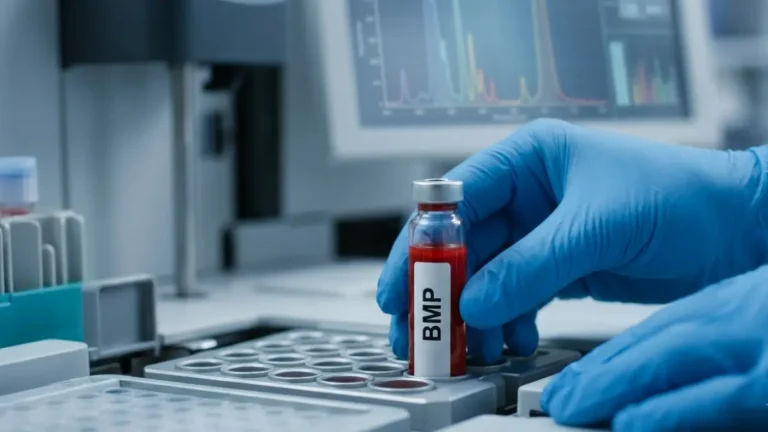
A basic metabolic panel measures eight substances, and the BUN-to-creatinine ratio is not one of them. It is arithmetic performed on two results already on the page.
Flagged high, flagged low, in range but uneasy — each has a section below. Black or bloody stools, barely urinating, or newly confused? Go to the last section now.
What the ratio is calculated from
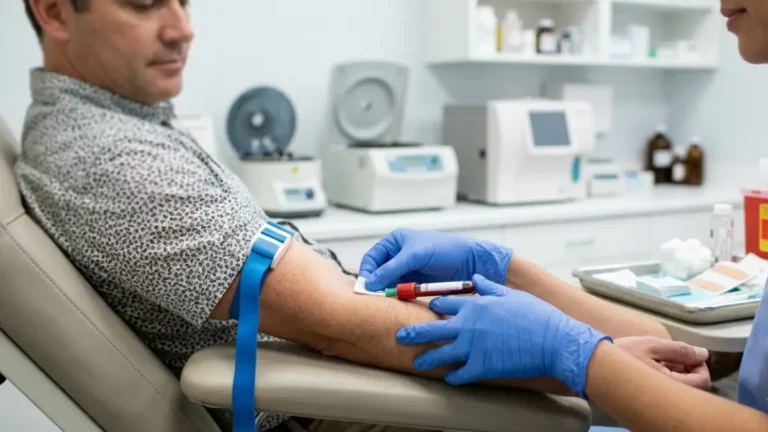
Your lab divides the blood urea nitrogen result by the creatinine result. Nothing extra was drawn — which is why the National Library of Medicine’s BUN test page lists it as another name for the BUN test.
What it was designed to answer
MedlinePlus explains the two can be compared from one sample to help find the cause of a kidney problem — not whether you have one. Our full basic metabolic panel guide covers the eight results behind it.
ℹ️ Medical Disclaimer: This article explains what a calculated laboratory value can and cannot indicate. It does not diagnose any condition, interpret your individual result, or recommend any medication, fluid target, dietary change, procedure or insurance decision. Bring your printed report to a board-certified primary care physician or nephrologist before acting on anything here.
Why dividing one waste product by another tells you anything
Urea and creatinine reach your blood by different routes, which is why comparing them works.
Urea is the waste left when your body breaks down protein, made almost entirely in the liver. Creatinine comes from muscle turnover, at a rate reflecting your lean body mass.

Urea gets partly reabsorbed; creatinine doesn’t
Both are filtered by your kidneys, but only urea is pulled back; creatinine is unaffected by urine flow.
🔬 How It Works: Picture fluid moving through the kidney tubule. Moving quickly, urea is swept along and leaves. Moving slowly, urea lingers and more seeps back into the blood — while creatinine keeps going either way. Slow flow lifts BUN without lifting creatinine, and the gap widens.
Why slow flow tips the balance
Low blood volume, reduced blood flow as in heart failure, and reduced filtration all push reabsorption up — which is how a problem outside the kidney shows up in a kidney number.
📊 Clinical Data Point: At urine flow rates above 2 mL/min, roughly 40% of filtered urea is reabsorbed; below that rate, reabsorption can rise to about 60% — Source: Clinical Methods, 3rd ed., Ch. 193, NCBI Bookshelf (National Library of Medicine).
See our guide to the kidney markers on a metabolic panel and the Clinical Methods chapter.
Why your ratio doesn’t match the chart you found online
The ratio has no units: one milligrams-per-decilitre figure divided by another cancels the units and leaves a bare number.
Several pages ranking for this question publish a “normal range” for the ratio in mg/dL. That figure is a blood urea nitrogen value wearing the wrong label.
US labs measure BUN, not whole urea
American laboratories report only the nitrogen fraction of urea, while much of the world assays the whole molecule. BUN is roughly 0.446 of blood urea, so an overseas urea-to-creatinine figure describes a different quantity.
What the commonly quoted patterns describe
The StatPearls review of renal function tests describes a ratio close to 20:1 in pre-renal problems and closer to 10:1 in kidney tissue disease, introducing both as useful when BUN is already raised. They are patterns read alongside the rest of the panel, not cut-offs.
No public health authority publishes an official normal range for this ratio, so we will not print one. The interval that governs your result is the one your own laboratory printed beside it — our guide to the reference ranges on a basic metabolic panel explains why those differ between labs.
What a high BUN-to-creatinine ratio can point to
A high ratio usually points away from the kidney tissue and toward something upstream:
- Less blood reaching the kidney — dehydration, blood loss, shock
- Less blood from the heart — heart failure lifts BUN while creatinine stays near normal
- Extra protein in the system — bleeding into the upper digestive tract is a large protein load, and StatPearls notes it can produce a very high ratio, sometimes above 30:1
- A breakdown state — fever and infection raise urea, leaving creatinine untouched
- Diet and medicines — a high-protein diet raises BUN, as do oral corticosteroids
- Blocked outflow — obstruction slows urine flow, and slow flow means more urea reabsorbed

When the ratio is high because creatinine is low
Creatinine production tracks muscle mass, so someone with little muscle produces little of it — StatPearls notes it is unreliable in older adults, amputees and people with muscular dystrophy. A smaller denominator raises the ratio with no rise in BUN at all.
Does a high ratio mean kidney disease?
Not by itself — most causes above sit outside the kidney. Our guide for families reading a parent’s blood work covers the muscle-mass effect, and how to prepare for a panel covers protein intake.
✅ Patient Action: Ask your primary care physician or a nephrologist, printout in hand: “Is my BUN itself raised, or is the ratio high because my creatinine is low for my body size?” That separates two situations which look identical on the page.
If dehydration proves part of it, a water intake calculator estimates a starting point for healthy adults — but in heart or kidney disease a clinician sets fluid targets, reading the StatPearls patterns against your record.
What a low BUN-to-creatinine ratio can point to
A low ratio usually means BUN is lower than expected rather than creatinine being high.
When urea is lower than expected
- Not enough protein in the diet, or malnutrition
- Advanced liver disease, since the liver is where urea is made
- Sickle cell anaemia, which increases urea excretion
- Dialysis, which clears urea more efficiently than creatinine

When creatinine is higher than expected
- Muscle injury and muscle disorders, including rhabdomyolysis
- Intense exercise shortly before the draw
- A meat-heavy diet, because cooking converts creatine in meat to creatinine
Pregnancy pulls the same way for a different reason: filtration rises, so creatinine falls. A low ratio is not automatically safer — kidney tissue disease characteristically produces a ratio nearer 10:1, the part of the scale that looks unremarkable.
Ask your primary care physician which side moved: is the ratio low because BUN is low, or because creatinine is up? Our guide to what raises creatinine and the creatinine test page cover the second.
What the ratio can’t tell you about your kidneys
A ratio inside the usual range does not confirm healthy kidneys — the most important thing on this page.
A ratio near 10:1 is what intrinsic kidney disease looks like
Kidney tissue disease moves the ratio toward 10:1 — the reassuring-looking middle. Reading that as a clean result gets the meaning backwards.
Why both numbers look normal early
Serum creatinine is a late marker, staying in range early in kidney disease. Healthy kidneys carry spare capacity: as filtering units are lost, the rest work harder and hold blood levels steady.
📊 Clinical Data Point: Around 50% of kidney function must be lost before a rise in serum creatinine can be detected — Source: StatPearls, Renal Function Tests, NCBI Bookshelf (National Library of Medicine), updated July 2024.
The ratio that isn’t this ratio
Two tests get confused constantly. This ratio comes from blood; the urine albumin-to-creatinine ratio is measured in urine and finds early damage a blood panel misses.
What estimates filtering capacity is the eGFR — creatinine plus age, weight, height and sex — and MedlinePlus is candid that even an eGFR may not always reflect kidney damage. See what an abnormal BMP result can mean and the glomerular filtration rate test.
When these results shouldn’t wait for your next appointment
Most people reading this can raise it at their next visit. A few should not wait.

Symptoms that change the timeline
Contact your clinician the same day, or seek emergency care, if a flagged ratio comes with black or bloody stools, vomit resembling coffee grounds, a sharp drop in urination, swelling with breathlessness, or new confusion.
⚠️ Clinical Warning: Bleeding into the upper digestive tract can drive a very high ratio and is not always obvious from the outside. Paired with a flagged result, black or tarry stools warrant same-day medical contact.
Why clinicians care about catching this early
Reduced blood flow to the kidney is often reversible when addressed promptly. Left in place it can progress to direct injury of the kidney tubules — the reversible problem becomes permanent.
✅ Patient Action: Calling the clinic, say this: “My BUN-to-creatinine ratio is flagged and I have [symptom] — do you want to see me before my scheduled visit?”
If the panel came from an emergency visit, see why an emergency department runs it; dangerous values fall under rules requiring the lab to call them through.
BUN-to-creatinine ratio: common questions
1. What does the BUN-to-creatinine ratio mean on a blood test?
It means your lab divided your BUN result by your creatinine result. The bun creatinine ratio meaning is comparative: it helps identify the likely cause of a kidney problem rather than detecting whether one exists. MedlinePlus lists it among other names for the BUN test, because no separate sample was needed.
2. What is a normal BUN-to-creatinine ratio?
No public health authority publishes one official normal range, which is why this article does not print one. Clinical references describe patterns rather than cut-offs: closer to 20:1 in pre-renal problems, nearer 10:1 in kidney tissue disease. The interval that applies is the one printed beside your result.
3. Is the BUN-to-creatinine ratio measured in mg/dL?
No. The ratio has no units, because one mg/dL figure divided by another cancels the units and leaves a bare number. Pages quoting a normal ratio “in mg/dL” have taken a blood urea nitrogen value and mislabelled it. If your result carries units, it is a BUN reading.
4. What does a high BUN-to-creatinine ratio mean?
It usually points away from the kidney tissue and toward something upstream: reduced blood flow from dehydration, blood loss or heart failure, bleeding into the upper digestive tract, a breakdown state such as fever, a high-protein diet, corticosteroids, or blocked outflow. Your clinician reads it alongside your BUN itself.
5. What does a low BUN-to-creatinine ratio mean?
Usually that BUN is lower than expected — from low dietary protein, malnutrition, advanced liver disease, sickle cell anaemia or dialysis. Less often creatinine is higher than expected, from muscle injury, intense exercise before the draw, or a meat-heavy diet. Pregnancy lowers creatinine too. Discuss which applies with your clinician.
6. Can the ratio look normal when the kidneys are damaged?
Yes, and this is the most important caution here. Disease of the kidney tissue itself characteristically produces a ratio near 10:1, which looks unremarkable. Serum creatinine is also a late marker, staying in range until roughly half of kidney function is lost. A reassuring ratio is not a clean bill of health.
7. Does low muscle mass change the ratio?
Yes. Creatinine production reflects lean body mass, so people with less muscle produce less of it — a group including many older adults, amputees and people with muscular dystrophy. A smaller creatinine value raises the ratio arithmetically even when BUN has not moved. Ask your clinician whether this applies.
8. How do I lower a high BUN-to-creatinine ratio?
The ratio is a signal, not the thing that gets treated — what helps depends entirely on which cause applies, and those range from diet to bleeding to heart failure. There is no single fix, and fluid intake is set by a clinician for anyone with heart or kidney disease. Identify the cause first.
What to do with this number
The ratio is calculated rather than measured, points toward a cause rather than a diagnosis, and its most reassuring-looking values are the least reassuring.
Print your report and bring two questions: whether your BUN itself is raised, and whether you have a current eGFR and urine albumin result rather than BUN and creatinine alone.
If other values are flagged, our guide to reading a metabolic panel line by line and the basic metabolic panel pillar work through the rest.
About this content
How this article was put together: researched from recognised health sources, drafted with the help of AI tools, and edited by hand, with sources linked throughout.

Sameer Patel is the founder and editor of My Medicine Advisor. He is not a doctor or medical professional — before starting this site he worked in banking,…
Medical disclaimer
The content on MyMedicineAdvisor is provided for general informational and educational purposes only and is not a substitute for professional medical advice, diagnosis, or treatment. Health information on this website should not be used to diagnose, treat, cure, or prevent any condition without guidance from a qualified healthcare professional. Always seek the advice of your doctor, physician, or another licensed healthcare provider with any questions you may have regarding a medical condition, symptoms, medications, or treatment decisions.