
On This Page – Quick Medical Summary
The honest answer to what you are asking
High blood sugar does its damage quietly, over years, and mostly without symptoms you would notice. That is the honest answer behind the question most people arrive with after a high result.
Where you are changes which part matters:
- Newly diagnosed, wondering what is already done: sections two through four
- Wondering whether damage started before your diagnosis: section five
- Wondering whether improving your numbers now still counts: section six
- Overdue for screening, or noticing something new: section seven
This article covers population-level risk from the long term effects of high blood sugar. It cannot tell you your own prognosis. If you are still working out where your result sits, what your glucose numbers actually mean is the place to start.
ℹ️ Medical Disclaimer: This article is health education, not a diagnosis, treatment plan, or prescribing guidance. Screening intervals cited here are general population recommendations from public health agencies, not a schedule set for you; your own testing schedule, glucose targets, and medication decisions belong to a board-certified physician who knows your history. Nothing here should be used to decide whether a symptom needs care.
How high blood sugar actually damages the body
Glucose in the bloodstream is not inert. At sustained high levels it injures the lining of blood vessels, and that single mechanism explains almost every complication that follows.
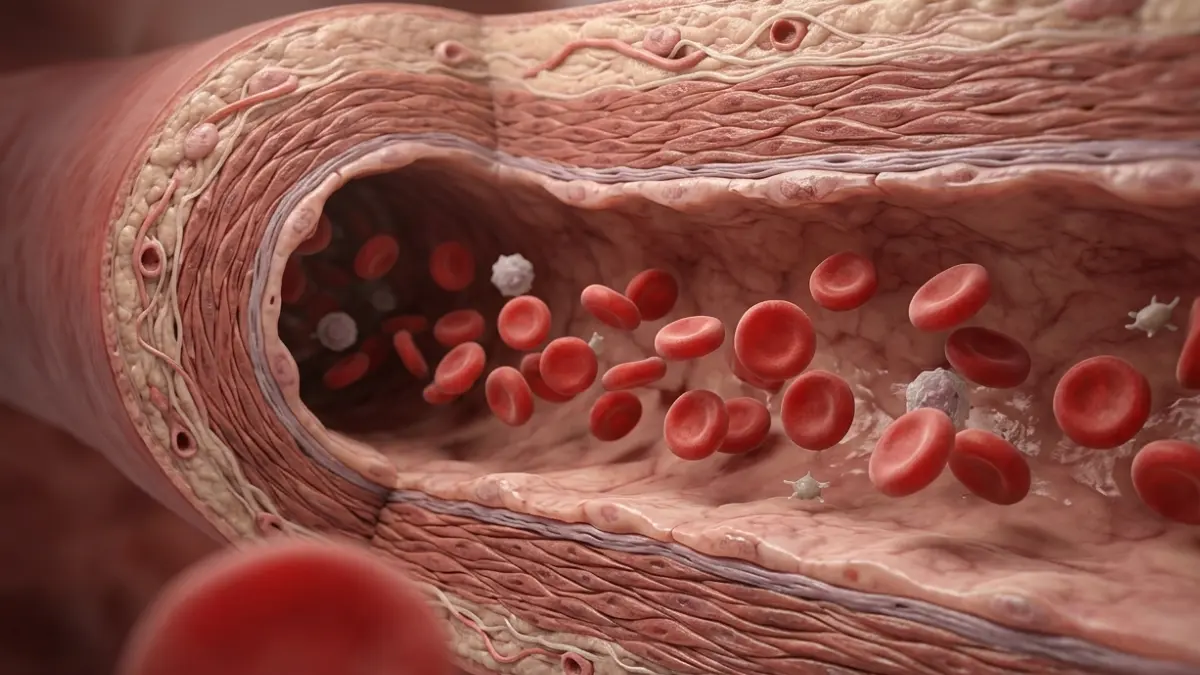
What happens inside a blood vessel
The inner lining of a vessel, the endothelium, regulates flow and repair. Sustained high glucose impairs it, and the vessel narrows, leaks, or scars.
Why small vessels fail before big ones
The smallest vessels have the least margin. The capillaries feeding the retina, the filtering units of the kidney, and the vessels supplying peripheral nerves are damaged earliest, which is why microvascular complications lead the list. Larger arteries stiffen too, but over a longer horizon.
🔬 How It Works: Think of the smallest vessels as the thinnest pipes in a building. When the water is corrosive, those fail first and quietly, long before the main lines show a problem. The kidney, retina, and nerve supply are the thinnest pipes in the body.
What ten years of high blood sugar does, year by year
There is no single date when damage starts. Change becomes detectable on a test years before it becomes noticeable to you, and that gap is the reason screening exists at all. For type 2 diabetes, researchers estimate elevated glucose is often present well before diagnosis, so the first decade may already be partly spent.
What shows up on a test, and what you would notice
| Body system | Shows on a test | Noticed by you | Key clinical detail |
|---|---|---|---|
| Eyes | Retinal change on a dilated exam | Blurred or lost vision, usually late | Leading cause of blindness in working-age adults |
| Kidneys | Albumin in urine, falling eGFR | Usually nothing until advanced | About 1 in 3 adults with diabetes has CKD |
| Nerves | Reduced sensation on a foot check | Burning, numbness, or nothing at all | Up to half of people with diabetes affected |
| Arteries | Blood pressure, lipids, imaging | Often the first cardiac event itself | Twice the risk of heart disease |
Sources: CDC (eyes, kidneys, heart); NIDDK (nerves). Sequence is typical, not guaranteed for any individual.
📊 Clinical Data Point: 40.1 million people in the United States have diabetes, and 11.0 million of them do not know it — 27.6% of adults with the condition. Source: CDC National Diabetes Statistics Report, updated January 2026, reporting 2023 data.
Why you can have real damage and feel completely fine
The most dangerous assumption a reader can hold is that they would have noticed. Nerve damage and kidney damage are both routinely silent while they progress.

Nerve damage without symptoms
Up to half of people with diabetes have peripheral neuropathy, according to the NIDDK’s page on peripheral neuropathy. The CDC reports that nearly half of those with it may have no symptoms.
Kidney damage without symptoms
Early kidney disease generally causes nothing a person can feel. NIDDK reports that as many as nine in ten adults with chronic kidney disease are unaware they have it.
What a test sees that you cannot
A urine albumin-to-creatinine ratio finds kidney injury before symptoms. A dilated eye exam finds retinal change before vision shifts. A monofilament foot check finds lost sensation before an injury goes unnoticed. High blood sugar does cause symptoms of its own — their absence simply does not rule damage out.
✅ Patient Action: At your next primary care visit, ask: “When were my urine albumin, eGFR, and dilated eye exam last done, and what were the results?”
For many people the first ten years happened before diagnosis
This is the part that reframes the question. A diagnosis date is when the condition was found, not when it began.
Damage found on the day of diagnosis
In a landmark analysis of retinopathy at diagnosis, researchers estimated that about one in five people in the US already had retinal change when type 2 diabetes was first identified. Working backwards from that, they estimated onset roughly 9 to 12 years before clinical diagnosis.
That figure is a modelled estimate, not a measured interval, and it should be read as an order of magnitude rather than a countdown.
What this means if your result was borderline
The CDC counts 115.2 million US adults with prediabetes. If yours came back in that range, an A1C between 5.7 and 6.4 is the point where baseline screening becomes worth asking about, not the point where nothing is happening yet.
How much does lowering your blood sugar actually change this
This is where the article stops describing damage and starts describing leverage, because the size of the benefit has been measured over decades.
What a 1% drop in A1C is worth
📊 Clinical Data Point: Each 1% reduction in average HbA1c was associated with 37% fewer microvascular complications, 21% fewer diabetes-related deaths, and 14% fewer heart attacks. Source: the UKPDS analysis of glycaemia and complications, BMJ 2000.
Those are relative reductions across a population, not a 37% cut in any one person’s absolute risk. The distinction matters when you apply it to yourself.
Why the first year after diagnosis matters most
Ten years after the UKPDS trial ended, and despite the glucose difference between groups disappearing within a year, the benefit persisted: fewer microvascular events, fewer heart attacks, fewer deaths. A later US cohort found that a first-year A1C at or above 6.5% tracked with worse outcomes a decade on, in people who survived at least ten years.
Is there a number below which nothing happens
No threshold was found. Risk fell continuously as A1C fell, with the lowest risk in the normal range. There is no line below which the clock stops. Practical ways to bring blood sugar down are worth reviewing with your prescriber, since the ADA sets glycemic goals individually rather than universally.
The checks that catch this early, and when to call sooner
Every silent complication above has a test that finds it. The tests are the entire point.
The screenings that find damage early
The CDC recommends yearly comprehensive vision exams including a dilated eye exam, and notes that 60% of people with diabetes do not get them; see the CDC’s guidance on diabetes and vision loss. Kidney screening uses urine albumin and eGFR. Your own intervals, including how often an A1C should be repeated, are set by your clinician, not by a general guideline.
Symptoms that should not wait
⚠️ Clinical Warning: A sudden change in vision, a foot wound that is not healing, or new chest symptoms are not items for the next routine appointment. Contact a clinician promptly. This list is a prompt to seek assessment, not a way to judge severity yourself.
✅ Patient Action: Ask your primary care physician directly: “Which of my diabetes screenings am I currently overdue for?”
Common questions about the long term effects of high blood sugar
1. What are the long term effects of high blood sugar?
The long term effects of high blood sugar include retinal damage, chronic kidney disease, peripheral nerve damage, and roughly double the risk of heart disease.
2. How long does it take for high blood sugar to damage your body?
Damage builds gradually. In type 2 diabetes, retinal change was already present in about one in five people at the time of diagnosis.
3. Can damage from years of high blood sugar be reversed?
Established retinal, kidney, and nerve damage is often permanent, though lowering blood sugar reduces further risk. Ask your clinician what your results show.
4. Which organ does high blood sugar damage first?
The smallest vessels fail first, so the retina, kidney filters, and peripheral nerves usually show measurable change before larger arteries do.
5. Does prediabetes cause long-term damage?
Damage can begin before glucose reaches the diabetes threshold, which is why retinal change was already present in roughly one in five people at diagnosis.
6. How much does lowering your A1C reduce complications?
UKPDS found each 1% drop in average A1C was associated with 37% fewer microvascular complications. Ask your clinician about your own target.
7. Can you have nerve damage without feeling symptoms?
Yes. The CDC reports that nearly half of people with diabetic peripheral neuropathy may have no symptoms at all.
8. How often should you get a dilated eye exam with diabetes?
The CDC recommends yearly comprehensive vision exams including a dilated eye exam. Your own schedule is set by your eye specialist.
9. Does high blood sugar damage kidneys without symptoms?
Yes. Early kidney disease usually causes no symptoms, and NIDDK reports as many as nine in ten adults with CKD are unaware.
10. Are you more likely to get heart disease from high blood sugar?
The CDC reports people with diabetes carry twice the risk of heart disease, and that risk rises the longer they have it.
11. What A1C level starts causing long-term damage?
UKPDS found no threshold below which risk stopped falling. Risk is continuous rather than a cliff. Your target is set with your clinician.
What to do with this
The decade behind you is fixed. The one ahead is not. In the UKPDS follow-up, the benefit of better control persisted for ten years after the glucose difference between groups had already vanished, which means effort now still counts later.
Bring your last three A1C results to your next appointment and ask which screenings you are overdue for.
About this content
How this article was put together: researched from recognised health sources, drafted with the help of AI tools, and edited by hand, with sources linked throughout.

Sameer Patel is the founder and editor of My Medicine Advisor. He is not a doctor or medical professional — before starting this site he worked in banking,…
Medical disclaimer
The content on MyMedicineAdvisor is provided for general informational and educational purposes only and is not a substitute for professional medical advice, diagnosis, or treatment. Health information on this website should not be used to diagnose, treat, cure, or prevent any condition without guidance from a qualified healthcare professional. Always seek the advice of your doctor, physician, or another licensed healthcare provider with any questions you may have regarding a medical condition, symptoms, medications, or treatment decisions.