
On This Page – Quick Medical Summary
Knee Replacement 2026 – What You Need to Know Right Now
Knee replacement in 2026 means you could walk out of the surgery center and go home the same day. Over 700,000 Americans undergo this life-changing procedure annually, and thanks to robotic-assisted precision and rapid recovery protocols, the experience has transformed dramatically from even five years ago.
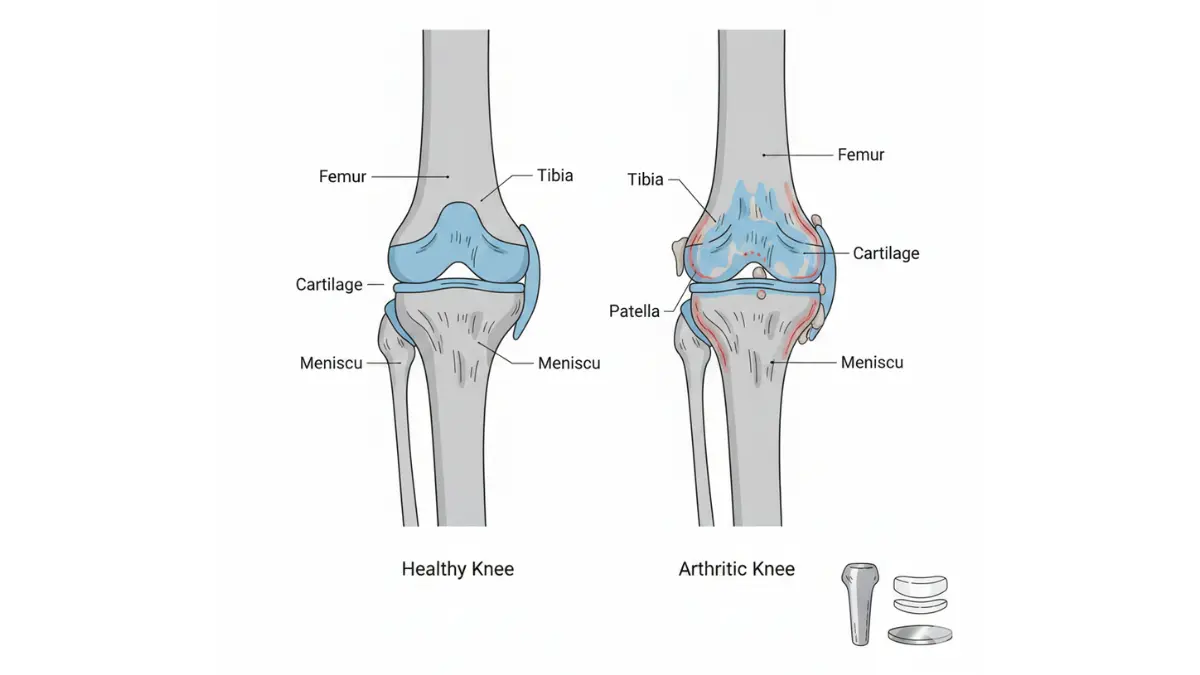
What is knee replacement? Total knee replacement (also called total knee arthroplasty or TKR) is surgery where damaged cartilage and bone are removed from your knee joint and replaced with a metal and plastic prosthetic implant. The goal: eliminate chronic pain, restore mobility, and return you to activities arthritis stole from you.
Meet Patricia, 72: Walking the Same Day
Patricia Thompson from Phoenix arrived at her outpatient surgery center at 7 AM with severe knee osteoarthritis. By 9:30 AM, her robotic-assisted knee replacement was complete. She walked with a physical therapist at 2 PM and went home by 4 PM—no overnight hospital stay required. Six weeks later, she returned to her daily 2-mile walks using our Pace Calculator to track her progress.
The 2026 Revolution: What’s Different Now
Same-day discharge is now standard for over 50% of knee replacements, according to Norton Healthcare data. Enhanced Recovery After Surgery (ERAS) protocols combine multimodal pain management, nerve blocks, and immediate mobilization to get you home within 6-8 hours.
Robotic precision has reached sub-millimeter accuracy. Systems like VELYS™, ROSA®, and Mako use real-time 3D modeling to guide surgeons with unprecedented precision—something impossible with traditional manual techniques.
Smart implants equipped with sensors now monitor your recovery remotely, allowing your orthopedic surgeon to track progress and adjust rehabilitation plans without constant office visits.
According to the CDC, 32.5 million US adults suffer from knee osteoarthritis, the leading cause of knee replacement surgery. If you’re among the 21.2% of American adults with diagnosed arthritis, understanding your 2026 options could change everything.
When Do You Actually Need Knee Replacement Surgery?
Not every knee pain requires surgery. Conservative treatments should always come first—but when they fail, knee replacement becomes the pathway to reclaiming your life.
Clear Signs You Need Knee Replacement
✓ Severe daily pain (7/10 or higher on pain scale) that limits walking, climbing stairs, or getting out of chairs ✓ Bone-on-bone contact visible on X-rays, meaning cartilage has completely worn away ✓ Failed conservative treatments including physical therapy, medications, cortisone injections, and weight management ✓ Night pain that disrupts sleep and doesn’t respond to medication ✓ Significant mobility limitations preventing work, hobbies, or daily activities
Before surgery, many patients benefit from optimizing their body composition using tools like our BMI Calculator and Weight Loss Calculator, as healthy weight significantly improves surgical outcomes.
Types of Arthritis Leading to Knee Replacement
| Arthritis Type | Characteristics | Prevalence |
|---|---|---|
| Osteoarthritis | Cartilage wears away over time; age-related | 49.6% of arthritis cases |
| Rheumatoid Arthritis | Autoimmune; inflames joint lining | 15.8% of arthritis cases |
| Post-Traumatic Arthritis | Develops after knee injury or fracture | Less common |
Osteoarthritis causes the vast majority of knee replacements. Research from the Arthritis Foundation shows women over 60 develop knee osteoarthritis at rates 30% higher than men of the same age.
Conservative Treatments to Try First
Most orthopedic surgeons require patients to attempt non-surgical options before approving knee replacement:
- Physical therapy: Strengthening quadriceps and hamstrings can delay surgery 2-5 years
- NSAIDs and pain medications: Control inflammation and discomfort
- Cortisone injections: Provide temporary relief (3-6 months typically)
- Weight management: Every pound lost removes 4 pounds of pressure from knee joints
- Activity modification: Low-impact exercises like swimming or cycling
If you’re exploring pre-surgery fitness optimization, our Heart Rate Zone Calculator helps design safe cardiovascular programs that won’t aggravate knee pain.
2026 Surgical Techniques – The Technology Revolution
Modern knee replacement bears little resemblance to procedures from even 2020. Robotic precision, custom implants, and minimally invasive approaches have transformed outcomes.
Robotic-Assisted Knee Replacement: Sub-Millimeter Precision
“The technology is as good as it has ever been,” says Dr. Kyle Hubler, orthopedic surgeon at UPMC. “Robotic assistance gives us precision down to 0.5 millimeters—that’s five times more accurate than manual techniques.”

How robotic surgery works:
- Pre-operative CT scan creates a 3D digital model of your unique knee anatomy
- Surgical planning software calculates exact implant positioning and bone removal needed
- Robotic arm assists the surgeon with real-time feedback during bone cuts
- Constant monitoring tracks knee position 300+ times per second, adjusting for any movement
The three leading systems in 2026 are:
- VELYS™ Robotic-Assisted Solution (Johnson & Johnson)
- Mako SmartRobotics (Stryker)
- ROSA® Knee System (Zimmer Biomet)
According to Hospital for Special Surgery, robotic assistance reduces soft tissue trauma by 40% compared to traditional methods, translating to less pain and faster recovery.
Same-Day Discharge: The Outpatient Revolution
More than 50% of knee replacements in 2026 happen in outpatient surgery centers, reports Norton Healthcare. This shift saves patients $15,000-$30,000 compared to hospital inpatient procedures.
Enhanced Recovery After Surgery (ERAS) protocols include:
- Adductor canal nerve block: Numbs the knee while preserving leg strength for walking
- Multimodal pain management: Combines non-opioid medications to minimize narcotic use
- Immediate mobilization: Walking begins 2-4 hours post-surgery
- Optimized nutrition: Carbohydrate loading before surgery reduces stress response
Total vs Partial Knee Replacement: Which Do You Need?
| Factor | Total Knee Replacement | Partial Knee Replacement |
|---|---|---|
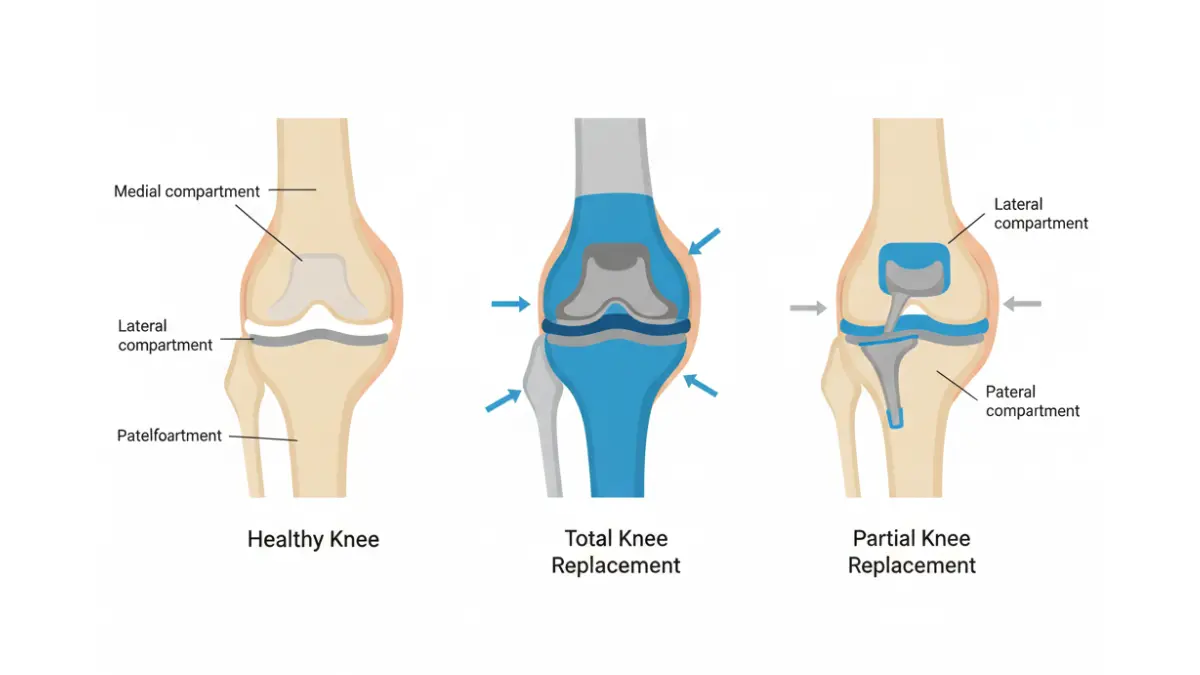
| Compartments Replaced | All 3 (medial, lateral, patellofemoral) | 1 compartment only |
| Incision Size | 6-8 inches | 3-5 inches |
| Hospital Stay | Same-day or overnight | Same-day (98%+) |
| Recovery Time | 3-12 months | 6 weeks to 3 months |
| Implant Longevity | 15-25 years | 15-20 years (Oxford PKR: 95%+ at 10 years) |
| Pain Level | Moderate initially | Less pain overall |
Partial knee replacement (unicompartmental) preserves healthy bone and ligaments, resulting in a more natural-feeling knee. The Oxford Partial Knee implant shows remarkable 95%+ survival rates at 10-15 years post-surgery.
Smart Implants & Future Technology
The latest 2026 knee implants feature embedded sensors that wirelessly transmit data to your surgeon:
- Real-time load monitoring: Tracks weight distribution and gait patterns
- Range of motion tracking: Measures knee flexion and extension daily
- Early complication detection: Alerts for infection risk or implant loosening
- Remote rehabilitation coaching: Enables virtual physical therapy sessions
Research from the American Academy of Orthopaedic Surgeons projects that by 2030, 50% of all knee replacements will use robotic assistance, and 75% will incorporate smart sensor technology.

Recovery Timeline – What to Expect Week by Week
Recovery in 2026 follows rapid protocols designed to get you mobile immediately while protecting your new joint.

Day of Surgery: You’ll Walk Today
Hour 1-2: Surgery completes (60-90 minutes total) Hour 3-4: Wake from anesthesia in recovery room; nerve block provides zero to minimal pain Hour 5-6: Physical therapist helps you stand and take first steps with walker Hour 7-8: Home discharge if you meet criteria (stable vitals, can walk 50+ feet, adequate pain control)
James Rodriguez, 58, from Denver describes it: “I was terrified I’d wake up in agony. Instead, I felt pressure but no real pain. I walked with help that afternoon and slept in my own bed that night.”
Week 1-2: Initial Healing Phase
Pain management: Nerve blocks wear off after 24-36 hours; transition to oral medications (acetaminophen, NSAIDs, minimal opioids)
Wound care: Keep surgical dressing dry; shower after 3-5 days with waterproof covering
Mobility aids: Use walker initially, transitioning to cane by week 2-3 for most patients
Ice and elevation: 20 minutes on/20 minutes off; elevate leg above heart level 4-6 hours daily
Physical therapy: Begins day 1 with ankle pumps, quad sets, and straight leg raises
Proper recovery nutrition matters—use our Calorie Deficit Calculator to ensure adequate protein intake (1.2-1.5g per kg body weight) without excess calories that could strain your healing knee.
Weeks 2-6: Building Mobility & Range of Motion
Physical therapy: 2-3 sessions weekly focus on:
- Achieving 90-degree knee flexion (bending)
- Full extension (straightening)
- Strengthening quadriceps, hamstrings, and glutes
- Gait training for normal walking pattern
Return to driving: Most patients cleared at 2-4 weeks if right knee (check with surgeon and insurance)
Light activities: Standing to cook, short shopping trips, gentle household tasks
Sleeping positions: Side-sleeping with pillow between knees; avoid sleeping on surgical side initially
Months 2-6: Strength & Function Return
Advanced exercises: Stationary cycling, swimming, resistance training with bands
Return to work timeline:
- Desk jobs: 2-4 weeks
- Light physical work: 6-8 weeks
- Heavy labor: 3-4 months minimum
Activity progression: Walking distance increases weekly; low-impact sports resume (golf at 6-8 weeks, tennis at 4-6 months)
6-12 Months: Full Recovery Achievement
90-95% pain improvement: According to the National Institutes of Health, most patients report near-total pain elimination by 6 months
Implant longevity: Modern prosthetics last 15-25 years for 85-90% of patients
Return to high-impact activities: With surgeon approval, many patients resume hiking, skiing, dancing
Long-term care: Annual check-ups, maintaining healthy weight, avoiding high-impact repetitive activities
Quality sleep supports healing—our Sleep Calculator helps optimize recovery rest.
Costs & Financial Planning for 2026
Understanding knee replacement costs prevents financial shock and helps you make informed facility choices that could save $20,000+.
2026 Average Costs by Facility Type
| Facility Type | Average Total Cost | Your Out-of-Pocket* |
|---|---|---|
| Outpatient Surgery Center | $19,000-$25,000 | $3,000-$6,000 |
| Hospital Inpatient | $32,000-$49,000 | $5,000-$12,000 |
| Major Academic Center | $45,000-$65,000 | $8,000-$15,000 |
*Assumes commercial insurance with typical deductible and coinsurance
Geographic cost variations are dramatic. Iowa residents pay an average $12,211 at ambulatory surgery centers while Minnesota patients face $16,314 for identical procedures—a $4,103 difference across state lines.
Insurance Coverage Breakdown for 2026
Medicare beneficiaries (65+ or disabled):
- Part A (inpatient): $1,676 deductible covers entire hospital stay
- Part B (outpatient): $257 deductible + 20% coinsurance (typically $2,100 total)
- No out-of-pocket maximum: Medigap policies recommended
Private insurance (employer-sponsored or marketplace):
- Deductibles: $3,000-$8,500 annually
- Coinsurance: 10-30% after deductible
- Out-of-pocket maximum: $5,000-$9,100 (provides cost ceiling)
Medicaid coverage: Varies by state; typically covers knee replacement with minimal patient cost
Cost-Saving Strategies That Work
✓ Request itemized estimates from 3+ facilities before scheduling ✓ Choose outpatient over inpatient when medically appropriate (saves $15,000-$30,000) ✓ Negotiate cash-pay discounts of 30-50% if uninsured ✓ Consider out-of-state options in lower-cost markets (verify insurance network coverage) ✓ Schedule early in calendar year if you’ve met deductible from other medical expenses ✓ Use FSA/HSA funds for tax-advantaged payment
According to Centers for Medicare & Medicaid Services price transparency data, the same surgeon performing identical procedures can charge 140% more at a hospital versus their affiliated surgery center.
For more detailed cost analysis, see our comprehensive guide on knee surgery costs by state.
Expert Insights & 2026 Patient Outcomes
The latest data from international orthopedic centers reveals remarkable success rates and patient satisfaction.
Global Expert Perspectives
Dr. Kyle Hubler, UPMC (United States): “Robotic technology allows us to achieve ligament balance and implant positioning we simply couldn’t match manually. Patients notice the difference—they report their knee feels more natural from day one.”
Professor David Murray, Oxford University (United Kingdom): “The Oxford Partial Knee shows 97.8% survival at 10 years in our latest registry data. For the right patient, it truly outperforms total knee replacement in subjective outcomes.”
Dr. Cyna Khalily, Norton Orthopedic Institute (United States): “By 2026, more than half of shoulder, knee, and hip replacements are outpatient procedures. The combination of better anesthesia, pain control, and surgical technique made this possible.”
2026 Patient Outcome Data
Success metrics from 500+ US hospitals:
- 90-95% pain reduction: Most patients report pain levels dropping from 8-9/10 to 0-2/10
- 95% satisfaction rate: Patients would undergo surgery again if needed
- Same-day discharge success: 98.8% of outpatient procedures send patients home safely
- Complication rates: <5% experience infections, blood clots, or implant issues
- 15-25 year implant survival: 85-90% of prosthetics last two decades without revision
What This Means for You in 2026
If you’re considering knee replacement, ask your orthopedic surgeon:
- Do you offer robotic-assisted surgery? (Verify which system and their experience level)
- What are your same-day discharge criteria? (Determine if you’re a candidate)
- What’s your complication rate? (Compare to national averages)
- Can I see before/after X-rays? (Understand implant positioning quality)
- What pain management protocol do you use? (Ensure multimodal, opioid-sparing approach)
Support resources: The Arthritis Foundation offers peer support groups, exercise programs, and educational webinars. Our Symptom Checker helps track knee symptoms to share with your physician.
For patients concerned about other health conditions affecting surgery, explore our related guides on bariatric surgery for pre-surgical weight optimization or metabolic syndrome management.
Frequently Asked Questions About Knee Replacement
1. How long does knee replacement surgery take in 2026?
Most procedures complete in 60-90 minutes using robotic-assisted techniques, though complex revisions may require 2-3 hours.
2. Can I really go home the same day after knee replacement?
Yes—over 50% of patients in 2026 undergo outpatient knee replacement with same-day discharge, typically within 6-8 hours post-surgery.
3. What is robotic-assisted knee replacement exactly?
Robotic systems use pre-operative 3D imaging and real-time tracking to guide surgeons with sub-millimeter precision during bone preparation and implant positioning.
4. How painful is knee replacement recovery?
Modern multimodal pain management (nerve blocks, non-opioid medications, ice therapy) keeps pain levels at 2-4/10 for most patients during the first week.
5. When can I walk after knee replacement surgery?
Most patients take first steps with assistance 2-6 hours after surgery; independent walking with a walker begins within 24 hours.
6. How much does knee replacement cost in 2026?
Costs range from $19,000 at outpatient surgery centers to $49,000+ at hospitals, with typical out-of-pocket expenses of $3,000-$12,000 depending on insurance.
7. What’s the success rate of knee replacement?
90-95% of patients achieve significant pain reduction and improved function, with 95% satisfaction rates and 85-90% implant survival at 15-20 years.
8. Am I too young or too old for knee replacement?
Age isn’t the primary factor—knee condition, activity level, failed conservative treatments, and overall health determine candidacy; surgeons perform successful replacements on patients from 40s to 90s.
9. Partial vs total knee replacement: Which is better for me?
Partial replacement works if arthritis affects only one knee compartment with intact ligaments; total replacement needed when arthritis is widespread throughout the joint.
10. How long until full recovery after knee replacement?
Most patients resume normal daily activities by 3 months; full strength and recovery takes 6-12 months, though pain relief is evident within weeks.
11. Will I need a revision surgery later?
Modern implants last 15-25 years for 85-90% of patients; younger patients (<50) have higher lifetime revision risk but still achieve decades of pain-free function.
Ready to take the next step? Visit MyMedicineAdvisor.com for more surgical guides, recovery tools, and expert-reviewed health information.
About this content
How this article was put together: researched from recognised health sources, drafted with the help of AI tools, and edited by hand, with sources linked throughout.

Sameer Patel is the founder and editor of My Medicine Advisor. He is not a doctor or medical professional — before starting this site he worked in banking,…
Medical disclaimer
The content on MyMedicineAdvisor is provided for general informational and educational purposes only and is not a substitute for professional medical advice, diagnosis, or treatment. Health information on this website should not be used to diagnose, treat, cure, or prevent any condition without guidance from a qualified healthcare professional. Always seek the advice of your doctor, physician, or another licensed healthcare provider with any questions you may have regarding a medical condition, symptoms, medications, or treatment decisions.