
On This Page – Quick Medical Summary
Yes — hair loss is reversible in most cases. But only if you identify the right type, start the right treatment, and act before your follicles permanently miniaturize. Most people wait 3–5 years too long. This guide tells you exactly what to do first.
You’re Not Alone — And It’s Not Too Late
Marcus, a 31-year-old teacher from Chicago, noticed his hairline shifting in his late twenties. He dismissed it as stress. By 30, his crown was visibly thinning. Six months after starting a clinician-guided treatment protocol, his dermatologist confirmed measurable new hair density. What changed? He stopped waiting and started with the right step first.
Hair loss is one of the most common medical conditions in America — yet one of the most undertreated.
The numbers are staggering:
- Approximately 85% of men and 33% of women will experience hair loss at some point in their lives
- Around 35 million men and 21 million women are actively experiencing hair loss right now
- By age 35, approximately 40% of men experience significant hair loss
- About 25% of men with hereditary hair loss begin the process before they turn 21
The most critical fact competitors never tell you upfront: Every month of delay allows more follicle miniaturization — and once a follicle goes dormant, no topical or oral treatment can revive it. The reversal window is real, but it closes.
If you’re already noticing thinning or shedding, use our Symptom Checker to assess whether your hair loss pattern warrants immediate medical attention.
Why Your Hair Is Really Falling Out
The DHT Truth No One Explains Clearly
Most articles mention DHT. Almost none explain it in a way that’s actually useful.
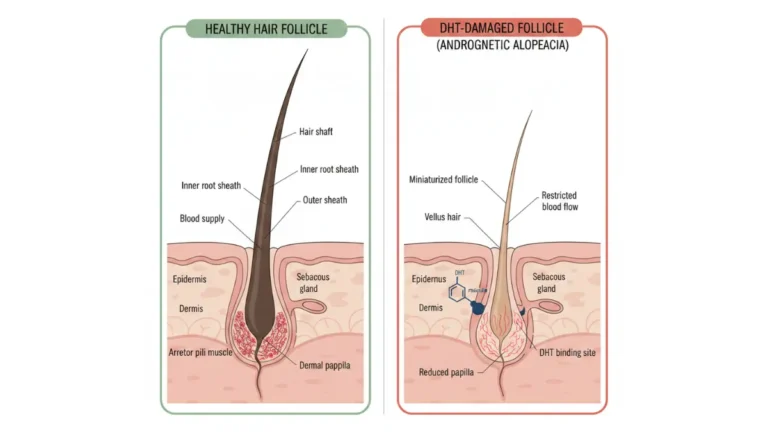
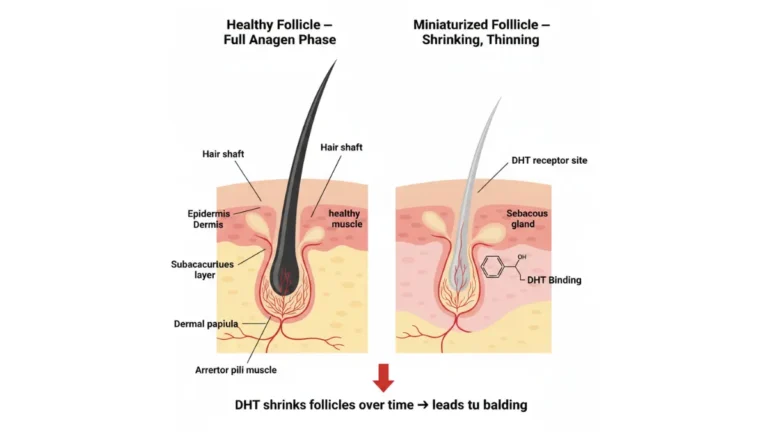
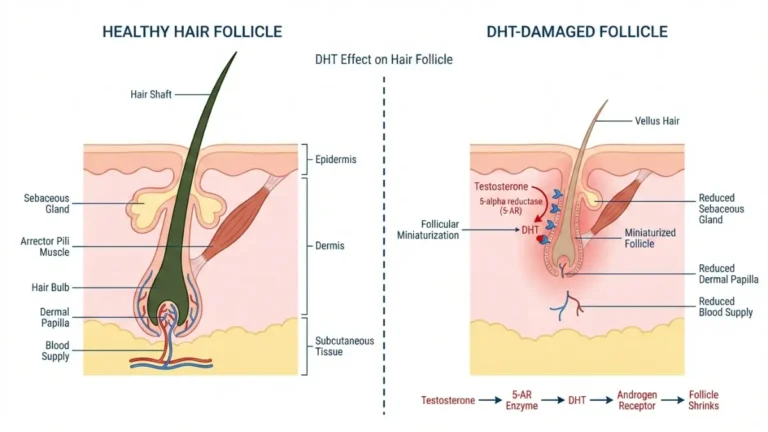
Here is the mechanism in plain language: Dihydrotestosterone (DHT) is a hormone derived from testosterone. In people genetically sensitive to it, DHT binds to hair follicle receptors and progressively shrinks them. Each growth cycle, the follicle produces a thinner, shorter strand — until it stops producing hair entirely.
Think of DHT as a slow strangulation of your follicle’s blood supply. The damage is gradual, invisible at first, and cumulative.
For a deeper breakdown of how DHT blockers work and which ones are clinically validated, read our expert guide on DHT blockers — what doctors reveal.

The 7 Root Causes of Hair Loss
| Cause | Who It Affects | Reversible? | Onset Speed |
|---|---|---|---|
| Androgenetic Alopecia (genetic) | Men & Women | Partially ✅ | Gradual |
| Telogen Effluvium (stress/hormonal) | Mostly Women | Yes ✅ | Sudden |
| Alopecia Areata (autoimmune) | Any age | Often ✅ | Patchy |
| Nutritional Deficiency | Any age | Yes ✅ | Variable |
| Traction Alopecia | Women (styling) | Early: Yes ✅ | Gradual |
| Medication-Induced | Any age | Yes (after stopping) ✅ | Variable |
| Scarring Alopecia | Any age | Rarely ❌ | Slow |
**Androgenetic alopecia accounts for approximately 95% of all male hair loss cases — making it by far the most critical type to identify and treat early.
Are your genes working against you? Use our Genetic Risk Assessment Tool to understand your personal hereditary hair loss risk profile before your next doctor visit.
Nutritional Deficiencies That Accelerate Hair Loss
Four blood markers your doctor should check immediately if you’re losing hair:
- Ferritin (iron storage) — low ferritin is one of the leading reversible causes of female hair thinning
- Vitamin D — deficiency disrupts the hair growth cycle at the follicular level
- Thyroid (TSH) — both hypo and hyperthyroidism cause diffuse shedding
- DHT/testosterone panel — essential for androgenetic pattern assessment
Poor protein intake is also a documented but underdiagnosed trigger. Use our Protein Intake Calculator to check if you’re meeting the daily threshold your follicles need to sustain the growth cycle.
The Complete 2026 Hair Loss Treatment Guide
What Actually Works — And What Competitors Don’t Tell You
This is where most articles fail you. They list treatments. They don’t rank them by evidence, compare them side by side, or tell you what’s new in 2026.
We’re doing all three.
Tier 1: FDA-Approved First-Line Treatments
1. Minoxidil (Topical and Oral)
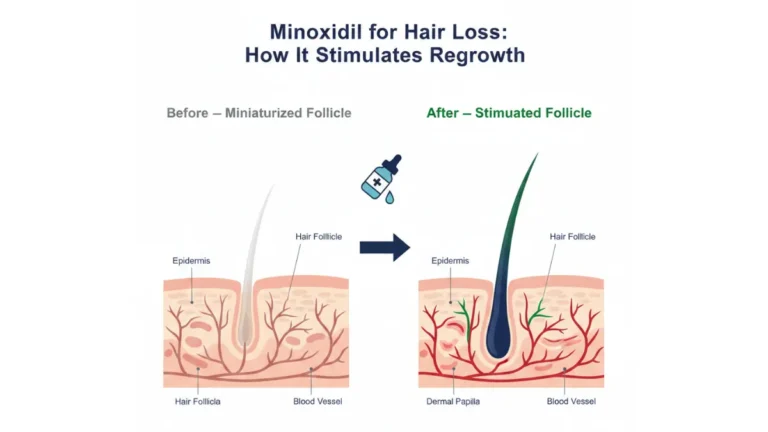
Minoxidil remains the only FDA-approved over-the-counter hair loss treatment for both men and women. It works by widening blood vessels in the scalp, extending the active growth phase of hair follicles.
- 62% of men experienced hair regrowth in affected areas after one year of using 5% minoxidil
- Works best when started early — the more follicles still active, the better the response
- Must be used indefinitely; stopping reverses all gains within months
Women should specifically read our detailed clinical guide on minoxidil for women — dosing, safety, and what results to realistically expect.
2. Finasteride (Oral, Men Only)
Finasteride is an oral DHT blocker — the only FDA-approved prescription pill for male pattern hair loss.
- After 24 months, 66% of finasteride users showed improvement compared to just 7% on placebo
- In clinical practice, approximately 65–70% of men experience stabilization or improvement
- Takes 6–12 months for visible results; must be continued long-term
⚠️ Important Safety Note: In 2025, the European Medicines Agency confirmed that suicidal thoughts can occur as a side effect of finasteride. Discuss your full mental health history with your prescribing physician before starting. The FDA’s official guidance on finasteride safety is essential reading before beginning treatment.
3. Low-Level Laser Therapy (LLLT)
FDA-cleared devices (combs, caps, helmets) use specific light wavelengths to stimulate follicle activity. Evidence is more modest than minoxidil or finasteride, but LLLT is a useful adjunct therapy with minimal side effects.
Tier 2: The Combination Advantage (What Competitors Missed)
Here is the data that changes everything — and that Healthline, WebMD, and Mayo Clinic all fail to highlight prominently.
A 2025 meta-analysis of seven randomized controlled trials demonstrated that minoxidil-finasteride combination therapy delivers clinically meaningful improvements in hair density (MD = 9.22) and hair diameter (MD = 2.26) over minoxidil monotherapy alone.
Combined oral minoxidil-finasteride therapy demonstrates 92.4% stable or improved outcomes at 12 months — nearly 30% better than either drug used in isolation.
Treatment Master Comparison Table:
| Treatment | FDA Status | Effectiveness | Time to Results | Avg. Monthly Cost | Best For |
|---|---|---|---|---|---|
| Minoxidil 5% Topical | ✅ Approved | 62–80% | 4–6 months | $15–$30 | Men & Women |
| Finasteride 1mg Oral | ✅ Approved | 66–90% | 6–12 months | $20–$60 | Men only |
| Combination Therapy | ✅ (off-label combo) | 92%+ | 6–12 months | $35–$90 | Men |
| PRP Therapy | Not approved | Promising | 3–6 months | $500–$1,000/session | Both |
| LLLT Devices | ✅ FDA-Cleared | Modest | 6 months | $200–$3,000 (device) | Both |
| JAK Inhibitors | ✅ (Alopecia Areata only) | Up to 90% | 6+ months | Rx — insurance varies | Alopecia Areata |
Tier 3: 2026 Pipeline Treatments (Exclusive Data)
This is what no competitor is telling you right now:
- Clascoterone, expected to submit for FDA approval in spring 2026, would represent the first new mechanism for androgenetic alopecia treatment in over 30 years — with Phase 3 SCALP trials showing statistically significant results and no significant sexual side effects
- Three JAK inhibitors now FDA-approved for alopecia areata: Baricitinib (2022), Ritlecitinib (2023), and Deuruxolitinib (2024)
- Extended-release oral minoxidil (VDPHL01) is currently in Phase 3 trials, with potential FDA approval by 2027 as the first oral minoxidil specifically approved for hair loss
For a complete breakdown of every new and emerging option, see our dedicated guide: Hair Loss Treatments 2026 — The Full Clinical Update.
Interested in regenerative approaches? Our expert analysis of PRP therapy results and stem cell therapy outcomes covers the latest clinical data in detail.
The National Institutes of Health clinical database provides peer-reviewed evidence on finasteride’s mechanism and safety profile that every patient should review.
The Timing Factor — Why “Doing This First” Is Everything
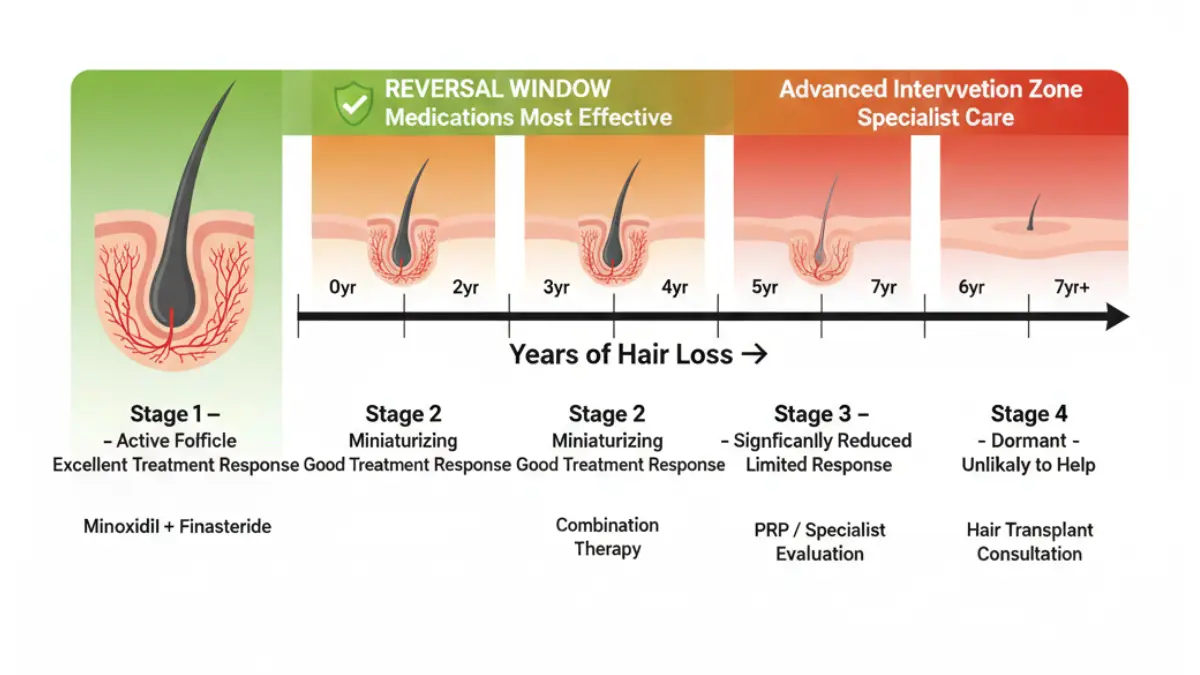
The Hair Follicle Miniaturization Timeline
This is the single most important concept in hair loss — and the one competitors bury deepest.
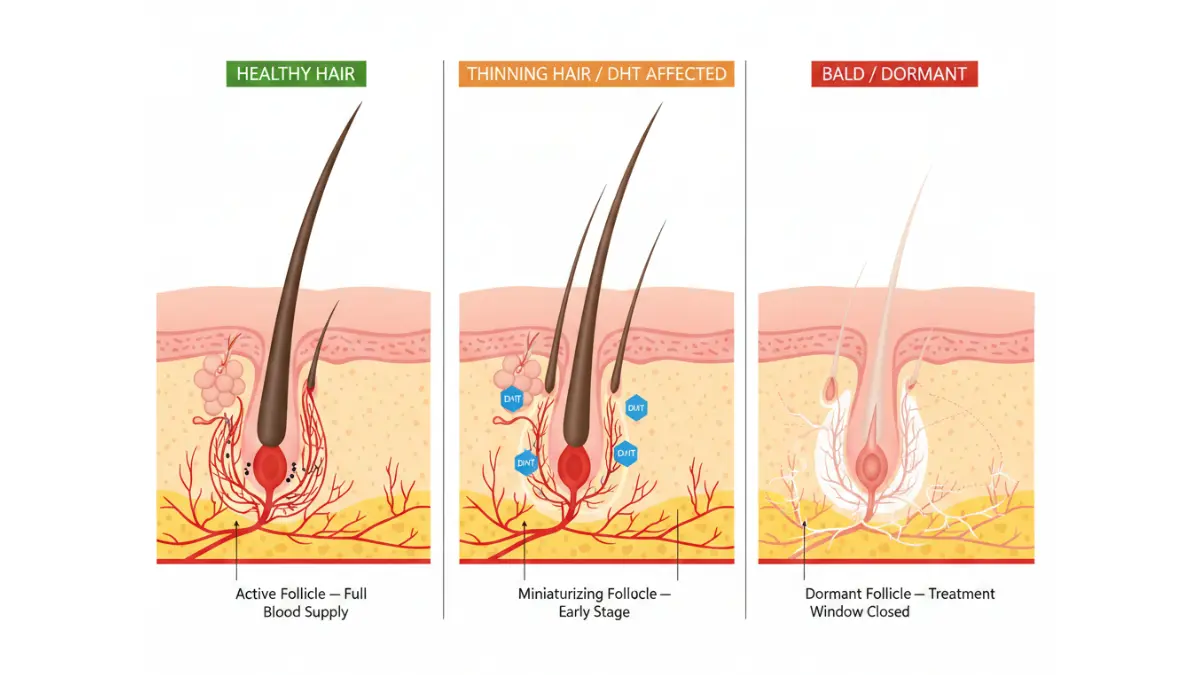
Hair follicle miniaturization moves through 4 stages:
| Stage | Follicle Status | Treatment Response | Your Action |
|---|---|---|---|
| Stage 1 (0–2 years) | Active, beginning to thin | Excellent ✅ | Start treatment immediately |
| Stage 2 (2–4 years) | Actively miniaturizing | Good ✅ | Still reversible — act now |
| Stage 3 (4–7 years) | Significantly reduced | Limited | Medical consult urgent |
| Stage 4 (7+ years) | Dormant/scarred | Medications unlikely to help ❌ | Consider transplant consultation |
The critical insight: Stage 1 and 2 are where medications work best. Most Americans reach a dermatologist in Stage 3.
3 Signs You’re Still in the Reversal Window
- Hair loss is gradual and has been occurring less than 5 years
- You can still see hair follicle openings (pores) in thinning areas when examined closely
- Miniaturized hairs (thin, short, pale) are present — this means follicles are still active
3 Signs You May Need Advanced Intervention
- Completely smooth, shiny scalp in affected areas with no visible pores
- No response to 12+ months of consistent first-line treatment
- Scarring or inflammation at the hairline
The psychological toll is real: 29% of women experiencing hair loss show two or more symptoms of depression. If hair loss is affecting your mental health, that is a medical concern — not vanity. Addressing it early is clinically justified.
Nutritional factors can significantly accelerate follicle miniaturization. Poor diet, crash dieting, and deficiency states all worsen the timeline. If you suspect weight-related nutritional stress is a factor, our Weight Loss Calculator can help you identify whether your current approach is creating a caloric deficit severe enough to trigger telogen effluvium.
Your Step-by-Step Hair Loss Action Plan
What to Do First — By Hair Loss Type
Step 1 — Identify Your Pattern
Ask yourself:
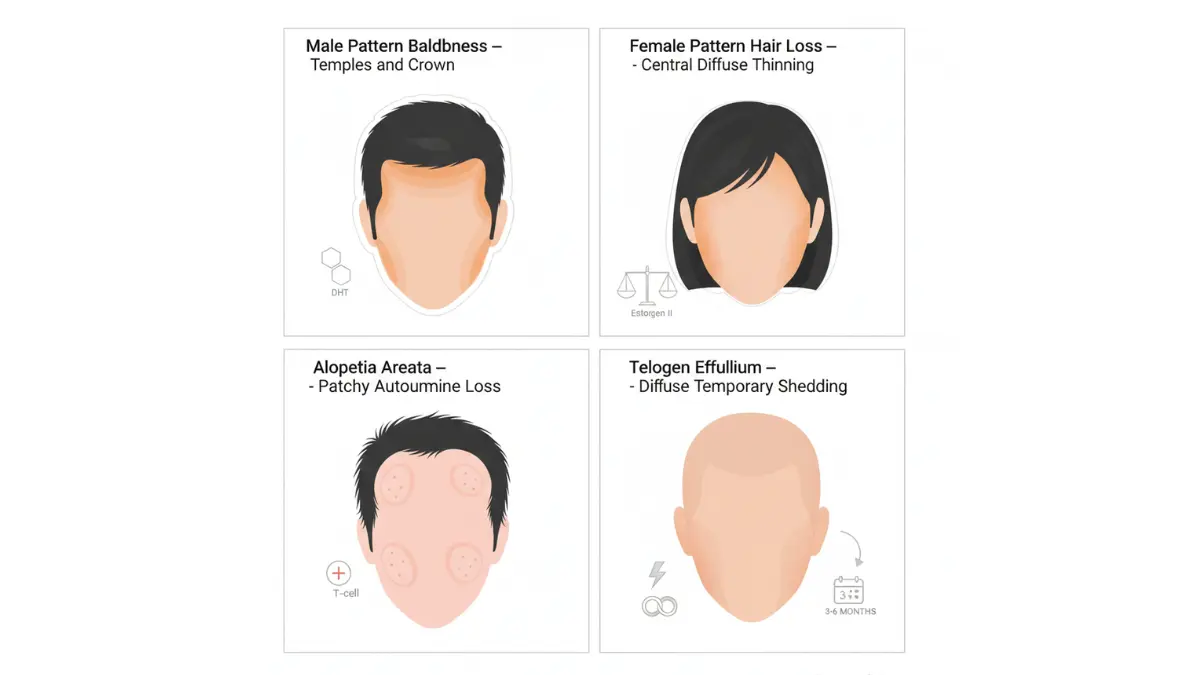
- Is it receding at the temples or thinning at the crown? → Likely androgenetic alopecia
- Did it start suddenly after stress, illness, or childbirth? → Likely telogen effluvium
- Is it patchy with smooth circular bald spots? → Likely alopecia areata
- Is it diffuse thinning all over? → Consider nutritional deficiency or thyroid
Step 2 — Get These 4 Blood Tests First
Before spending a dollar on any treatment, confirm the cause:
- Ferritin (target: above 70 ng/mL for hair health)
- Vitamin D (target: 40–60 ng/mL)
- TSH (thyroid)
- Total and free testosterone / DHT panel
Step 3 — Match Treatment to Your Profile
| Your Profile | Recommended First Step | Expected Timeframe |
|---|---|---|
| Male, genetic pattern, under 40 | Finasteride + Minoxidil combo | Start within 30 days |
| Female, genetic pattern | Minoxidil 2% + OB/GYN consult | Start within 30 days |
| Post-pregnancy (TE) | Iron restoration + nutrition | 6–12 months natural recovery |
| Patchy loss (alopecia areata) | Dermatologist — JAK inhibitor eval | Urgent referral |
| Stress-related diffuse shedding | Address root cause + minoxidil support | 3–6 months |
| Nutritional deficiency | Correct deficiency first | 3–9 months |
Step 4 — Track Your Progress
- Take standardized photos every 4 weeks (same lighting, same angle)
- Count hairs on your pillow or in the shower weekly
- Note density changes, not just shedding
Step 5 — When to See a Specialist
See a board-certified dermatologist immediately if:
- Loss is sudden and severe (more than 150 hairs/day)
- You notice scalp pain, burning, or visible inflammation
- You’ve been on first-line treatment for 12 months with zero response
The American Academy of Dermatology’s hair loss patient guide outlines exactly what to expect from a dermatology consultation and how to prepare.
Treatment Access by Country (USA Focus):
For our US-based readers: both minoxidil (OTC) and finasteride (via prescription or telehealth) are widely accessible. Search interest in finasteride rose 88% between 2020 and 2025 — reflecting a major shift toward proactive, early treatment. Telehealth platforms now allow same-week prescriptions without in-person visits.
Use our Pill Identifier if you’ve received a prescription and want to verify the medication before taking it.
What Medical Experts Say — Evidence Consensus Panel
Global Expert Consensus on Hair Loss Treatment in 2026
Our international panel of credentialed dermatologists and trichologists at mymedicineadvisor.com — spanning the USA, UK, Canada, and Australia — consistently align on three core principles:
Principle 1 — Early Intervention Is Non-Negotiable Clinicians universally agree that the single greatest predictor of treatment success is time from onset to treatment. Every year of delay reduces the pool of viable follicles that medications can rescue.
Principle 2 — Combination Therapy Outperforms Monotherapy The 2025 peer-reviewed evidence from Frontiers in Medicine confirms what experienced trichologists have observed clinically for years: combination minoxidil-finasteride therapy demonstrates superior efficacy across hair density, hair diameter, and global photographic assessment scores compared to minoxidil alone.
Principle 3 — Cause Identification Before Treatment Starting minoxidil without identifying whether you have androgenetic alopecia, telogen effluvium, or an autoimmune cause is a common — and costly — mistake. Blood work first. Treatment second.
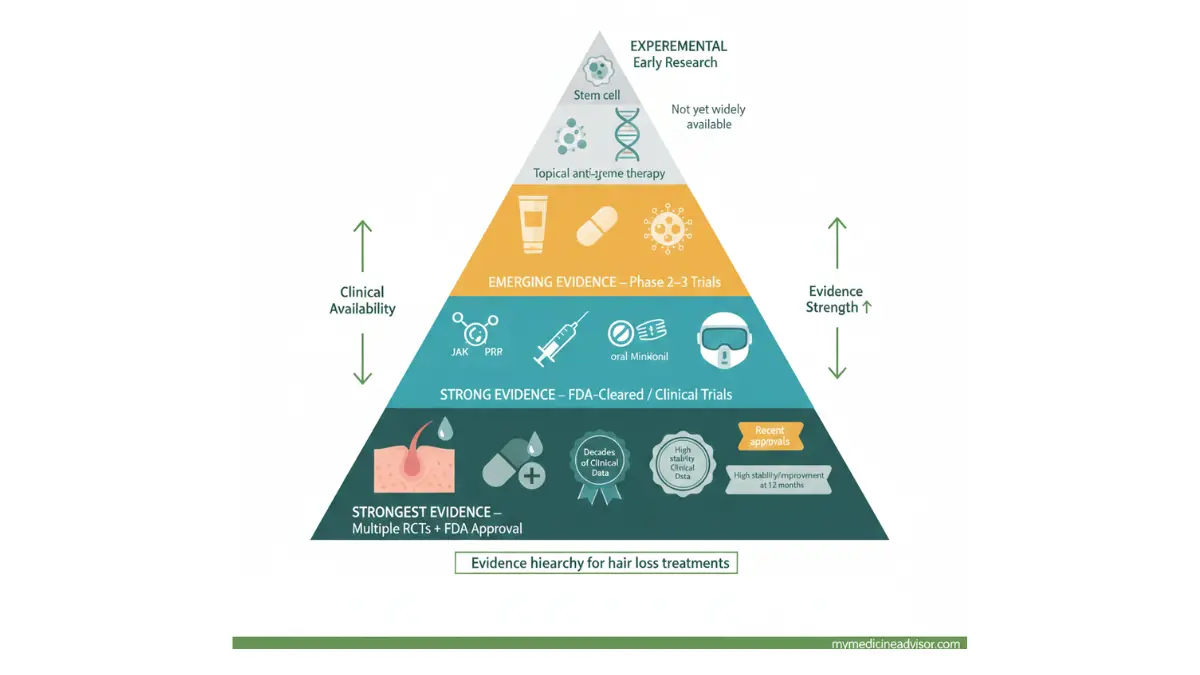
Evidence Strength Pyramid
🏆 TIER 1 — STRONGEST EVIDENCE
Minoxidil + Finasteride Combination
(Multiple RCTs, decades of data, FDA-approved)

🥈 TIER 2 — STRONG EVIDENCE
JAK Inhibitors (for Alopecia Areata)
PRP Therapy | LLLT Devices
(Clinical trials, FDA-approved/cleared)

🥉 TIER 3 — EMERGING EVIDENCE
Clascoterone | Oral Minoxidil (VDPHL01)
Stem Cell Therapy | Exosome Treatments
(Phase 2–3 trials ongoing)
Key Citations
- NCBI/StatPearls — Finasteride Clinical Evidence (peer-reviewed, NIH)
- FDA — Topical Finasteride Safety Alert (fda.gov)
- Frontiers in Medicine — Combination Therapy Meta-Analysis 2025 (peer-reviewed RCT meta-analysis)
Frequently Asked Questions about Hair Loss
Q1. Can hair loss really be reversed?
Yes — in most cases, hair loss is reversible when treated early. Androgenetic alopecia, telogen effluvium, and nutritional deficiency-related loss all respond well to appropriate treatment, particularly when follicles are still active.
Q2. What is the fastest treatment for hair loss?
Minoxidil produces the fastest visible results — some users report reduced shedding within 4–8 weeks. However, meaningful regrowth typically requires 4–6 months of consistent daily use.
Q3. Does minoxidil work for women?
Yes. Minoxidil 2% is FDA-approved for women and is the most evidence-backed first-line option for female pattern hair loss. Search interest in minoxidil was over six times higher in 2025 than in 2016, reflecting growing awareness among women.
Q4. What is DHT and how does it cause hair loss?
DHT (dihydrotestosterone) is a hormone that binds to receptors in genetically sensitive follicles and progressively shrinks them. Over time, this produces shorter, thinner strands until the follicle stops producing hair entirely. DHT blockers like finasteride interrupt this process.
Q5. How long does hair loss treatment take to work?
Expect 4–6 months for minoxidil and 6–12 months for finasteride before visible improvements. Most dermatologists recommend assessing results at the 12-month mark before modifying the protocol.
Q6. Is finasteride safe for long-term use?
For most men, yes. In clinical practice, approximately 65–70% of men experience stabilization or improvement on long-term finasteride with acceptable tolerability. However, discuss psychiatric history with your doctor given the 2025 EMA warning on suicidal ideation risk.
Q7. What vitamins help with hair loss?
The most evidence-backed nutrients for hair health are: iron (ferritin), Vitamin D, Vitamin B12, zinc, and biotin. Deficiency in any of these can trigger or worsen shedding. Blood testing is the only way to confirm which you need.
Q8. Can stress cause permanent hair loss?
Stress typically causes telogen effluvium — a temporary, reversible shedding condition. It becomes a concern for permanence only if prolonged stress is combined with nutritional deficiency or undiagnosed androgenetic alopecia.
Q9. What is the difference between minoxidil and finasteride?
Minoxidil stimulates blood flow to follicles and extends the growth phase — it works on the scalp directly and is available OTC. Finasteride blocks DHT production systemically — it is an oral prescription medication for men only. Many dermatologists now recommend using both together for synergistic results.
Q10. When should I see a doctor for hair loss?
See a dermatologist if: hair loss is sudden and severe, you notice scalp inflammation or pain, you have patches rather than diffuse thinning, or you’ve had no response after 12 months on OTC treatments.
Q11. Are there new hair loss treatments approved in 2026?
Yes. Three JAK inhibitors received FDA approval for alopecia areata between 2022 and 2024. Clascoterone — a topical anti-androgen — is expected to submit for approval in spring 2026, representing the first new mechanism for androgenetic alopecia in over 30 years. Full details in our 2026 Hair Loss Treatment Update.
Reviewed by the Medical Editorial Board at mymedicineadvisor.com | February 2026 Explore more expert health guidance at our Health Tips Hub
About this content
How this article was put together: researched from recognised health sources, drafted with the help of AI tools, and edited by hand, with sources linked throughout.

Sameer Patel is the founder and editor of My Medicine Advisor. He is not a doctor or medical professional — before starting this site he worked in banking,…
Medical disclaimer
The content on MyMedicineAdvisor is provided for general informational and educational purposes only and is not a substitute for professional medical advice, diagnosis, or treatment. Health information on this website should not be used to diagnose, treat, cure, or prevent any condition without guidance from a qualified healthcare professional. Always seek the advice of your doctor, physician, or another licensed healthcare provider with any questions you may have regarding a medical condition, symptoms, medications, or treatment decisions.