
On This Page – Quick Medical Summary
Which number are you holding right now?
Most people arrive at this page holding one number, or two that do not seem to agree with each other. Neither number is lying to you. They are measurements of different things, taken over different windows, and the 2026 guidelines use both.
You have both numbers
You have a lab A1C test result and a sensor report showing a time in range percentage, and they tell different stories. Start at the section on what each one measures, then go to the section on what happens when they disagree.
You have only an A1C
You have never worn a sensor and want to know whether you are missing something. The section on what an average hides is written for you.
You have only a sensor report
You bought an over-the-counter continuous glucose monitor, you have percentages on a phone app, and you have never had a lab A1C. Read what those percentages mean, then read what a sensor cannot decide.
You are reading someone else’s report
You are a parent looking at a child’s sensor app, or an adult child looking at an older parent’s numbers. The goals in this article are not one-size-fits-all, and for older adults they are often set differently on purpose.
✅ Patient Action: Before you compare the two numbers, know this: your A1C and your time in range can both be correct at the same time, because they are not measuring the same thing — and a large or persistent gap between them is worth showing to the clinician who ordered the test or prescribed the sensor. Bring both numbers to the same appointment rather than deciding between them yourself.
ℹ️ Medical Disclaimer: This page is general education about two ways of assessing glycemic status. It is not a diagnosis, not an interpretation of your own results, and not instruction to start, stop or change any medication, insulin dose, or monitoring device. Glucose goals are individualized, and setting or changing yours — including any decision about diagnosis, treatment, devices, or what your insurance will cover — belongs to you and a board-certified physician, most often your primary care clinician or an endocrinologist.
What each number actually measures
The two numbers come from two different substances, sampled on two different clocks. That single fact explains almost every disagreement between them.
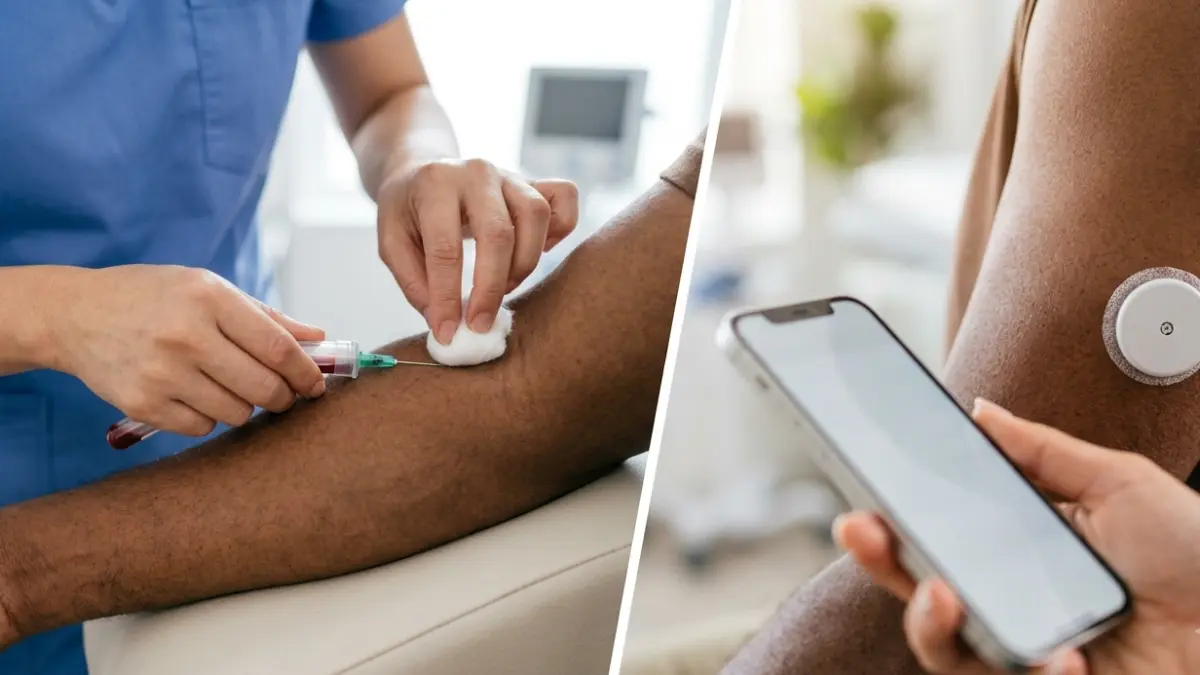
What the A1C test looks at
The A1C test measures glycated hemoglobin — glucose that has attached to the hemoglobin inside your red blood cells — and reflects your average glucose over roughly the previous three months. It is one number from one blood sample, drawn at one moment. It has its own measurement margin, which is a separate topic covered in how much a single A1C result can move.
What a CGM counts instead
A continuous glucose monitor works differently. According to the National Institute of Diabetes and Digestive and Kidney Diseases, whose continuous glucose monitoring page was last reviewed in June 2023, a CGM uses a tiny sensor reading taken from a filament inserted under the skin, and those sensors estimate glucose in the fluid between your cells — a level that is very similar to, but not identical with, the glucose in your blood. NIDDK also notes that for safety you may sometimes need to compare a CGM reading against a finger-stick test with a standard meter.
Time in range is the share of those readings that fell inside a target range of 70 to 180 mg/dL. In a 2020 interview published by NIDDK, Richard M. Bergenstal, MD, describes that interval as the target blood glucose range the international metrics were built around. If your report shows 68% time in range, 68% of your sensor’s readings over the reporting period sat between those two values.
You can convert those numbers to mmol/L if your report uses different units. If you are instead trying to work out what a normal glucose reading looks like outside a diabetes context, that is a different question with a different answer.
Two different fluids, two different clocks
One number is a three-month chemical record from blood. The other is a percentage of thousands of estimates from interstitial fluid, usually over 14 days. Neither is a version of the other.
🔬 How It Works — two fluids, and two meanings of one word: Hemoglobin circulates in your blood for months and carries a chemical record with it, which is why one blood sample can report a three-month average; a sensor filament sits in the fluid between your cells and can only report what is passing it right now, which is why it needs thousands of readings to describe the same fortnight. That difference in method is also a difference in vocabulary: time in range means a target glucose interval of 70 to 180 mg/dL, while the A1C’s margin means how much a single lab result can move on a repeat test. If you came here from our A1C pillar, that page is about the margin and this page is about the interval.
Why two people with the same A1C can have different days
An average tells you the total. It cannot tell you what it averaged. Two people can walk out of the same lab with the same A1C and have spent their fortnight in completely different places.

What an average hides
The A1C test is an average measure of blood glucose level, and in the NIDDK-published interview, Dr. Bergenstal states plainly that it does not pick up hypoglycemia or glycemic variability. A person whose glucose stays fairly steady and a person who swings between lows and highs can produce the same average. This is precisely why the 2026 Standards of Care assess glycemic status using A1C measurement, blood glucose monitoring and CGM metrics together, rather than treating any one of them as the whole picture.
The lows an A1C cannot see
A lab A1C is a single draw. A sensor records around the clock, including overnight, when a low is least likely to be noticed and least likely to be reported. Time below range is the metric that makes those episodes visible, and the 2026 Standards recognize time below range and time above range as useful parameters for reevaluating a treatment plan.
Why the same result can feel different
If your A1C looks acceptable but your days feel unpredictable, that experience is not a contradiction of the number. It is the part of your glucose pattern the number was never designed to carry.
📊 The two questions, side by side: An A1C answers how much glucose has my body seen overall? Time in range answers how much of my day did I spend where I want to be? Both are real questions, and neither answer substitutes for the other — for the interpretive bands that go with an A1C figure, see what the A1C bands mean.
✅ Patient Action: At your next visit, ask your primary care clinician or endocrinologist one specific question: “Does my A1C hide any low readings I should know about?” That question, rather than a request for a lower number, is what opens the conversation about variability.
What the 2026 standards say about both numbers
A goal time in range of more than 70% is appropriate for many nonpregnant adults using a CGM, and an A1C goal of under 7% is appropriate for many nonpregnant adults without severe hypoglycemia. Both figures come from the same place — the American Diabetes Association Standards of Care in Diabetes—2026, Section 6 — and both carry that scope clause for a reason.
The A1C goal and the time-in-range goal
The 2026 Standards state these as paired recommendations, not as competing ones. Recommendation 6.3a gives the A1C goal of under 7% for many nonpregnant adults without severe hypoglycemia or hypoglycemia affecting health or quality of life. Recommendation 6.3b gives the time-in-range goal of over 70% for many nonpregnant adults using CGM.
Recommendation 6.3c adds the low-glucose goals: under 4% of time below 70 mg/dL — or under 1% for older adults — and under 1% of time below 54 mg/dL. You can read the Section 6 record for the 2026 Standards at PubMed.
The three other numbers on the report
Your sensor report almost certainly shows more than one percentage, and this is where the sourcing has to be precise, because most pages blur it. The two high-glucose targets — under 25% of time above 180 mg/dL and under 5% of time above 250 mg/dL — are not ADA 2026 recommendations. They come from the 2019 international consensus on time in range, the expert group that built the metrics, as described by Dr. Bergenstal in his July 2020 NIDDK interview.
Goals that are set lower on purpose
For older adults with significant cognitive or functional limitations, frailty or severe comorbidities, the 2026 Standards Section 13 gives deliberately less stringent goals: an A1C under 8.0% and/or time in range of at least 50%, with time below 70 mg/dL kept under 1%. A lower time-in-range goal in that situation is not a lower standard of care. It is a goal reweighted toward avoiding hypoglycemia, which for that reader carries more risk than a slightly higher average.
Whether your monitoring is covered is a separate question — see what your plan covers.
📊 Paired glycemic goals, and what each one does not tell you
What it measures The goal Who this goal is for What it does not tell you A1C — average glucose over ~3 months Under 7% Many nonpregnant adults without severe hypoglycemia (ADA 2026, Rec 6.3a) Whether you had lows, or how much your glucose moved Time in range — % of readings 70–180 mg/dL Over 70% Many nonpregnant adults using CGM (ADA 2026, Rec 6.3b) Anything about the two weeks the sensor was not worn Time below 70 mg/dL Under 4% Adults using CGM; under 1% for older adults (ADA 2026, Rec 6.3c) How severe any single low was Time below 54 mg/dL Under 1% Adults using CGM (ADA 2026, Rec 6.3c) Whether you felt the low or slept through it Time above 180 mg/dL Under 25% Most people with type 1 or type 2 diabetes (2019 international consensus) How long any single high lasted Time above 250 mg/dL Under 5% Most people with type 1 or type 2 diabetes (2019 international consensus) What caused it Older-adult variant A1C under 8.0% and/or time in range at or above 50% Older adults with significant limitations, frailty or severe comorbidities (ADA 2026, Section 13) Nothing about younger adults or pregnancy Sources: American Diabetes Association, Standards of Care in Diabetes—2026, Sections 6 and 13; international consensus on time in range, 2019, as described in an NIDDK-published interview, July 2020.
⚠️ Clinical Warning: These are goals, not thresholds — being under one is not a diagnosis, and clearing one is not a pass. Both are set with a clinician, and for a substantial number of people they are deliberately set differently. Ask yours: “Is the standard time-in-range goal the right one for me, or should mine be set differently?”
When your A1C and your CGM report disagree
A mismatch between a sensor report and a lab A1C is expected often enough that the expert who helped design the metrics addressed it directly. It is not evidence that one of them malfunctioned.

Why the two can disagree
Your report may show a glucose management indicator, or GMI — a figure that estimates what your A1C would be if your glucose stayed at the same general level for the next 30 days. In his NIDDK interview, Dr. Bergenstal notes that a GMI is meaningful when there are about 14 days of data with the sensor active at least 70% of the time, and says plainly that in some cases a person’s GMI and A1C might not agree. The 2026 Standards similarly describe a 10- to 14-day CGM assessment with 70% or higher sensor wear time as the basis for reading these metrics.
Three ordinary things drive most of the gap. The two numbers cover different windows, and they measure different substances. An A1C can also be shifted by conditions affecting red blood cell turnover, which have nothing to do with your glucose at all.
Which one gets acted on
⚠️ Clinical Warning — read this as one statement, not two halves: In the NIDDK-published interview, Dr. Bergenstal writes that “in many cases the GMI, in my opinion, is probably more clinically relevant for making management decisions for an individual, while the A1C is a standard population-based risk marker for diabetes complications.” That is one sentence with two directions, and it is his stated opinion rather than NIDDK policy. Read either half alone and you will reach the wrong conclusion about the other number.
A glucose meter and a lab A1C can also disagree with each other for related reasons, covered in why a finger-stick meter and a lab A1C can disagree.
What to bring to the appointment
Bring the ambulatory glucose profile — the one-page summary your sensor app generates — alongside the lab result, and bring both to the same visit.
✅ Patient Action: Ask the clinician who ordered the A1C or prescribed the sensor: “My sensor report and my A1C don’t match — which one are you using to make decisions, and why?” The answer tells you more than either number does.
When time in range is used instead of A1C
There are named situations in which a clinician stops relying on the A1C and uses glucose data instead. Being in one of them does not mean your past A1C results were meaningless.
Conditions that make an A1C unreliable
The 2026 Standards Section 13 notes that A1C results may be inaccurate after a blood transfusion and in conditions affecting red blood cell turnover, including kidney failure, recent significant blood loss and erythropoietin therapy. In his NIDDK interview, Dr. Bergenstal adds iron deficiency and significant kidney or liver disease, and notes that the A1C value can vary considerably with an individual’s red blood cell lifespan. Because these all concern red cells, red blood cell conditions and low hemoglobin are worth understanding alongside your glucose results.
This is not a list to score yourself against. It is a list of reasons a clinician might raise the question first.
What replaces it
In those situations, the 2026 Standards direct that blood glucose monitoring and/or CGM be used for glycemic goal setting instead. The 2026 edition also added a second, unrelated place where sensor data can stand in: for elective surgery, a 14-day GMI under 8% or time in range above 50% is offered as an alternative to an A1C under 8% in the three months beforehand.
Why this is not a downgrade of the A1C
Nothing here says the A1C test is a bad test. It says that certain conditions change what the test is measuring, and that when they are present, a different instrument gets chosen for a named reason. The glucose-lowering medication decisions built on that data are unchanged in kind; only the measurement feeding them is different.
🩺 Physician Note: Current guidance frames this as instrument selection, not as a verdict on the A1C. A common point of confusion is reading “your A1C isn’t reliable for you” as “your A1C was always wrong” — those are different statements, and only a clinician who knows your full history can tell you which situation applies. Ask the clinician managing the underlying condition: “Given my kidney or blood condition, is my A1C reliable for me, or should we be using sensor data instead?”
What this page cannot decide for you
Two boundaries sit at the edge of this topic, and most pages on this query leave both of them open.
What a sensor report cannot diagnose
Diabetes is diagnosed with an A1C, a fasting glucose or an oral glucose tolerance test — not with sensor data. A continuous glucose monitor report, however good the percentages look, does not diagnose or rule out diabetes, and the manufacturers’ own indication statements say the same thing. If you are looking at a diagnostic-range result, what a diagnostic A1C result starts and a result in the 5.7 to 6.4 band cover what happens next, and whether a routine panel can find diabetes covers the test you may already have had.
Who should not use an over-the-counter sensor
On June 12, 2026, the FDA cleared the first over-the-counter CGM for children, extending an FDA clearance that had covered adults 18 and over since March 2024 down to people two years of age and older who do not use insulin. In the same announcement, the FDA states that the system is not for people with problematic hypoglycemia, because it is not designed to alert users when that potentially dangerous condition occurs; that it is not for people on dialysis; and that people with a history of disordered eating or eating disorders should talk with their health care provider before using it. The FDA also states that users and their caregivers should consult their health care provider before making any medication adjustments based on the device’s output, and that for children the device should be used under adult supervision.
Three questions worth asking
Ask your primary care clinician: Should I be using a sensor at all? If I use one, which numbers on the report do you want to see? What would make you change which test you rely on?
⚠️ What we are declining to do: This page recommends no sensor, meter, test kit or monitoring product, and links to none. Our own cited sources are the reason: the FDA’s clearance excludes several groups by name and requires a clinician before any medication change, and a sensor report cannot diagnose anything. A page that sold you a device while telling you that would be arguing against itself.
Common questions about A1C vs time in range
1. What is the difference between A1C and time in range?
An A1C measures glycated hemoglobin and reflects average glucose over roughly three months from a single blood sample. Time in range is the percentage of continuous glucose monitor readings that fell between 70 and 180 mg/dL over the reporting period, usually about two weeks. Different substances, different windows — which is why comparing A1C vs time in range is not comparing two versions of one measurement.
2. What is a good time in range percentage?
The 2026 ADA Standards of Care give a goal of more than 70% time in range for many nonpregnant adults using a CGM, alongside an A1C goal of under 7%. The scope clause matters as much as the figure. For older adults with significant limitations or frailty, Section 13 gives a deliberately different goal of at least 50%.
3. Is time in range more accurate than A1C?
Neither is more accurate, because accuracy assumes they measure the same thing. In the A1C vs time in range comparison, an A1C reports an overall average and time in range reports how your days were distributed. The 2026 Standards assess glycemic status using A1C, blood glucose monitoring and CGM metrics together rather than ranking one above the others.
4. Why is my time in range good but my A1C high?
There are three ordinary reasons: the two numbers cover different windows, they measure different substances, and an A1C can be shifted by conditions affecting red blood cell turnover that have nothing to do with your glucose at all. A gap between them is common enough that the expert who helped design these metrics addressed it directly. Bring both numbers to your clinician rather than deciding between them yourself.
5. What does 70 to 180 mg/dL mean?
It is the target blood glucose interval that time in range counts against. Every sensor reading between 70 and 180 mg/dL counts as in range; readings below 70 count as time below range, and readings above 180 count as time above range. A report showing 68% time in range means 68% of that period’s readings sat inside those two values.
6. Can a CGM diagnose diabetes?
No. Diabetes is diagnosed with an A1C, a fasting glucose or an oral glucose tolerance test, and sensor data is not a diagnostic test — the manufacturers’ own indication statements say so. A sensor can show you patterns worth investigating. If your readings concern you, ask your primary care clinician which diagnostic test is appropriate for you.
7. Do I still need an A1C test if I wear a CGM?
That is your clinician’s decision, and the 2026 Standards use both measures rather than replacing one with the other. In his NIDDK interview, Dr. Bergenstal describes the A1C as the standard population-based risk marker for diabetes complications while considering the sensor-derived figure often more relevant for day-to-day management. Ask your clinician which one they are using to make decisions about your care.
8. What is GMI on my sensor report?
The glucose management indicator estimates what your A1C would be if your glucose stayed at the same general level for the next 30 days. It is meaningful when you have roughly 14 days of data with the sensor active at least 70% of the time. A GMI and a laboratory A1C do not always agree, and a mismatch between them is not evidence that either device malfunctioned.
9. Is a lower time-in-range goal ever correct?
Yes, and deliberately so. For older adults with significant cognitive or functional limitations, frailty or severe comorbidities, the 2026 Standards Section 13 gives a goal of time in range at or above 50% with an A1C under 8.0% — a goal reweighted toward avoiding hypoglycemia rather than toward lowering an average. Ask the clinician who set your goal which reasoning applies to you.
10. When is time in range used instead of A1C?
When something makes the A1C unreliable for that person. The 2026 Standards name blood transfusion and conditions affecting red blood cell turnover, including kidney failure, significant blood loss and erythropoietin therapy, and direct that blood glucose monitoring and/or CGM be used for goal setting instead. Ask the clinician managing that condition whether it applies to you.
11. Can children use an over-the-counter glucose sensor?
Since June 12, 2026, the FDA has cleared an over-the-counter CGM for people two years of age and older who do not use insulin, extending a clearance that covered adults 18 and over from March 2024. The FDA states it is not for people with problematic hypoglycemia or on dialysis, and that for children it should be used under adult supervision.

Taking both numbers to your next appointment
You do not have to decide which number to believe. That was never the choice in front of you.
An A1C tells you how much glucose your body has seen overall. Time in range tells you how much of your day you spent where you wanted to be. The 2026 Standards use both, set goals for both, and give different goals to different people on purpose — which is why a figure you read on a page is a starting point for a conversation rather than a verdict on your health.
So bring both. Bring the lab result and the one-page sensor summary to the same appointment, and ask which one your clinician is using to make decisions and why. If you want to understand the lab number itself more deeply first, what a single A1C result can and cannot tell you is the place to start.
About this content
How this article was put together: researched from recognised health sources, drafted with the help of AI tools, and edited by hand, with sources linked throughout.

Sameer Patel is the founder and editor of My Medicine Advisor. He is not a doctor or medical professional — before starting this site he worked in banking,…
Medical disclaimer
The content on MyMedicineAdvisor is provided for general informational and educational purposes only and is not a substitute for professional medical advice, diagnosis, or treatment. Health information on this website should not be used to diagnose, treat, cure, or prevent any condition without guidance from a qualified healthcare professional. Always seek the advice of your doctor, physician, or another licensed healthcare provider with any questions you may have regarding a medical condition, symptoms, medications, or treatment decisions.