
On This Page – Quick Medical Summary
Can your liver be scarred when your ALT is normal?
Yes. You can have liver scarring with a normal ALT result, especially if you have diabetes or carry extra weight. ALT flags liver cells being injured right now; it does not measure scar tissue that has built up over years.
The most common cause is fatty liver disease, now called MASLD. The American Liver Foundation estimates it affects about 100 million people in the US, roughly 25% of the population. If you want the basics first, see what your ALT number actually measures or the MedlinePlus guide to the ALT test.
If you already have a FIB-4 result
Skip ahead to the score ranges to see what 1.3, 2.0 and 2.67 mean.
If you have diabetes or excess weight
Start with who should ask for a FIB-4, then read what happens if your score is high.
ℹ️ Medical Disclaimer: This article explains liver test results for general education. It does not diagnose liver disease, interpret your personal results, or recommend any test, treatment, medication or procedure. Affiliate links, where present, are disclosed beside them. Before acting on anything here, speak with your primary care physician or a board-certified hepatologist or gastroenterologist.
Why ALT can look normal while scarring builds
ALT measures active injury, not damage that has already accumulated.
What ALT measures, and what it doesn’t
🔬 How It Works: Damaged liver cells release ALT into your blood, so a high level signals injury happening now. Scar tissue, called fibrosis, is what remains after injury, and it doesn’t leak ALT. A liver can be quietly scarring while today’s ALT sits in range.

Fatty liver disease is usually silent, with few or no symptoms, according to the NIDDK overview of fatty liver disease.
📊 Clinical Data Point: In a biopsy study of 458 patients, steatohepatitis (fat plus inflammation and cell damage) was found in 59% of those with normal ALT versus 74% with raised ALT. The authors concluded normal ALT is not a valid reason to skip further assessment. Source: Fracanzani et al., Hepatology, September 2008.
That 2008 liver biopsy study in Hepatology studied Italian patients referred for biopsy, so it reflects a higher-risk group than the general public.
What counts as a “normal” ALT
Lab ranges differ. MedlinePlus lists 4 to 36 U/L. The American College of Gastroenterology instead puts a truly healthy ALT at 29–33 IU/L for men and 19–25 IU/L for women. Our guide to the healthy ALT range explains why.
What is the FIB-4 score and how is it calculated?
The FIB-4 score estimates your chance of advanced liver scarring from four routine values:
FIB-4 = (Age × AST) ÷ (Platelet count × √ALT)
Age is in years, AST and ALT in U/L, and platelets in 10⁹/L. The formula was developed by Sterling and colleagues in 2006.
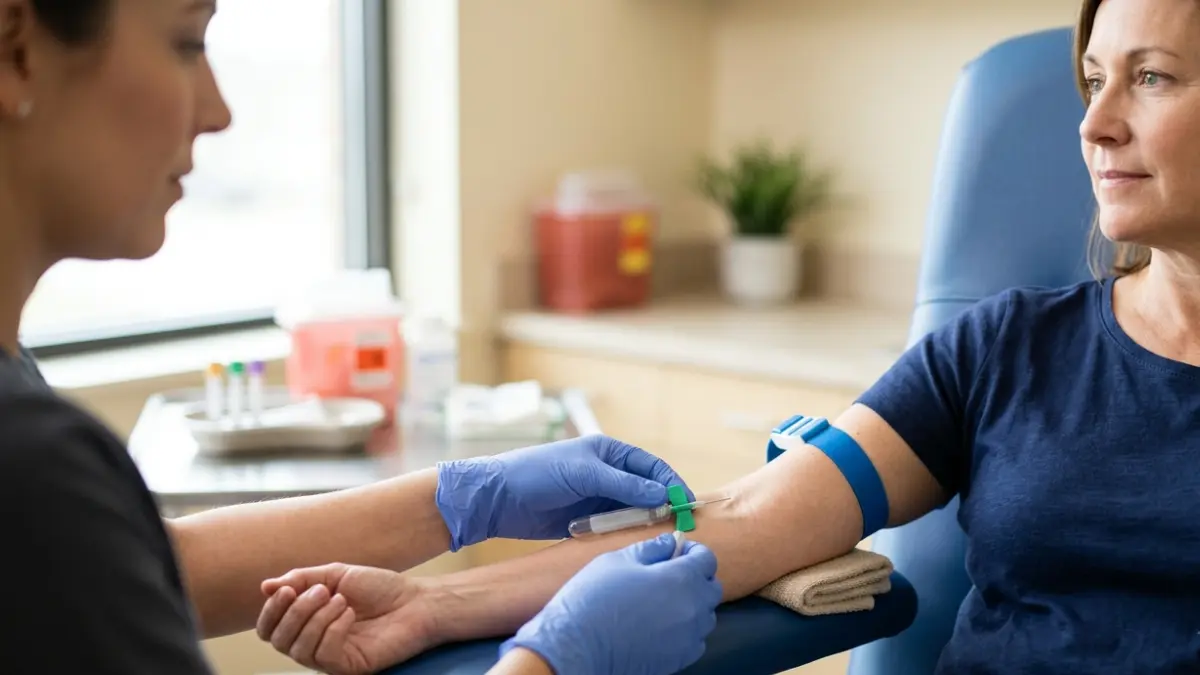
The four numbers FIB-4 uses
Your age, AST, ALT and platelet count are often already on recent lab work. AASLD describes FIB-4 as the most well-validated of the simple blood-based scores. AST’s role is covered in our AST-to-ALT ratio guide, and platelets in what causes a low platelet count.
Why a lower ALT can raise your score
🔬 How It Works: ALT sits under a square root in the bottom half of the formula. A smaller ALT shrinks the bottom half, which pushes the score up. Higher AST, older age and a lower platelet count raise it further.
FIB-4 score ranges: what 1.3, 2.0 and 2.67 mean
The 2023 AASLD practice guidance sorts FIB-4 into three risk bands for advanced fibrosis.
Low, indeterminate and high risk
| FIB-4 score | Risk band | Key Clinical Detail |
|---|---|---|
| Below 1.3 | Low | Can usually be followed in primary care |
| 1.3–2.67 | Intermediate | A second test, such as a liver stiffness scan or ELF blood test, is typically used |
| Above 2.67 | High | Higher likelihood of advanced fibrosis; hepatology referral is typically considered |
Source: 2023 AASLD practice guidance on fatty liver disease, Hepatology, May 2023.
A low score is good at ruling out advanced scarring. It estimates risk; it doesn’t diagnose.
The different cutoff if you’re over 65
Because age is part of the formula, AASLD uses a cutoff above 2.0, rather than 1.3, for people over 65.
✅ Patient Action: Ask your primary care physician: “What is my FIB-4, and is it below the cutoff for my age?”
Who should ask for a FIB-4 even with a normal ALT
AASLD guidance names specific groups to check for advanced fibrosis, whatever their ALT.
Guideline risk groups
- People with type 2 diabetes
- People with obesity plus metabolic complications (you can check your BMI as a starting point)
- People with fatty liver who also drink alcohol moderately
- Parents, siblings or children of someone with cirrhosis caused by fatty liver disease
Normal enzymes don’t rule this out. In one study of 103 people with type 2 diabetes and normal aminotransferases, half had fatty liver on MR spectroscopy.
How often to recheck
With prediabetes, type 2 diabetes, or two or more metabolic risk factors, the guidance suggests considering a repeat FIB-4 every 1–2 years.
✅ Patient Action: Ask your primary care physician or endocrinologist: “With my diabetes, should my next labs include a FIB-4?”
Your FIB-4 is above 1.3: what usually comes next
A score above 1.3, or above 2.0 if you’re over 65, usually leads to a more precise second test, not a diagnosis.
Liver stiffness scans and what kPa means
The most common is vibration-controlled transient elastography (VCTE, often called FibroScan). A probe sends a mild vibration through the liver in a test lasting about 5–7 minutes, and stiffness is reported in kilopascals (kPa). AASLD treats 8–12 kPa as intermediate risk and above 12 kPa as high risk; an ELF blood test is an alternative.
When MRI or biopsy comes up
If results are indeterminate or cirrhosis is suspected, an MRI-based test or liver biopsy may be considered.
✅ Patient Action: Ask your hepatologist or gastroenterologist: “Does my liver stiffness result change my FIB-4 risk category?”
When a FIB-4 score can mislead you
FIB-4 is a screening estimate with known blind spots.
Under 35 or over 65
Accuracy is low under 35, so a different assessment may be used if you’re younger with metabolic risk or raised liver tests. FIB-4 shouldn’t be used during acute illness. Fibrosis prediction scores are also not recommended for children.
Why a low score isn’t a guarantee
🩺 Editor’s Note: Current guidance treats FIB-4 as a first step, not a final answer. AASLD notes it can miss some people who truly have advanced fibrosis, and accuracy improves when it’s paired with a liver stiffness scan.
Normal ALT and FIB-4: quick answers
1. Can your liver be damaged if ALT is normal?
Yes. Normal ALT suggests little active injury today, but it cannot rule out liver damage from scarring, especially with diabetes.
2. What is a good FIB-4 score?
Below 1.3 is low risk at ages 36–65, or below 2.0 over 65. Confirm your result’s meaning with your doctor.
3. Is FIB-4 accurate?
It’s well validated for ruling out advanced fibrosis, but can miss cases, is less accurate under 35, and isn’t for acute illness.
4. Can fatty liver cause normal liver enzymes?
Yes. In one study, half of people with type 2 diabetes and normal liver enzymes had fatty liver on MR spectroscopy.
5. What does a FIB-4 over 2.67 mean?
It places you in the high-risk band for advanced liver fibrosis. Ask your doctor whether a hepatology referral fits your situation.
6. What happens if FIB-4 is high?
A second test usually follows, such as a liver stiffness scan or ELF blood test. Review next steps with a hepatologist.
7. What is a normal FibroScan kPa?
AASLD treats 8–12 kPa as intermediate risk and above 12 kPa as high. Your hepatologist interprets it alongside FIB-4.
8. Who should get a FIB-4 test?
People with type 2 diabetes, obesity with metabolic complications, fatty liver plus moderate drinking, or a close relative with fatty-liver cirrhosis.
9. Why is FIB-4 different over 65?
Age is part of the formula, so older adults score higher. AASLD uses a 2.0 cutoff over 65 instead.
10. How often should FIB-4 be repeated?
With prediabetes, type 2 diabetes or two or more metabolic risk factors, guidance suggests considering a repeat every 1–2 years.
11. What is a normal ALT for men and women?
The American College of Gastroenterology puts a healthy ALT at 29–33 IU/L for men and 19–25 IU/L for women.
Your next step
A normal ALT is good news about today’s liver injury. It isn’t a clean bill of liver health if you have diabetes, excess weight, or a family history of fatty-liver cirrhosis. The simplest next step often costs nothing extra: ask whether your recent labs can produce a FIB-4 score, and what that score means at your age.
About this content
How this article was put together: researched from recognised health sources, drafted with the help of AI tools, and edited by hand, with sources linked throughout.

Sameer Patel is the founder and editor of My Medicine Advisor. He is not a doctor or medical professional — before starting this site he worked in banking,…
Medical disclaimer
The content on MyMedicineAdvisor is provided for general informational and educational purposes only and is not a substitute for professional medical advice, diagnosis, or treatment. Health information on this website should not be used to diagnose, treat, cure, or prevent any condition without guidance from a qualified healthcare professional. Always seek the advice of your doctor, physician, or another licensed healthcare provider with any questions you may have regarding a medical condition, symptoms, medications, or treatment decisions.