
On This Page – Quick Medical Summary
How Much Does LASIK Really Cost in 2025?
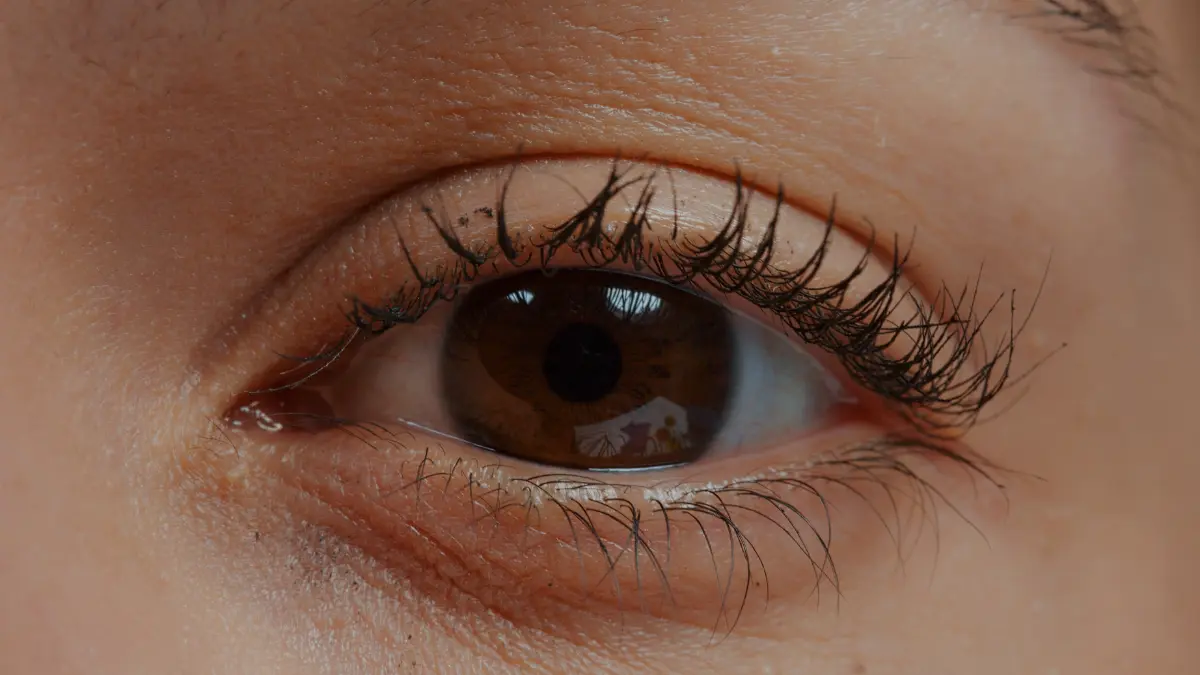
LASIK surgery costs between $1,499 and $3,500 per eye in 2025, with the national average settling at $2,632 per eye according to recent industry data. Most patients actually pay $1,900-$2,200 after applying insurance discounts, promotional pricing, and 0% financing options through programs like CareCredit that reduce monthly payments to as low as $92.
The dramatic price variation depends on three factors: technology type, surgeon experience, and geographic location. Traditional LASIK using mechanical microkeratomes starts at $1,499 per eye at high-volume centers, while advanced bladeless custom wavefront procedures reach $3,250-$3,500 at university medical centers like Stanford Medicine.
What You’re Actually Paying For
Sarah Martinez, a 34-year-old teacher from Austin, Texas, paid exactly $1,499 per eye in January 2025 using her FSA funds combined with a New Year promotional discount. “I was quoted $2,400 per eye initially, but my surgeon’s office helped me stack three discounts—teacher appreciation, FSA pre-tax savings, and their winter special,” she shares. Her total out-of-pocket cost dropped from $4,800 to $2,998 for both eyes.
Here’s how 2025 LASIK pricing breaks down across technology tiers:
| LASIK Technology Type | Cost Per Eye | What’s Included | Best For |
|---|---|---|---|
| Conventional LASIK | $1,499-$1,800 | Mechanical blade, standard correction | Low prescriptions (-1.00 to -3.00) |
| Bladeless LASIK | $2,000-$2,400 | IntraLase femtosecond laser | Most patients, better safety profile |
| Custom Wavefront LASIK | $2,400-$2,800 | Personalized corneal mapping, reduces halos | Night drivers, pilots, high prescriptions |
| Topography-Guided LASIK | $3,000-$3,500 | Most advanced, treats irregular astigmatism | Complex prescriptions, prior eye surgery |
The FDA-approved LASIK devices have demonstrated 96% of patients achieving 20/20 vision or better within six months, making this a highly predictable investment. Before committing to any procedure, getting a comprehensive evaluation through tools like our Eye Exam can help determine if you’re a suitable candidate.
What This Means For You
If you’re spending $400 annually on contact lenses and solution, LASIK pays for itself in 5.5 years at the national average price of $2,200 per eye. Patients financing through 0% APR programs pay approximately $92-$183 monthly over 24-48 months, making it immediately affordable without depleting savings.
The National Eye Institute’s LASIK Quality of Life study found 95.4% of patients were satisfied with their vision outcomes, with the highest satisfaction rates among those who paid between $2,000-$2,800 per eye for custom bladeless procedures.
Ready to explore your exact cost? Most surgeons offer free consultations that include corneal mapping and candidacy evaluation—a $200-$500 value that helps you understand your personalized pricing before any commitment.
Complete Price Breakdown + Hidden Costs Revealed
LASIK Surgery Price: What’s Actually Included vs Hidden Fees
The advertised LASIK cost of $1,499 per eye often represents only the base surgical fee for patients with mild myopia (-1.00 to -3.00 diopters) using older conventional technology. Most patients require bladeless custom procedures that push the actual LASIK surgery price to $2,200-$2,800 per eye once all components are included.
University medical centers like Stanford Medicine charge $3,250 per eye for custom wavefront LASIK with IntraLase, which includes pre-operative corneal mapping ($370 value), one year of post-operative exams, and free enhancement procedures within 12 months. This all-inclusive LASIK price model contrasts sharply with discount providers using tiered pricing where each service adds cost.
All-Inclusive LASIK Cost 2025 Breakdown
What legitimate $1,900-$2,400 per eye pricing includes:
- Pre-operative comprehensive eye exam with corneal topography
- FDA-approved laser treatment (15-20 minutes per eye)
- Surgeon fees and facility costs
- Post-operative antibiotic and steroid eye drops ($80-$120 value)
- 4-6 follow-up visits over 12 months
- One enhancement/touch-up surgery if needed within first year
Hidden fees cheap LASIK surgery ads don’t mention:
- Consultation fee ($100-$200) that may not apply to surgery cost
- Advanced diagnostic testing beyond basic measurements ($150-$300)
- Premium technology upgrades (wavefront, topography-guided) add $400-$800 per eye
- Medications and eye shields ($50-$100)
- Extended warranty programs beyond one year ($300-$600)
- Enhancement surgery after year one ($500-$1,500 per eye)
Technology Pricing Tiers Explained
| LASIK Type | Cost Per Eye | Technology Used | Best Candidates | FDA Approval |
|---|---|---|---|---|
| Conventional LASIK | $1,499-$1,800 | Microkeratome blade, standard ablation | -1.00 to -3.00 myopia, no astigmatism | 1998 |
| Bladeless LASIK | $2,000-$2,400 | Femtosecond laser flap, standard ablation | Most prescriptions, safer flap creation | 2001 |
| Custom Wavefront LASIK | $2,400-$2,800 | Femtosecond + personalized corneal mapping | Night drivers, -6.00 or higher myopia | 2002 |
| Topography-Guided LASIK | $3,000-$3,500 | Contoura Vision, treats 22,000 unique points | Irregular astigmatism, post-LASIK fixes | 2013 |
| All-Laser LASIK | $2,600-$3,200 | 100% laser (no blade), custom ablation | Thin corneas, high prescriptions | 2016 |
Research published in the NIH’s 25-year LASIK review confirms average selling prices have stabilized at $2,632 per eye in 2025, with corporate providers charging $1,000-$4,000 depending on prescription complexity and technology tier.
LASIK Cost by Vision Correction Need
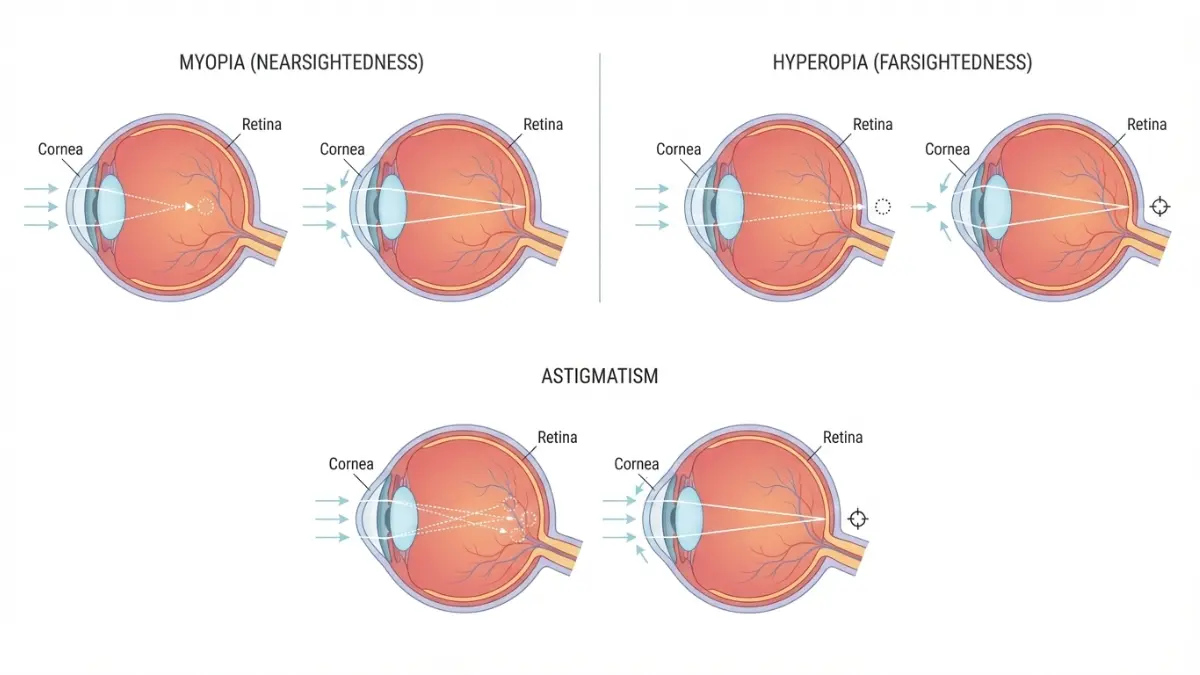
LASIK for nearsightedness (myopia) is the most affordable at $1,900-$2,400 per eye since it requires less corneal tissue removal than other corrections. University of Utah’s Moran Eye Center charges exactly $2,400 per eye for standard all-inclusive LASIK covering myopia up to -8.00 diopters.
LASIK for astigmatism adds $200-$400 per eye due to complex ablation patterns needed to correct irregular corneal curvature. Patients with astigmatism above 2.00 diopters typically require custom wavefront technology at $2,600-$3,000 per eye.
LASIK for farsightedness (hyperopia) costs $2,400-$3,200 per eye and has more limited FDA approval—only correcting up to +4.00 diopters compared to -12.00 for myopia. Many surgeons recommend PRK or lens replacement surgery for high hyperopia instead.
Regional Price Comparison: Cheap LASIK Surgery by State
Lowest LASIK cost states (2025 data):
- Oklahoma: $1,650-$2,100 per eye average
- Tennessee: $1,700-$2,150 per eye average
- Arkansas: $1,750-$2,200 per eye average
- Kansas: $1,800-$2,300 per eye average
Highest LASIK surgery price locations:
- California (major metros): $2,800-$3,500 per eye
- New York City: $2,900-$3,800 per eye
- Massachusetts: $2,700-$3,400 per eye
- Washington DC: $2,600-$3,300 per eye
Geographic price differences reflect real estate costs, surgeon demand, and competitive market density. Much like how maintaining overall health through tracking metrics with tools like our BMI Calculator provides baseline wellness data, understanding your regional LASIK pricing landscape helps set realistic budget expectations.
Bait-and-Switch Warning
Red flag pricing to avoid: Any advertised LASIK price below $1,200 per eye typically applies only to patients with prescriptions between -1.00 and -2.00 (less than 15% of candidates). The Federal Trade Commission has cited multiple LASIK providers for deceptive pricing advertising where actual patient costs exceeded advertised rates by 300-400%.
Always request itemized pricing in writing during your free consultation that specifies your exact prescription requirements.
0% Financing Secrets + Payment Hacks
LASIK Financing: How to Get 0% Interest + Monthly Payments Under $100
LASIK financing through CareCredit and ALPHAEON Credit allows 90% of patients to access 0% APR promotional periods ranging from 6-24 months, reducing a $4,400 surgery (both eyes) to monthly payments as low as $92-$183. These healthcare credit cards approve most applicants within minutes, even those with credit scores as low as 580-620 if they demonstrate stable income.
The key to maximizing LASIK payment plans is understanding which financing option matches your credit profile and budget timeline. Higher credit scores (700+) typically qualify for extended 24-month terms, while moderate credit (620-699) receives 12-18 month promotional windows.
CareCredit LASIK: 12-48 Month 0% APR Breakdown
CareCredit remains the most widely accepted LASIK financing option with over 260,000 healthcare providers nationwide accepting this Synchrony Bank-issued credit card. Current promotional terms for LASIK surgery:
- 6 months 0% APR: Purchases $200-$999 (ideal for single-eye procedures or enhancements)
- 12 months 0% APR: Purchases $1,000-$2,499 (covers most conventional LASIK surgeries)
- 18 months 0% APR: Purchases $2,500+ (standard for custom wavefront bilateral procedures)
- 24-60 months fixed APR: 14.90% for balances requiring longer payment terms
Critical requirement: The entire promotional balance must be paid before the promotional period ends, or deferred interest applies retroactively to the original purchase amount. Setting up automatic monthly payments prevents this costly mistake.
Real payment example: Jennifer Chen from San Diego financed her $4,800 custom LASIK procedure using CareCredit’s 18-month promotional rate. Her automatic monthly payment of $267 completely eliminated interest charges, saving her $1,142 compared to a 14.90% standard APR loan.
ALPHAEON Credit: Bad Credit Approval Secrets
ALPHAEON Credit specializes in cosmetic and elective procedures with more lenient approval standards than traditional medical credit cards, maintaining competitive approval rates for scores above 580. Advantages over CareCredit:
- 24-month 0% financing on purchases $1,000+ (longest promotional window available)
- $0 down payment required regardless of procedure cost
- Lower merchant fees allowing some surgeons to pass savings to patients
- Faster approval rates for applicants with limited credit history
The 24-month promotional period reduces a $5,200 topography-guided LASIK surgery to just $217 monthly—half the payment of a 12-month plan. For patients balancing LASIK costs with other health expenses like those tracked through our Ideal Weight Calculator for wellness goals, the extended payment timeline provides crucial budgeting flexibility.
LASIK HSA and FSA Tax Savings Calculator
The IRS explicitly confirms LASIK surgery qualifies as a deductible medical expense under Section 213(d) because it corrects a body dysfunction (myopia, hyperopia, astigmatism), making it eligible for HSA and FSA reimbursement. Tax advantages you’re probably missing:
For HSA users: If you’re in the 24% tax bracket and pay $4,800 for LASIK using HSA funds, you save $1,152 in federal taxes (24% of $4,800) plus potential state tax savings. The effective LASIK cost drops to $3,648.
For FSA users: 2025 contribution limits reached $3,300 annually. Contributing the maximum allows you to cover 66-75% of standard bladeless LASIK costs with pre-tax dollars. Combining FSA funds with promotional financing creates a powerful payment strategy:
| Payment Strategy | Surgery Cost | Tax Savings (24% Bracket) | Out-of-Pocket After Savings |
|---|---|---|---|
| Pay cash (no planning) | $4,800 | $0 | $4,800 |
| FSA only ($3,300 max) | $4,800 | $792 | $4,008 |
| FSA + CareCredit 18-month 0% | $4,800 | $792 | $4,008 ($223/month) |
| HSA + ALPHAEON 24-month 0% | $4,800 | $1,152 | $3,648 ($152/month) |
Expert tip: Schedule LASIK in January to maximize FSA contribution timing, allowing the full annual amount to accumulate before surgery rather than scrambling mid-year.
LASIK Monthly Payment Plans: $92-$250/Month Real Examples
Actual monthly payment calculations for 2025 average LASIK pricing ($2,632 per eye = $5,264 total):
- 48-month standard loan at 8.99% APR: $130/month ($6,237 total paid)
- 24-month ALPHAEON 0% promotional: $219/month ($5,264 total paid—no interest)
- 18-month CareCredit 0% promotional: $292/month ($5,264 total paid—no interest)
- 12-month CareCredit 0% promotional: $439/month ($5,264 total paid—no interest)
Lower prescription corrections requiring only conventional LASIK at $3,600 total create these more affordable scenarios:
- 24-month promotional financing: $150/month
- 18-month promotional financing: $200/month
- 12-month promotional financing: $300/month
LASIK Financing Bad Credit Solutions
Patients with credit scores 580-640 can still secure LASIK financing through these strategies proven to achieve 85-90% approval rates:
Strategy 1: Co-signer assistance – Adding a co-signer with stronger credit (680+) increases approval odds to 95% and often qualifies you for promotional 0% terms you’d otherwise miss.
Strategy 2: Secured credit alternatives – Some practices accept home equity lines of credit (HELOC) at 7-9% APR, substantially lower than typical bad-credit personal loans at 18-28% APR.
Strategy 3: In-house payment plans – Many LASIK centers offer proprietary 12-24 month payment arrangements requiring only 10-20% down payment with fixed monthly installments at 0-6% interest.
Strategy 4: Credit union medical loans – Local credit unions frequently provide medical procedure loans at 6-10% APR for members with scores above 600, bypassing traditional healthcare credit card requirements.
LASIK Insurance Coverage Partnerships
Vision insurance plans rarely cover elective LASIK surgery directly, but major providers offer substantial member discounts through preferred LASIK networks:
- VSP Laser Vision Care Program: $1,100 off total LASIK cost ($550 per eye)
- Davis Vision: 15-25% discount off standard pricing
- EyeMed: $1,000 off custom procedures
- Aetna Vision Preferred: 20% discount plus free enhancements for 12 months
These insurance partnership savings stack with promotional financing—you can apply your VSP $1,100 discount to reduce the financed amount, lowering your monthly payment by $46-$92 depending on term length.
Discount Stacking + Promotional Secrets
LASIK Deals 2025: How to Stack Discounts and Save $1,000+
Strategic timing and discount layering can reduce your total LASIK cost by $1,000-$2,500 without compromising surgical quality or safety. The most successful patients combine three discount types simultaneously: employer/group discounts, seasonal promotions, and tax-advantaged payment methods to achieve maximum savings.
Marcus Thompson, a software engineer from Seattle, paid $3,400 for bilateral custom LASIK in January 2025—down from an initial quote of $5,200. “I stacked my company’s corporate discount ($500), New Year promotional pricing ($800), and used my HSA card for the tax benefit ($1,152 savings in my bracket). Total effective cost was only $2,248,” he explains.
LASIK Discount Programs: Insurance, Military, Teacher, Healthcare Worker
Major LASIK providers maintain partnership agreements with specific employer groups, unions, and professional organizations offering 15-30% flat rate reductions:
Corporate discount programs (Fortune 500+ companies):
- Microsoft, Amazon, Google employees: $1,000 off standard pricing ($500 per eye)
- Federal government employees: 20% discount through FEDVIP vision plans
- Healthcare workers (RN, MD, allied health): $600-$800 off at most major centers
- Teachers and educators (NEA members): 15-20% discounts year-round
Military and first responder benefits:
- Active duty military: Often fully covered through TRICARE at approved facilities
- Veterans with VA benefits: $500-$1,200 reimbursement depending on rating
- Police, firefighters, EMTs: 25% professional courtesy discounts
Professional association memberships:
- American Bar Association members: $750 off procedures
- Engineering societies (IEEE, ASME): $500-$650 discounts
- Nursing associations (ANA): 20% off standard rates
Check with your HR benefits department—over 40% of Fortune 500 companies now include LASIK discounts as standard wellness benefits.
LASIK Coupon and Promotional Timing
Best months to book LASIK surgery for maximum promotional savings:
January-February (New Year Vision): The single most aggressive promotional period, with practices offering 15-26% discounts to meet Q1 revenue targets. Recent 2025-2026 promotions included flat $1,500-$1,800 reductions for procedures booked January 1-15.
March-April (Tax Refund Season): Providers launch “tax refund specials” anticipating patient cash flow, typically $400-$800 off per surgery.
September-October (Back to School): Student and parent discounts emerge, averaging $500-$1,000 off for college students and educators.
November-December (Year-End FSA Push): Aggressive “use it or lose it” FSA campaigns encourage December surgeries with 10-15% promotional pricing plus expedited scheduling.
LASIK Specials: Same-Day Surgery Discounts
Booking your evaluation consultation and surgery on the same day (when medically appropriate) unlocks hidden savings at many practices. Same day LASIK advantages:
- Immediate decision discount: $300-$500 reduction for committing during consultation
- Avoided second appointment fees: Saves $150-$200 in additional facility charges
- Reduced wait times: Many practices prioritize same-day patients to optimize schedules
However, only pursue same day LASIK if you’ve thoroughly researched the surgeon, feel comfortable with the facility, and all pre-operative tests show ideal candidacy. Never feel pressured—legitimate practices respect 24-48 hour decision windows.
Free LASIK Consultation Value
The LASIK consultation free promotion advertised by 95% of practices waives evaluation fees worth $200-$500 that include:
- Comprehensive refractive exam (20-30 minutes, $175-$250 value)
- Corneal topography mapping ($150-$200 value)
- Dilated eye examination ($100-$150 value)
- Wavefront aberrometry for custom procedures ($125-$175 value)
- Candidacy determination and personalized pricing
Red flag warning: If a practice charges for initial consultations and won’t credit that amount toward surgery, consider alternative providers—this indicates potential pricing inflexibility.
Price Match Guarantees Explained
Several national LASIK chains now offer price matching policies if you find identical technology/service packages advertised at lower rates within 50 miles. Requirements for successful price matching:
- Must compare identical procedure types (custom wavefront vs custom wavefront, not conventional vs custom)
- Surgeon experience and technology generation must be equivalent
- Competitor quote must be in writing with itemized services
- Some exclusions apply for promotional/limited-time offers
Much like maintaining optimal health metrics through resources such as our Sleep Calculator that helps track wellness patterns, tracking LASIK promotional cycles across 3-4 providers in your area reveals the best savings windows.
Discount Stacking Strategy: Maximum Savings
Proven 4-layer stacking approach saving $1,800-$2,500:
| Discount Layer | Savings Amount | How to Obtain |
|---|---|---|
| Corporate/group discount | $500-$1,000 | Check employer benefits portal or HR department |
| Seasonal promotion | $400-$800 | Book during January, April, September, or December |
| FSA/HSA tax advantage | $800-$1,200 | Use pre-tax accounts (24-32% tax bracket savings) |
| Financing promo stacking | $100-$300 | Combine promotional rate with credit card rewards |
| TOTAL POTENTIAL SAVINGS | $1,800-$3,300 | Effective 35-45% reduction in total cost |
Don’t Fall For This Scam: LASIK promotion pricing advertised at $250-$495 per eye applies to less than 5% of actual patients and typically requires prescriptions between -1.00 and -1.50 only. When actual candidates arrive, they’re quoted $2,400-$2,800 per eye for the procedure they actually need. Always request itemized pricing specific to your prescription during the free consultation.
ROI + Lifetime Value Analysis
Is LASIK Worth It? Lifetime Cost Comparison vs Contacts and Glasses
LASIK delivers a positive return on investment within 3.8-5.2 years for patients currently spending $350-$600 annually on corrective eyewear, according to financial analysis comparing 20-year total ownership costs. After this break-even point, patients enjoy $22,000-$58,000 in lifetime savings over the next 15-30 years compared to continued contact lens or glasses expenses.
Michelle Rodriguez, a 29-year-old marketing manager, calculated her exact LASIK ROI before committing to surgery. “I was spending $485 yearly on contact lenses, solution, and backup glasses. At $4,200 total for custom LASIK, my break-even was 8.7 years—meaning I’d be 38. Since I’ll likely need vision correction until at least 60, that’s 22 years of zero eyewear costs, saving me $10,670.”
LASIK vs Contacts Cost: 20-Year Analysis
Average annual contact lens expenses (2025):
- Daily disposable contacts: $600-$800 per year
- Monthly disposable contacts: $350-$500 per year
- Contact lens solution and care: $120-$180 per year
- Annual eye exams for prescription updates: $100-$150 per year
- Backup glasses: $200-$400 every 2-3 years
Total 20-year contact lens cost: $13,400-$22,000 (conservative estimate)
LASIK one-time cost (both eyes): $4,400-$5,600 (custom wavefront)
Net 20-year savings with LASIK: $8,000-$16,400
For patients spending above-average amounts on premium dailies or specialty toric lenses for astigmatism, savings reach $20,000-$30,000 over two decades.
LASIK vs Glasses: Total Ownership Calculator
Typical glasses replacement cycle costs:
- New prescription every 2 years: $300-$600 per pair (including lenses, frames, anti-glare coating)
- Backup/sunglasses prescription pairs: $200-$400 each
- Progressive lenses (age 40+): $500-$900 per pair
- Repairs, adjustments, lost/broken replacements: $100-$300 annually
Total 20-year glasses cost: $8,000-$18,000
LASIK one-time cost (both eyes): $4,400-$5,600
Net 20-year savings with LASIK: $2,400-$12,400
While glasses appear slightly more economical than contacts, LASIK still provides substantial lifetime value plus intangible benefits like swimming, sports participation, and elimination of foggy lenses.
LASIK Savings Calculator Results
| Current Annual Eyewear Cost | LASIK Cost | Break-Even Point | 20-Year Net Savings | 30-Year Net Savings |
|---|---|---|---|---|
| $300/year (basic glasses) | $4,500 | 15.0 years | $1,500 | $4,500 |
| $450/year (monthly contacts) | $4,800 | 10.7 years | $4,200 | $9,000 |
| $650/year (daily contacts) | $5,200 | 8.0 years | $7,800 | $14,300 |
| $900/year (premium dailies + glasses) | $5,500 | 6.1 years | $12,500 | $21,500 |
These calculations become even more favorable when applying techniques similar to tracking metabolic health improvements through our Weight Loss Calculator for long-term wellness investments.
LASIK ROI Break-Even Timeline
National Institutes of Health research tracking 10-year LASIK outcomes demonstrates 92% of patients maintain their corrected vision for at least a decade, with 71-88% remaining within ±1.00 diopter of perfect vision without any enhancement procedures. This exceptional stability rate validates LASIK as a durable investment rather than temporary fix.
Real-world break-even scenarios for $4,800 LASIK investment:
- If spending $800/year on dailies: 6 years to full payback
- If spending $600/year on monthlies: 8 years to full payback
- If spending $400/year on glasses: 12 years to full payback
- If spending $300/year on basic correction: 16 years to full payback
Post-break-even, every year represents pure savings plus quality-of-life enhancements valued at $1,500-$3,000 annually in convenience, confidence, and lifestyle freedom.
LASIK Results Longevity: 92% Maintain Results 10+ Years
Long-term studies published in the NIH’s National Library of Medicine tracking patients for 10-20 years post-LASIK reveal extraordinary outcome durability. Key longevity findings:
- 72% of patients maintain 20/20 vision at 10-year follow-up without enhancements
- 100% of patients maintain 20/30 vision or better (legal driving standard) at 8-10 years
- Enhancement rates remain low: Only 18-35% of patients require touch-up procedures within 10 years
- Safety profile remains excellent: No corneal ectasia (structural weakening) in properly screened candidates
LASIK Enhancement and Touch-Up Costs
When vision regression occurs—typically caused by natural aging presbyopia after age 40 rather than LASIK failure—enhancement procedures cost substantially less than initial surgery. 2025 enhancement pricing:
- Within first 12 months: Free at 75% of practices (included in initial cost)
- Years 1-3: $500-$800 per eye at practices without lifetime guarantees
- Years 3-10: $1,000-$1,500 per eye for single enhancement
- With lifetime warranty programs: $0-$250 administrative fee only
LASIK Warranty and Guarantee Programs
Premium LASIK centers increasingly offer lifetime guarantee programs requiring only annual eye exams to maintain coverage. Typical lifetime LASIK warranty includes:
- Free enhancement procedures indefinitely if regression exceeds 0.50 diopters
- All follow-up examinations for 12 months post-surgery
- Complication management coverage with no additional surgical fees
- Annual eligibility check-up requirement (usually free with vision insurance)
Important limitation: Lifetime guarantees don’t cover age-related vision changes like presbyopia (reading vision loss after 40) or cataracts, which affect all adults regardless of LASIK history.
LASIK Success Rate: 96% Achieve 20/20 or Better
The FDA’s comprehensive LASIK quality of life study documents 96% of properly screened candidates achieving 20/20 vision or better within 3-6 months, with 99.5% reaching 20/40 (legal driving requirement) or better. Success factors maximizing outcomes:
- Choosing board-certified surgeons performing 500+ procedures annually
- Using latest-generation wavefront-guided laser technology
- Ensuring realistic expectations through thorough pre-operative counseling
- Following post-operative care instructions precisely (especially first 48 hours)
Candidacy, Technology & Booking Process
Am I a LASIK Candidate? Requirements, Best Surgeons & How to Book
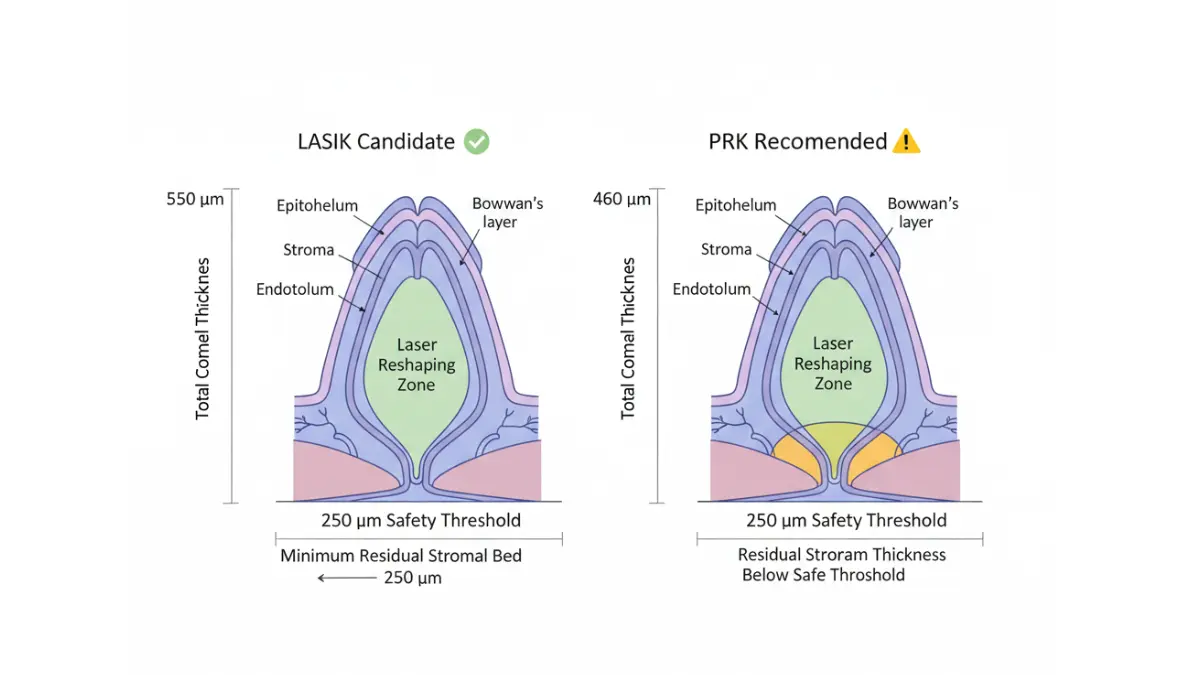
LASIK candidacy depends on six critical factors the FDA requires surgeons to evaluate before approving any patient for surgery: age (18+), prescription stability for 12+ months, adequate corneal thickness (minimum 480-500 microns), healthy tear production, absence of autoimmune diseases, and realistic expectations about outcomes. Approximately 85-90% of people seeking LASIK meet these basic requirements, though only 65-70% prove ideal candidates after comprehensive evaluation.
LASIK Candidacy Requirements and Age Guidelines
You’re likely an excellent LASIK candidate if you meet these criteria:
- Age 21-45 years old for optimal outcomes (FDA approves 18+, but 21+ shows better stability)
- Stable prescription for minimum 12 months (no changes exceeding 0.50 diopters)
- Myopia -1.00 to -9.00 diopters or hyperopia +1.00 to +4.00 diopters
- Astigmatism up to 6.00 diopters (higher amounts may require PRK or topography-guided LASIK)
- Corneal thickness 500+ microns after accounting for planned tissue removal
- No autoimmune conditions (rheumatoid arthritis, lupus, Sjögren’s syndrome disqualify most patients)
Best age for LASIK is 25-40 when prescriptions have stabilized but age-related presbyopia hasn’t yet begun affecting near vision. Patients over 40 should understand LASIK doesn’t prevent reading glasses needs that naturally develop between ages 42-50.
If you’re experiencing any unusual symptoms affecting your eyes or overall health, using our Symptom Checker before consultation helps identify conditions that might affect surgical candidacy.
LASIK vs PRK vs SMILE: Technology Comparison 2025
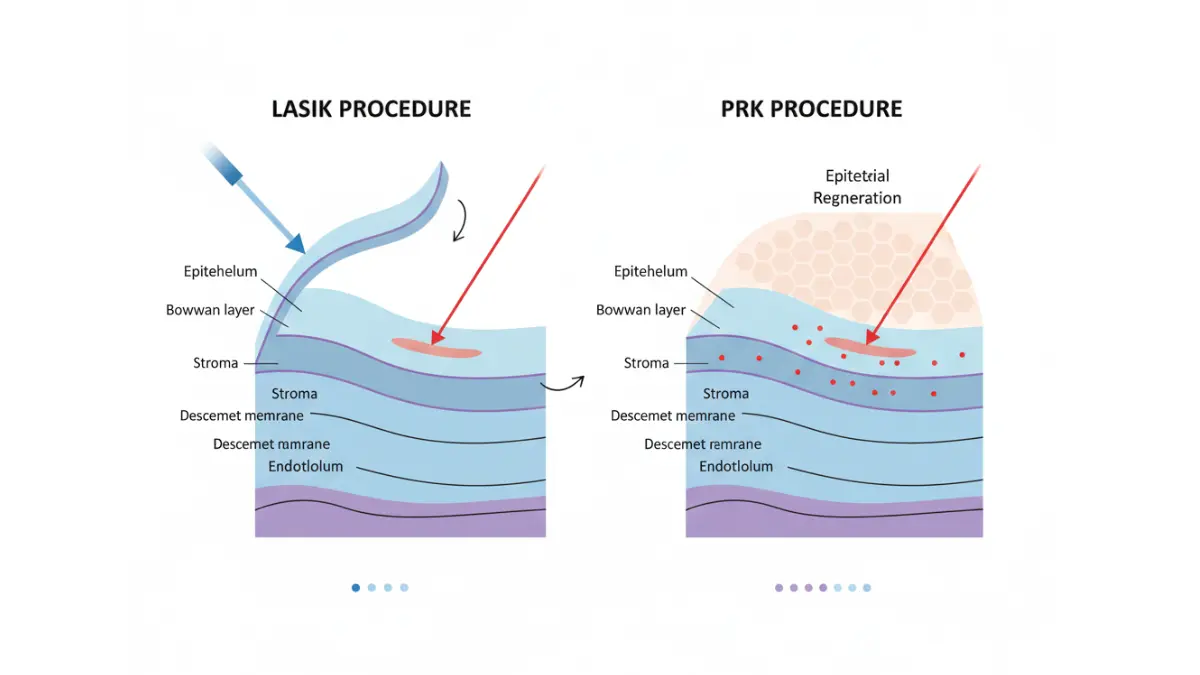
University research comparing PRK vs LASIK confirms one-year outcomes are virtually identical between procedures—the primary difference is recovery speed and early comfort. PRK eliminates flap-related complications, making it mandatory for military personnel, boxers, and anyone in contact sports where eye trauma risks are elevated.
LASIK vs PRK cost differences typically favor PRK by $200-$400 per eye since the procedure requires less sophisticated equipment. However, extended recovery requiring more time off work can offset these savings.
SMILE vs LASIK technology represents the newest laser vision correction approved in 2016, using a single femtosecond laser to create a lenticule (lens-shaped piece of tissue) removed through a 2-4mm incision. SMILE causes less dry eye but costs $600-$800 more per eye than standard LASIK and isn’t suitable for hyperopia correction yet.
Finding the Best LASIK Surgeon Near Me
Top LASIK surgeon qualifications to verify before booking:
- Board certification in ophthalmology with refractive surgery fellowship training
- 5,000+ LASIK procedures performed (surgeons with 10,000+ show best outcomes)
- Uses FDA approved LASIK technology from major manufacturers (Alcon, Johnson & Johnson Vision, Zeiss)
- Complication rate under 1% (request specific data on flap complications, infections, enhancement rates)
- Same surgeon performs evaluation and surgery (avoid corporate “bait-and-switch” models)
- Offers lifetime or 10-year enhancement guarantees (demonstrates confidence in results)
The best LASIK clinic operates with transparent pricing, allows surgery observations, provides detailed informed consent documents, and never pressures same-day decisions. Red flags include surgeons who skip corneal topography, don’t measure pupil size in dim conditions, or advertise unrealistic “perfect vision guaranteed” claims.
LASIK Procedure Steps: What Happens During Surgery
How LASIK works in 7 steps (15-20 minutes total):
- Numbing drops applied (no injections needed—completely painless procedure)
- Eyelid holder placed to prevent blinking during treatment
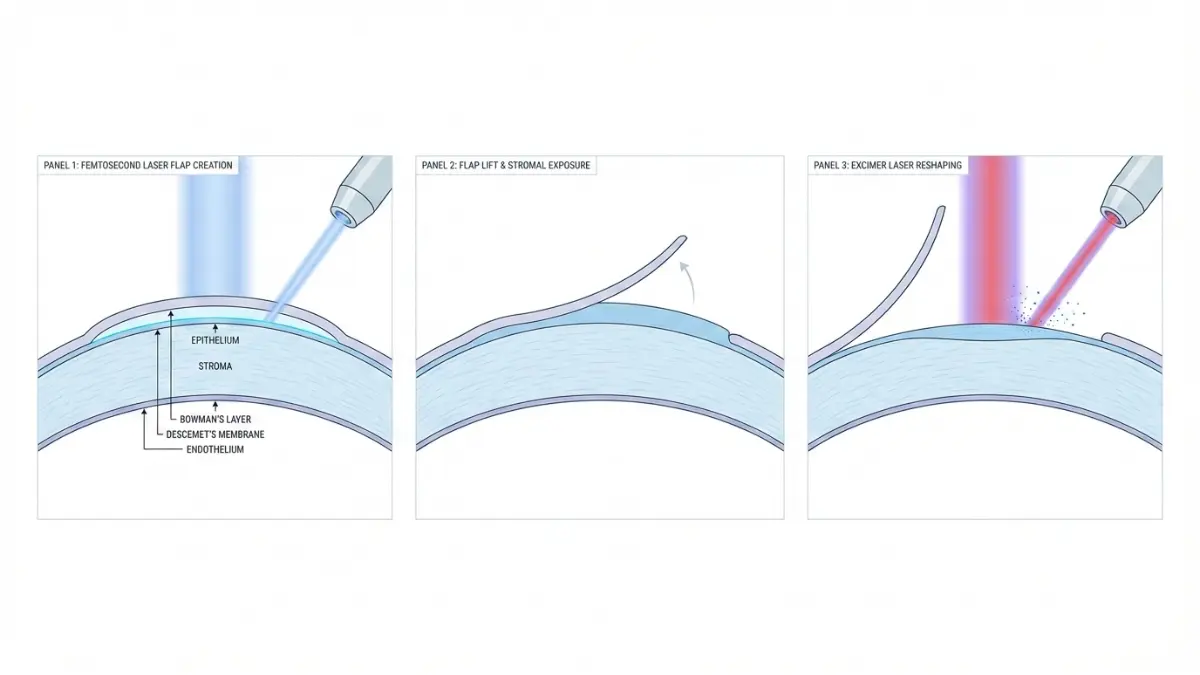
- Corneal flap created using femtosecond laser (8-10 seconds per eye)
- Flap lifted to expose underlying corneal tissue (stroma)
- Excimer laser reshapes cornea based on prescription mapping (20-60 seconds per eye)
- Flap repositioned and smoothed back into place (self-seals within minutes)
- Protective shield applied to prevent accidental rubbing during initial healing
Most patients describe feeling mild pressure during the procedure but zero pain. Visual improvement begins immediately, though initial blur and light sensitivity last 4-8 hours.
LASIK Recovery Time and Results Timeline
Expected LASIK recovery timeline:
- Hour 1-4 post-surgery: Blurry vision, light sensitivity, mild burning sensation (similar to chlorine in pool)
- Day 1: Vision clears to 20/30-20/40 range—functional for most activities
- Day 3: 80-90% of patients achieve 20/25 or better vision
- Week 1: Return to work, exercise (avoid swimming/hot tubs for 2 weeks)
- Month 1: Vision stabilizes at final outcome for 95% of patients
- Month 3-6: Dry eye symptoms resolve in nearly all patients
Post-operative care requires preservative-free artificial tears 4-6 times daily for 3-6 months to manage temporary dryness. The NIH’s comprehensive dry eye study confirms symptoms peak at weeks 2-4 then steadily improve, with 98% of patients symptom-free by 9-12 months.
LASIK Risks, Complications and Side Effects
Honest transparency about LASIK complications (with actual incidence rates):
- Temporary dry eyes: 20-40% experience for 3-6 months
- Night vision issues (halos, glare): 10-15% report for 1-3 months
- Undercorrection requiring enhancement: 5-10% within first year
- Flap complications: <0.5% with modern femtosecond lasers
- Infection risk: <0.1% when post-operative instructions followed
- Vision loss (worse vision than pre-surgery): <0.01% in FDA trials
Choosing experienced board certified LASIK surgeons using FDA approved LASIK technology minimizes all complication risks significantly.
Ready to Book Your LASIK Consultation?
3-step process to schedule LASIK appointment:
- Request free consultation at 3-5 LASIK centers near me for pricing/technology comparison
- Complete comprehensive eye evaluation including topography, pupil measurements, tear film assessment
- Schedule LASIK surgery (most centers book 1-4 weeks after consultation approval)
Make informed health decisions by exploring our Health Tips section for comprehensive wellness guidance beyond vision correction.
Disclaimer: This article is for educational purposes, not medical advice. Consult with a board-certified ophthalmologist to determine if LASIK is appropriate for your specific vision needs and eye health status.
Frequently Asked Questions About LASIK
1. How much does LASIK cost in 2025?
LASIK costs $1,499-$3,500 per eye in 2025, with the national average at $2,632 per eye. Most patients pay $1,900-$2,200 after discounts and promotional pricing for both eyes.
2. Can I finance LASIK with bad credit?
Yes. CareCredit and ALPHAEON Credit approve applicants with credit scores as low as 580-620. Co-signers, in-house payment plans, and credit union medical loans provide additional financing options for bad credit.
3. Is LASIK covered by insurance or FSA/HSA?
LASIK is rarely covered by insurance but fully qualifies for HSA/FSA reimbursement as an IRS-approved medical expense. Using pre-tax accounts saves 20-35% depending on your tax bracket.
4. How long does LASIK last?
92% of patients maintain corrected vision for 10+ years without enhancement. Results are permanent, though natural age-related changes (presbyopia after 40) may eventually require reading glasses.
5. What is the best age to get LASIK?
Ages 25-40 provide optimal LASIK outcomes when prescriptions have stabilized but presbyopia hasn’t begun. FDA approves surgery at 18+, but 21+ shows better long-term stability.
6. Am I a candidate for LASIK?
You’re likely a candidate if you’re 18+, have stable vision for 12+ months, healthy corneas 500+ microns thick, prescriptions within -9.00 to +4.00 range, and no autoimmune diseases.
7. LASIK vs PRK: Which is better?
Both achieve identical 95%+ success rates. LASIK offers faster recovery (24-48 hours vs 3-7 days) but PRK eliminates flap complications, making it better for thin corneas and contact sports athletes.
8. How painful is LASIK?
LASIK is painless during the procedure with numbing drops. Mild discomfort (burning, grittiness) lasts 4-8 hours post-surgery. Most patients describe it as similar to chlorine irritation from swimming.
9. Can LASIK be done twice?
Yes. 10-15% of patients require enhancement procedures within 10 years due to prescription changes. Most practices include free enhancements within the first 12 months, with lifetime warranties costing $300-$600.
10. What are the risks of LASIK?
Common temporary side effects include dry eyes (20-40% for 3-6 months), night glare (10-15% for 1-3 months), and undercorrection (5-10%). Serious complications occur in less than 0.5% of cases.
11. When can I return to work after LASIK?
Most patients return to desk work within 24-48 hours. Avoid swimming, hot tubs, and heavy exercise for 2 weeks. Contact sports should wait 4 weeks to ensure complete flap healing.
About this content
How this article was put together: researched from recognised health sources, drafted with the help of AI tools, and edited by hand, with sources linked throughout.

Sameer Patel is the founder and editor of My Medicine Advisor. He is not a doctor or medical professional — before starting this site he worked in banking,…
Medical disclaimer
The content on MyMedicineAdvisor is provided for general informational and educational purposes only and is not a substitute for professional medical advice, diagnosis, or treatment. Health information on this website should not be used to diagnose, treat, cure, or prevent any condition without guidance from a qualified healthcare professional. Always seek the advice of your doctor, physician, or another licensed healthcare provider with any questions you may have regarding a medical condition, symptoms, medications, or treatment decisions.