Maybe you couldn’t name it, but you felt it: you’re more tired than your sleep should allow. Your patience is thinner. Your chest gets tight in moments that used to roll off. Nothing “happened,” exactly—and that’s what makes it unsettling.
A lot of people are carrying that same quiet confusion into this year. Not a crisis. Not a collapse. Just a steady sense that the world sped up half a notch… and the body got the memo first.
The shift wasn’t loud. It was physical.
What’s surfaced isn’t one dramatic symptom. It’s a cluster of small bodily protests that feel strangely personal: the jaw that won’t unclench, the stomach that’s suddenly picky, the headache that arrives like a notification.
For many, it’s not even pain. It’s the feeling of being slightly miscalibrated—like the internal settings changed overnight and no one asked permission.
And because it’s subtle, it’s easy to question: Is this stress? Hormones? Screens? Aging? Something I’m missing?
Why people started saying it out loud
The last few years trained people to normalize a lot—working through exhaustion, living with low-grade worry, staying reachable all the time. But normalization has a shelf life.
What’s different now is how often the “off” feeling is shared. It’s showing up in group chats as jokes about brain fog. It’s in the way friends ask, more seriously than they used to, “Are you okay?”—and actually wait for the answer.
Even the most self-aware people are getting caught off guard, because the signals aren’t always emotional first. They’re physical first.

Why this feels different right now
Plenty of years have been stressful. This one feels like it comes with fewer natural brakes.
There’s less separation between public life and private life—between work and the rest of the day, between news and downtime, between other people’s emergencies and your own nervous system. The background noise isn’t just loud; it’s intimate, living in the same pocket as your keys.
And in that kind of environment, the body does what bodies do: it tries to predict. It scans. It braces. It keeps a little extra fuel in the tank, just in case. The problem is that “just in case” starts to become a lifestyle.
The tension peak: “What if this is just… me now?”
This is the part many people don’t say out loud: the fear isn’t only that something is wrong.
It’s the fear that nothing is wrong in a way that can be fixed.
That this is your new baseline—less energy, less focus, less resilience. That you’ll be the person who cancels more, forgets more, flinches internally at a full calendar. That you’ll have to quietly adjust your life downward and pretend it’s “fine.”
That thought lands hardest in ordinary moments: rereading the same sentence three times, snapping at someone you love, waking up already behind.
Timing matters—and so does the culture around it
Part of what’s happening is cultural timing: a lot of major systems have been shifting at once, and people are adapting in real time.
Work has changed shape, but expectations didn’t always soften with it. Technology has become more conversational and more constant, and the line between “quick check” and “hour lost” has blurred. Even social connection can feel fragmented—present, but thin.
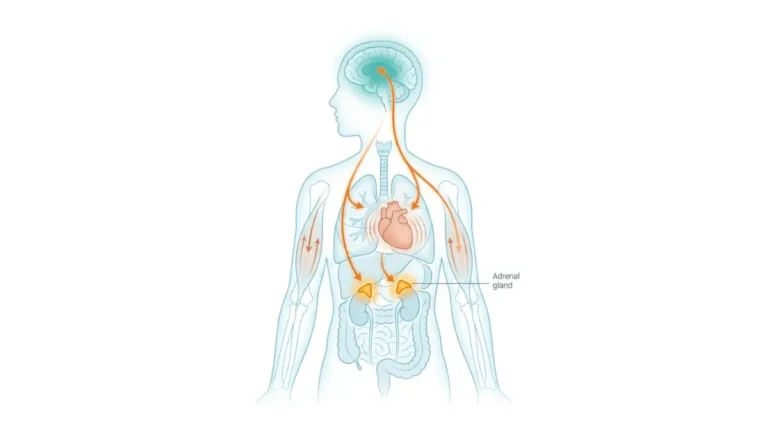
The American Psychological Association has described stress as touching nearly every system in the body, not just mood or thoughts, which helps explain why this kind of year can feel physical even when life looks “fine” on paper. The same organization’s recent Stress in America reporting has also emphasized how disconnection can be a central stressor—not a side effect—which resonates with why so many people feel strangely alone while being constantly pinged.
How this shows up in real life
It often looks like “nothing,” until it looks like everything.
A typical day might include:
- Coffee that suddenly feels too sharp in the system.
- A racing mind at bedtime, but a heavy body in the morning.
- Random irritation—at traffic, at a slow app, at a harmless question.
- Forgetting words that used to come easily.
- Skin flares, jaw pain, headaches, or stomach weirdness that feels out of character.
- A social battery that drains faster, even around people you like.
Notice what’s missing from that list: a single, satisfying explanation. That’s why it’s so easy to spiral into self-blame.
The part clinicians emphasize carefully
The careful message is not “it’s all in your head.” It’s closer to: your body keeps score, even when your mind is trying to be reasonable.
Stress responses can show up as sleep disruption, muscle tension, digestive changes, fatigue, and “wired but tired” energy—especially when the stress is chronic, ambiguous, and socially shared.
The important limitation: these signals aren’t diagnostic. Similar symptoms can come from dozens of causes, and bodies vary widely. That uncertainty is frustrating—but it’s also protective, because it keeps the story from turning into a single neat narrative that doesn’t fit everyone.
How to hold this—especially if you’re a parent
Kids and teens are often the first to mirror the atmosphere, even when adults think they’re hiding it well. They may not talk about “stress,” but their sleep, stomach, and mood will.
The calm frame that tends to land is: your body is trying to help you. It’s not being dramatic. It’s responding to a world that has felt unpredictable, loud, and fast.
For adults, the same frame can be surprisingly stabilizing. The goal isn’t to hunt for a perfect hack. It’s to stop treating every signal as a personal failure—and to start treating it as information.
What the near future is likely to bring
The next stretch may not feel instantly easier—but it may feel more nameable.
More people are learning the difference between being busy and being braced. More workplaces are stumbling, slowly, toward healthier norms. More families are talking about nervous-system stress the way they talk about hydration: not as a moral test, just as maintenance.
And if you’ve been feeling “off,” it doesn’t mean you’re broken—or that you’re alone in it. It may simply mean your body noticed the shift early, and it’s been trying, in its clumsy human way, to keep you steady until your mind caught up.
About this content
How this article was put together: researched from recognised health sources, drafted with the help of AI tools, and edited by hand, with sources linked throughout.

Sameer Patel is the founder and editor of My Medicine Advisor. He is not a doctor or medical professional — before starting this site he worked in banking,…
Medical disclaimer
The content on MyMedicineAdvisor is provided for general informational and educational purposes only and is not a substitute for professional medical advice, diagnosis, or treatment. Health information on this website should not be used to diagnose, treat, cure, or prevent any condition without guidance from a qualified healthcare professional. Always seek the advice of your doctor, physician, or another licensed healthcare provider with any questions you may have regarding a medical condition, symptoms, medications, or treatment decisions.