
On This Page – Quick Medical Summary
A high result on the 1-hour glucose test does not mean you have gestational diabetes. It is a screening result, and most people who screen above the cutoff do not have the condition.
Where you are right now
What to read next depends on where you are. If you have just been told your number was high, the next two sections explain what the test measures and how often it turns out to be nothing. If you are already booked for the 3-hour test, go to what test day involves. If your 3-hour test came back normal, the final section was written for you.
What “failing” actually means
Failing is clinic shorthand for a result above a screening threshold, nothing more. The screen was built to be crossed by many people who are fine.
ℹ️ Medical Disclaimer: This article explains how gestational diabetes screening and diagnosis work in general terms. It does not interpret your individual result, diagnose any condition, recommend or adjust any medication, or advise on insurance coverage. Diagnostic thresholds, follow-up testing and treatment decisions belong to the obstetric clinician managing your pregnancy — an OB-GYN, certified nurse-midwife or family physician providing prenatal care. Bring your actual lab report to them before acting on anything you read here.
What the 1-hour glucose test actually measures
A high result does not mean gestational diabetes, because this test was never designed to diagnose it. The glucose challenge test measures how your blood sugar responds one hour after a 50-gram glucose drink, and it is deliberately set to flag anyone who might need a closer look.
🔬 How It Works: Placental hormones make your cells respond less efficiently to insulin as pregnancy progresses. In most pregnancies the pancreas compensates. When it cannot keep pace, blood sugar stays higher than expected an hour after a glucose load — which is what the screen detects.

Why the cutoff is different at different clinics
There is no single national cutoff. Practices choose one threshold and apply it consistently, commonly 130, 135 or 140 mg/dL. A lower cutoff catches more cases but also sends more people who do not have gestational diabetes for the longer test, and ACOG leaves that trade-off to each practice.
When the test is done
The U.S. Preventive Services Task Force recommends screening at 24 weeks of gestation or later — a Grade B recommendation issued in August 2021. Our guide to what the 1-hour glucose test involves covers the appointment, and the glucose levels chart shows how thresholds differ across tests.
How many people who screen high actually have gestational diabetes
Roughly one in five screened patients comes back above the cutoff and is referred for the 3-hour test, according to the NIH’s StatPearls clinical reference on gestational diabetes. Most of that group is not ultimately diagnosed.
📊 Clinical Data Point: Gestational diabetes was recorded in 8.3% of US births in 2021, up from 6.0% in 2016 — Source: CDC, National Vital Statistics System, MMWR QuickStats, January 2023.
Why the two numbers differ so much
Around 20% screen positive, while roughly 8% of births carry the diagnosis. That gap is not an error in the test — it is the screen doing its job by casting a wide net and letting the second test sort it out.
Who is more likely to be diagnosed
CDC natality data shows the rate varies with maternal age and pre-pregnancy body mass index, rising steadily with age. Those are population patterns, not predictions about any individual pregnancy.
What happens at the 3-hour glucose tolerance test
The 3-hour oral glucose tolerance test is the diagnostic step, and unlike the screen it requires fasting. Here is the sequence, as described by the NIH’s guide to glucose screening tests during pregnancy:
- Fast for 8 to 14 hours beforehand — nothing but sips of water, and no eating during the test itself.
- Have a fasting blood sample drawn on arrival.
- Drink a solution containing 100 grams of glucose.
- Have three more samples drawn, one every 60 minutes.
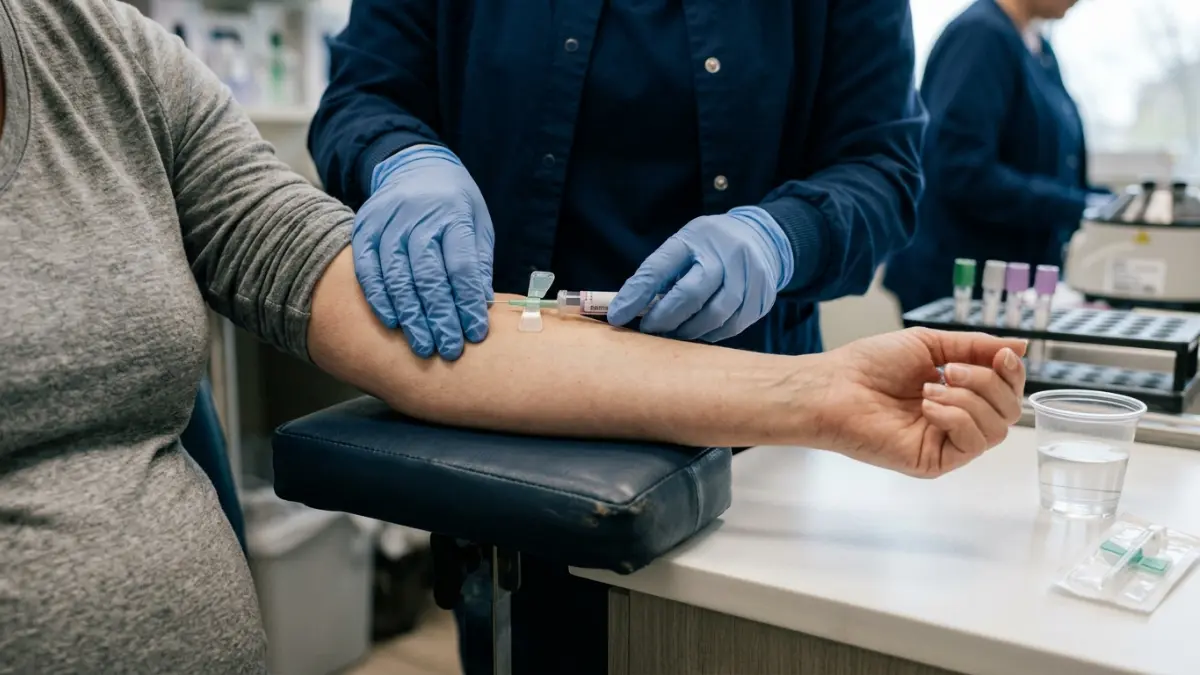
Plan for at least three hours in the chair. Our 3-hour test timeline walks through the wait, and this guide covers how long to fast before a glucose test.
✅ Patient Action: Before test day, ask the scheduling nurse or your obstetric clinician: “Should I hold any of my current medications or prenatal supplements the morning of the test?”
How your 3-hour results are read
Your four values are compared against a named set of diagnostic criteria, and a diagnosis generally requires two or more values at or above threshold. Two sets are in use in the US, and they are not interchangeable.
| Sample | Carpenter-Coustan | National Diabetes Data Group | Key clinical detail |
|---|---|---|---|
| Fasting | 95 mg/dL | 105 mg/dL | Drawn before the drink |
| 1 hour | 180 mg/dL | 190 mg/dL | Usually the highest value |
| 2 hours | 155 mg/dL | 165 mg/dL | Shows the downward curve |
| 3 hours | 140 mg/dL | 145 mg/dL | Final sample |
Thresholds as documented in peer-reviewed literature indexed at PubMed Central (NIH). ACOG recognises both sets; which one applies to you depends on your lab.
Why one abnormal value is not the same as two
A single value above threshold does not meet the standard diagnostic rule, and it sits in a genuine grey area rather than a clear answer. If your results are reported in mmol/L, you can convert your result between mg/dL and mmol/L.
✅ Patient Action: Ask your obstetric clinician: “Which criteria set did the lab use, and how many of my four values were at or above it?”
When a high screen means something different
Two situations change the usual path, and both are decided by your clinician rather than by a number you can look up.
When the 3-hour test is skipped
Some practices treat a markedly elevated screening value as sufficient on its own and move straight to management. The value that triggers this varies between practices and is not a single national standard, so ask yours directly rather than comparing your number to one you found online.
Whether what you ate explains the result
The 1-hour screen is designed to be taken without fasting or any change to your diet. A recent meal is not the explanation, and this result is not something you caused.
⚠️ Clinical Warning: Persistent excessive thirst, persistent frequent urination, or new blurred vision alongside a high screening result are worth reporting the same day rather than waiting for the 3-hour appointment. These can point toward diabetes that predates the pregnancy, which is managed differently.
If your 3-hour test comes back normal
Most people in your position land here, and a normal 3-hour test means you do not have gestational diabetes. One finding is still worth raising at your next visit.
📊 Clinical Data Point: Among 37,277 screened pregnancies at a US tertiary centre, 79.7% screened normal, 13.7% had an abnormal screen with a normal 3-hour test, and 6.6% were diagnosed — Source: retrospective cohort study indexed at PubMed Central, NIH.
That middle group showed modestly higher odds of caesarean delivery and hypertensive disorders of pregnancy than those who screened normal. This is a single retrospective study at one centre, and it shows an association rather than a cause.
🩺 Physician Note: A common point of confusion is treating a normal 3-hour result as the end of the conversation. Published outcome data suggests the abnormal-screen group is worth mentioning to whoever manages the rest of your care.
Common questions about a failed 1-hour glucose test
1. Does failing the 1-hour glucose test mean I have gestational diabetes?
No. The 1-hour test is a screen, not a diagnosis, and most people who screen above the cutoff are not diagnosed.
2. What number counts as failing the 1-hour glucose test?
Practices set a single cutoff, commonly 130, 135 or 140 mg/dL. Ask your clinic which threshold it applies.
3. How many people fail the 1-hour glucose test?
Roughly one in five screened patients comes back above the cutoff and is referred on for the 3-hour test.
4. Do I have to fast for the 3-hour glucose test?
Yes. It requires 8 to 14 hours with nothing but sips of water, and no eating during the test.
5. How long does the 3-hour glucose test take?
Plan for at least three hours: a fasting draw, a 100-gram glucose drink, then three more draws an hour apart.
6. How many abnormal values diagnose gestational diabetes?
Two or more values at or above your lab’s criteria set. Ask your obstetric clinician how many of yours qualified.
7. Can what I ate cause a failed 1-hour glucose test?
No. The screen is designed to be taken without fasting or diet changes, so a recent meal does not invalidate it.
8. Can I skip the 3-hour glucose test?
That is your clinician’s call. An unresolved abnormal screen means gestational diabetes is neither confirmed nor ruled out.
9. Is a very high 1-hour result diagnostic on its own?
Some practices treat a markedly elevated screen as sufficient and skip ahead. The triggering value varies, so confirm with your clinician.
10. When in pregnancy is the glucose test done?
Screening is recommended at 24 weeks of gestation or later, and most practices schedule it between 24 and 28 weeks.
11. If my 3-hour test is normal, does anything change?
An abnormal screen with a normal 3-hour test has been linked to modestly higher delivery risks. Raise it with your clinician.
What to do next
Book the 3-hour test if you have not already, and bring two questions with you: which criteria set the lab uses, and how many values were above it. If you do end up diagnosed, the NIH’s overview of gestational diabetes covers what management involves.
About this content
How this article was put together: researched from recognised health sources, drafted with the help of AI tools, and edited by hand, with sources linked throughout.

Sameer Patel is the founder and editor of My Medicine Advisor. He is not a doctor or medical professional — before starting this site he worked in banking,…
Medical disclaimer
The content on MyMedicineAdvisor is provided for general informational and educational purposes only and is not a substitute for professional medical advice, diagnosis, or treatment. Health information on this website should not be used to diagnose, treat, cure, or prevent any condition without guidance from a qualified healthcare professional. Always seek the advice of your doctor, physician, or another licensed healthcare provider with any questions you may have regarding a medical condition, symptoms, medications, or treatment decisions.