On This Page – Quick Medical Summary
Justin, 47, had been snoring so loudly his wife moved to the guest room. He woke exhausted every morning despite eight hours in bed. His doctor gave him a choice: a $200 home sleep apnea test delivered to his door, or a $2,800 overnight lab study. He had no idea which to choose — and neither option was clearly explained.
If you’re in the same position, this guide ends the confusion. You’ll get the exact decision framework sleep specialists use in 2026, real accuracy numbers, a complete cost breakdown, and a clear answer on which sleep apnea test is right for you.
What Is a Home Sleep Apnea Test vs. a Lab Sleep Study?
Before choosing, you need to understand what each test actually measures — because they are not the same thing.
Home Sleep Apnea Test (HSAT)
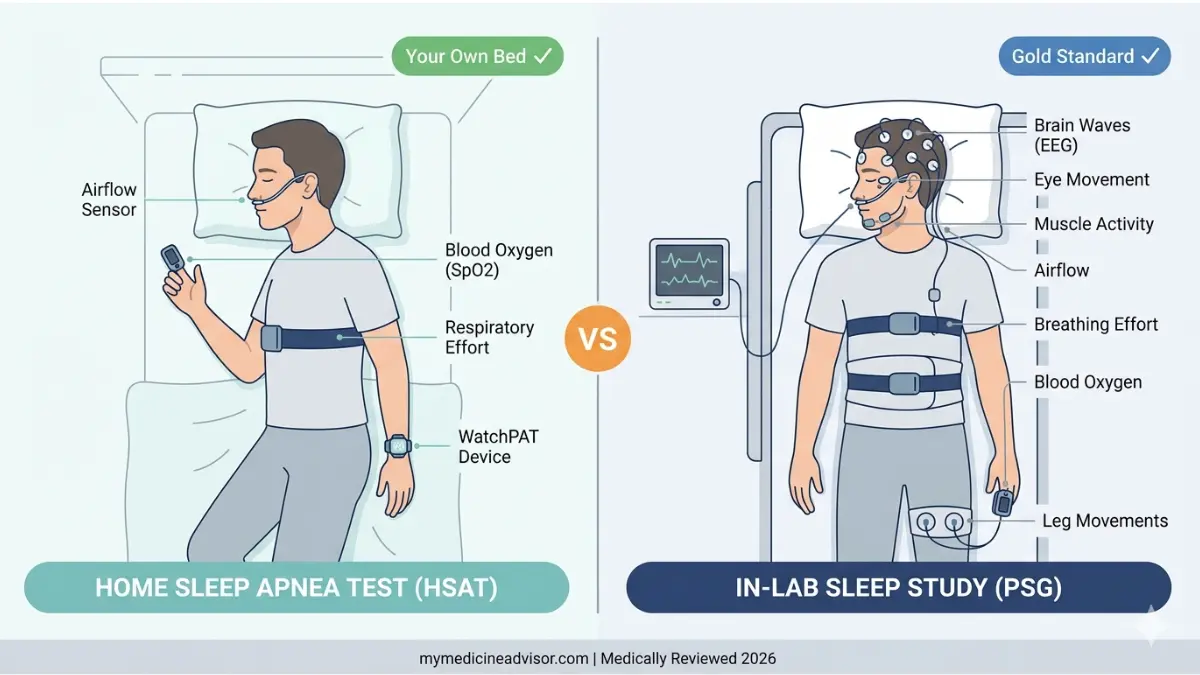
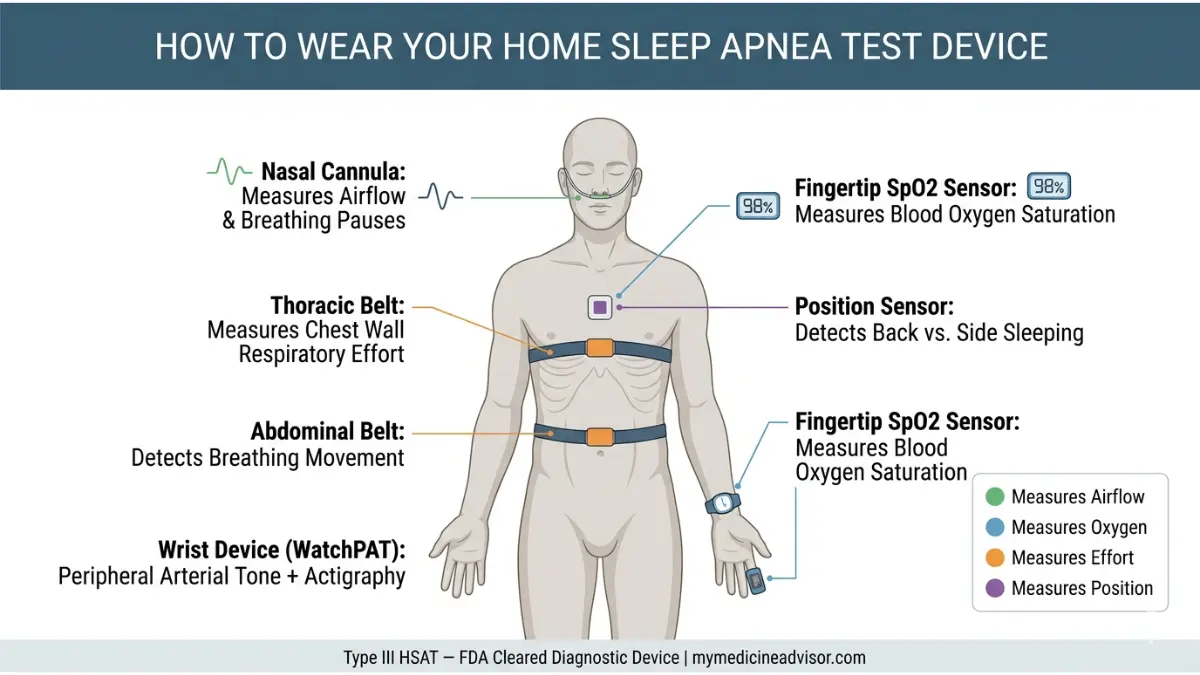
A home sleep apnea test (also called HSAT or HST) is a Type III or Type IV portable diagnostic device you use overnight in your own bed. Your doctor or a telehealth provider prescribes it, and the kit is mailed to your home or picked up from a clinic.
What it measures:
- Airflow (via nasal cannula)
- Blood oxygen saturation (fingertip pulse oximeter)
- Respiratory effort (chest and abdominal belts)
- Heart rate
- Body position and snoring (on newer devices)
What it does NOT measure:
- Brain waves (EEG) — so it cannot detect sleep stages
- Leg movements
- Eye movements
- Actual sleep time (it uses “time in bed” instead, which can slightly underestimate severity)
The newest 2026 HSAT devices — including the WatchPAT ONE and NOX-T3s — use Bluetooth and peripheral arterial tone technology to improve accuracy. These represent a significant upgrade over the bulky Type III devices used a decade ago.
Before your test, use our free Sleep Calculator to establish your baseline sleep patterns — it helps your doctor interpret results in context.
In-Lab Sleep Study (Polysomnography / PSG)
An in-lab sleep study, formally called polysomnography (PSG), is the gold standard for sleep disorder diagnosis. You spend one night at an accredited sleep center while a licensed technician monitors you in real time.
What it measures (22+ channels):
- Brain waves (EEG) — detects all sleep stages including REM
- Eye movements (EOG)
- Muscle activity (EMG)
- Heart rhythm (ECG)
- Breathing patterns, airflow, and oxygen levels
- Leg movements
- Body position and audio/video recording
A split-night study allows diagnosis and CPAP titration in a single overnight visit — meaning you leave with a treatment prescription the next morning.
Side-by-Side Comparison
| Feature | Home Sleep Test (HSAT) | Lab Sleep Study (PSG) |
|---|---|---|
| Cost (no insurance) | $150–$1,000 | $1,000–$10,000 |
| Cost (with insurance) | Often $0–$40 copay | Varies by deductible |
| Medicare 2026 | 80% after $283 deductible | 80% after $283 deductible |
| Accuracy for OSA | ~90–94% sensitivity | Gold standard |
| Measures brain waves | ❌ No | ✅ Yes |
| Detects other sleep disorders | ❌ No | ✅ Yes |
| Convenience | ✅ Your own bed | ❌ Overnight at clinic |
| Results turnaround | 3–5 business days | 1–2 weeks |
| CPAP titration same night | ❌ No | ✅ Split-night option |
| Pediatric use | ❌ Not recommended | ✅ Yes |
Who Should Choose Which Test? The 2026 Decision Framework
This is the section no competitor clearly answers. Here is the exact framework sleep medicine specialists use.
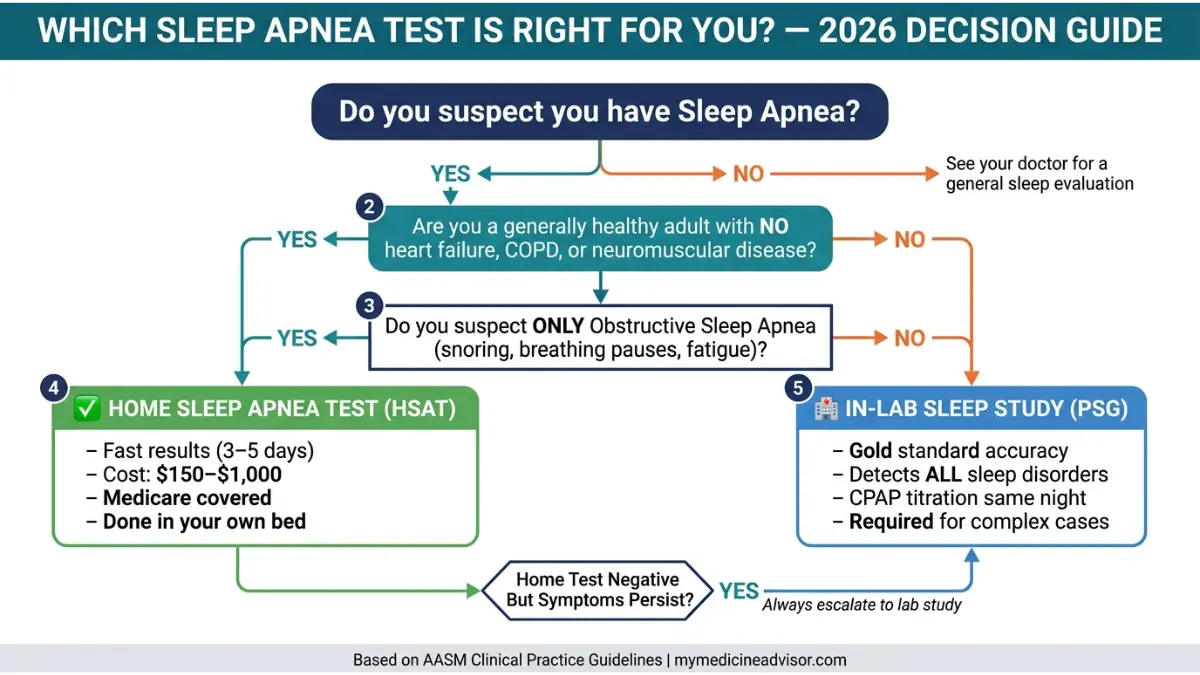
✅ Choose a Home Sleep Apnea Test IF:
- You are a generally healthy adult with no complex medical history
- You snore loudly, feel exhausted after a full night’s sleep, or a partner has witnessed you stop breathing
- Your doctor suspects moderate-to-severe obstructive sleep apnea (OSA)
- You want a faster diagnosis at significantly lower cost
- You need a sleep apnea test for occupational screening (commercial truck drivers, airline pilots, military personnel)
- You have difficulty sleeping in unfamiliar environments
Since obesity is the single largest risk factor for obstructive sleep apnea, check your BMI here and share the result with your physician — a BMI above 30 significantly increases OSA probability and strengthens your case for HSAT approval.
Not sure if your symptoms match obstructive sleep apnea? Run a quick self-assessment using our Symptom Checker before your doctor’s visit — it helps you articulate your symptoms more precisely.
🏥 Choose an In-Lab Sleep Study IF:
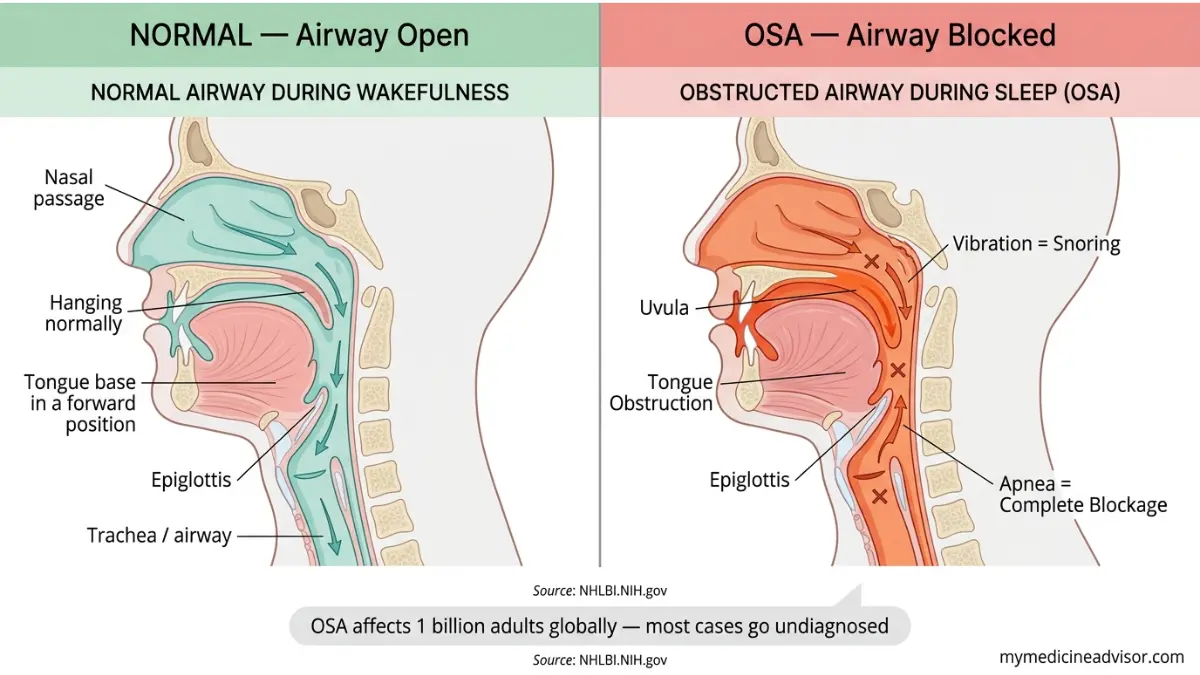
- You have congestive heart failure, COPD, or pulmonary hypertension — these conditions cause oxygen desaturation that mimics OSA, causing false positives on home tests
- You use opioid medications regularly
- Your doctor suspects central sleep apnea (where the brain fails to signal breathing — not an airway obstruction)
- You may have narcolepsy, REM sleep behavior disorder, sleepwalking, or severe insomnia
- Your home sleep apnea test came back negative but symptoms persist — a negative HSAT never definitively rules out OSA
- You are under 18 years old — the American Academy of Sleep Medicine (AASM) recommends PSG only for children and adolescents
- You need same-night CPAP titration via a split-night protocol
For a deeper clinical understanding of how sleep apnea is diagnosed, see our detailed guide on how sleep apnea is diagnosed, which covers screening questionnaires, physical exams, and specialist referral criteria.
What This Means For You: If you’re a healthy adult who snores, feels unrefreshed after sleep, or has been told you stop breathing — start with a home sleep apnea test. It’s accurate, affordable, and fast. If you have heart disease, lung disease, or symptoms pointing to a disorder beyond OSA, go directly to a lab study.
How Accurate Is a Home Sleep Apnea Test? Understanding Your AHI Score
This is where patients get the most confused — and where competitors give the least useful information.
What Is the AHI Score?
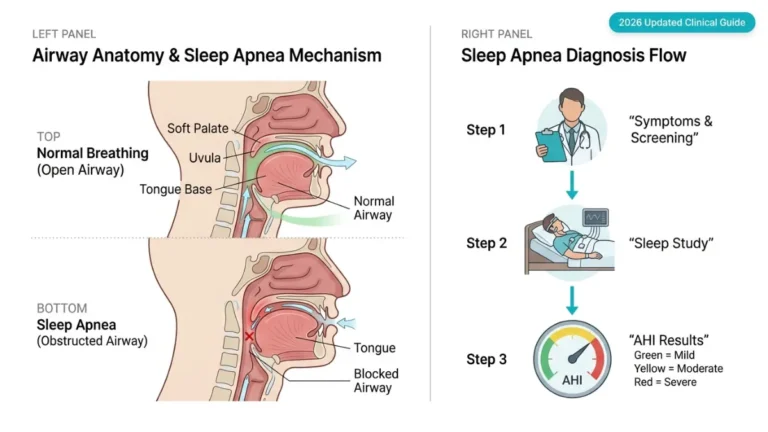
The Apnea-Hypopnea Index (AHI) is the core metric from any sleep apnea test. It measures the average number of breathing interruptions (apneas and hypopneas) per hour of sleep.
| AHI Score | Classification | Recommended Action |
|---|---|---|
| < 5 | Normal | No sleep apnea — explore other causes |
| 5–14 | Mild OSA | Lifestyle changes; CPAP may be recommended |
| 15–29 | Moderate OSA | CPAP therapy strongly recommended |
| ≥ 30 | Severe OSA | Urgent CPAP or specialist referral |
A score of 15+ with symptoms like hypertension or excessive daytime sleepiness qualifies for Medicare CPAP coverage in 2026.

The Real Accuracy Numbers (2026 Data)
Home sleep apnea tests perform impressively well for their intended purpose — diagnosing obstructive sleep apnea in healthy adults.
- A 2022 peer-reviewed study in PubMed found HSAT sensitivity of 94.9% for detecting any OSA, with an overall diagnostic accuracy exceeding 91%
- For correctly classifying moderate-to-severe OSA specifically, accuracy drops to approximately 77.6% — still clinically useful, though PSG may be needed to fine-tune severity classification
- WatchPAT correlation with in-lab PSG has an AHI correlation coefficient of 0.82 — considered statistically strong for clinical decision-making
The critical caveat: Because HSATs cannot measure actual sleep time (only time in bed), they may slightly underestimate AHI severity. If you lie awake for two hours but the device records eight hours, your breathing events are divided by eight instead of six — artificially lowering your score.
What If Your Home Test Is Negative But You Still Feel Awful?
A negative home sleep apnea test does not mean you don’t have OSA.
Common reasons for false negatives:
- Sensor displacement during sleep (no technician to reattach equipment at 3 AM)
- Mild OSA that falls below the HSAT detection threshold
- Predominantly REM-related OSA that HSATs may underrepresent
If you feel exhausted despite a negative result, read our article on always feeling tired no matter how much sleep you get — there are over a dozen non-apnea causes that warrant investigation, and a full PSG can investigate them all.
⚠️ Key Takeaway: Home sleep apnea tests are highly reliable for diagnosing obstructive sleep apnea in otherwise healthy adults. However, they cannot detect brain activity or measure sleep stages, making in-lab polysomnography essential for anyone with complex medical conditions or non-OSA suspected disorders.
Cost, Insurance & How to Get Tested in 2026
Cost is the number one reason Americans delay sleep apnea testing — and it doesn’t need to be.
How Much Does Each Test Cost?
| Test Type | Without Insurance | With Private Insurance | Medicare 2026 |
|---|---|---|---|
| Home Sleep Test (HSAT) | $150–$1,000 | Often $0–$40 copay | 80% after $283 deductible |
| Lab Sleep Study (PSG) | $1,000–$10,000 | Varies by plan/deductible | 80% after $283 deductible |
| CPAP Machine (post-diagnosis) | $500–$1,000 | Typically covered | 80% after 4hr/night compliance |
| Split-Night PSG | $1,500–$5,000 | Often covered with prior auth | 80% after deductible |
Does Insurance Cover a Home Sleep Apnea Test?
Yes — in most cases, when medically prescribed.
- Private insurance (Blue Cross, Aetna, United): Covers HSAT when prescribed by a physician and deemed medically necessary. Many insurers now prefer HSAT as the first step because it costs less.
- Medicare Part B (2026): Covers Type I, II, III, and IV sleep studies. After the 2026 Part B deductible of $283, Medicare pays 80% and you pay 20%. Review current coverage details at Medicare.gov.
- ⚠️ New for 2026: Starting January 1, 2026, Medicare requires prior authorization for certain PSG procedures in select states. Check with your provider before scheduling a lab study to avoid unexpected out-of-pocket costs.
- Medicaid: Coverage varies by state — many state programs cover at least home sleep testing.
For a complete breakdown of how sleep study results translate into CPAP coverage and ongoing treatment costs, see our guide on sleep study polysomnography.
How to Get a Sleep Apnea Test — Step-by-Step
Step 1: Track your symptoms for 1–2 weeks. Note snoring frequency, witnessed breathing pauses, morning headaches, and daytime fatigue. The Epworth Sleepiness Scale is a validated 8-question tool your doctor will likely use — take it before your appointment.
Step 2: Visit your primary care physician or book a telehealth consultation. Many providers now prescribe HSATs via telehealth in under 30 minutes.
Step 3: Your doctor prescribes either an HSAT or PSG based on your symptom profile, BMI, and medical history.
Step 4: Complete the test. HSAT results are typically available in 3–5 business days; PSG results within 1–2 weeks.
Step 5: Review your AHI score and classification with your doctor.
Step 6:
- Positive result: CPAP prescription issued. Telehealth services can often deliver a CPAP within 48 hours.
- Borderline or negative with ongoing symptoms: Follow-up PSG ordered.
If you’ve been experiencing excessive daytime sleepiness for more than three months, don’t wait — untreated OSA raises your risk of hypertension, type 2 diabetes, and cardiovascular events, as confirmed by the National Heart, Lung, and Blood Institute.
Warning Signs You Should Not Ignore Before Testing
Many people delay a sleep apnea test for years. These are the red flags that mean you need to act now.
See a doctor immediately if you experience:
- Waking up gasping or choking at night
- Morning headaches occurring more than 3 times per week
- Falling asleep involuntarily during the day (driving, meetings, conversations)
- Your heart racing or pounding during sleep
- Unexplained high blood pressure resistant to medication
- Memory problems or difficulty concentrating that has worsened over months
These symptoms align closely with the warning signs of a sleep disorder that our expert panel has documented as requiring urgent clinical evaluation.
Caffeine can also mask these symptoms significantly. If you rely on caffeine to function through the day, our article on how caffeine disrupts sleep explains why this creates a dangerous diagnostic delay.
Frequently Asked Questions: Sleep Apnea Test
1. Can I diagnose sleep apnea at home without a doctor?
No. A physician’s prescription is required for any medically valid home sleep apnea test. However, telehealth consultations have made this faster than ever — many patients receive a prescription within the same day.
2. How long does a home sleep apnea test take?
You wear the device for one full night in your own bed. Results are reviewed by a sleep specialist within 3–5 business days.
3. Is a home sleep test as accurate as a lab study?
For obstructive sleep apnea in otherwise healthy adults, yes — accuracy exceeds 90%. In-lab studies remain the gold standard for diagnosing complex or non-OSA sleep disorders.
4. What does a high AHI score mean?
An AHI of 30 or higher indicates severe sleep apnea requiring prompt treatment — most commonly CPAP therapy. Scores between 15–29 indicate moderate OSA, also typically treated with CPAP.
5. Can a home sleep test detect central sleep apnea?
Standard HSAT devices cannot reliably distinguish central from obstructive events. If central sleep apnea is suspected, an in-lab PSG is required.
6. How much does a home sleep apnea test cost without insurance?
Between $150 and $1,000 depending on the device and provider. In-lab studies range from $1,000 to $10,000 uninsured.
7. Does Medicare cover home sleep apnea tests in 2026?
Yes. Medicare Part B covers HSAT when medically prescribed. After meeting the 2026 Part B deductible of $283, Medicare reimburses 80% of approved costs.
8. What happens after a positive sleep apnea test?
Your physician will recommend a treatment plan — most commonly CPAP therapy. Some patients require a separate CPAP titration study to determine the optimal pressure setting.
9. Can children take a home sleep apnea test?
No. The American Academy of Sleep Medicine recommends in-lab polysomnography exclusively for patients under 18 years old.
10. My home test was negative but I still feel exhausted. What now?
Request a full in-lab PSG. Sensor displacement, mild OSA, or a non-apnea disorder like narcolepsy or REM behavior disorder may explain ongoing symptoms. Also review our article on what causes insomnia as a parallel investigative step.
11. How do I prepare for a home sleep apnea test?
Avoid caffeine after noon and alcohol entirely on test night. Sleep in your usual position and follow device setup instructions precisely. Use our Sleep Calculator the week before to log your natural sleep-wake patterns — this data helps your specialist contextualize your results.
For most healthy American adults with suspected obstructive sleep apnea, a home sleep apnea test is the faster, more affordable, and clinically validated starting point. It correctly identifies OSA in over 90% of appropriate candidates and gets you to treatment weeks sooner than a lab backlog allows.
An in-lab sleep study is the right choice when you have cardiovascular disease, lung conditions, suspected non-OSA disorders, or when a home test returns negative results that contradict your symptoms.
The worst decision is no decision. Untreated sleep apnea is linked to a 3x higher risk of cardiovascular events, accelerated cognitive decline, and significantly reduced quality of life. The test takes one night. The benefits can last a lifetime.
If your symptoms extend beyond apnea alone — including restless legs, mood changes, or depression-related sleep problems — discuss a comprehensive sleep evaluation with your physician.
This article is for educational purposes only and does not constitute medical advice. Consult a board-certified sleep medicine specialist for personalized diagnosis and treatment recommendations.
Medical disclaimer
The content on MyMedicineAdvisor is provided for general informational and educational purposes only and is not a substitute for professional medical advice, diagnosis, or treatment. Health information on this website should not be used to diagnose, treat, cure, or prevent any condition without guidance from a qualified healthcare professional. Always seek the advice of your doctor, physician, or another licensed healthcare provider with any questions you may have regarding a medical condition, symptoms, medications, or treatment decisions.