
On This Page – Quick Medical Summary
Marcus, 44, spent three months applying apple cider vinegar to a skin tag on his neck every night before bed. By week six, the tag was still there — but the surrounding skin had developed a chemical burn and a scar that required a dermatologist visit to treat. The tag cost him nothing to ignore. The DIY attempt cost him $340 in treatment fees.
Skin tag removal is one of the most searched skin topics in America — and one of the most misunderstood. According to a clinical review published on NCBI StatPearls, acrochordons (skin tags) affect an estimated 46% of the general population. Most are harmless. But removing them the wrong way can cause infection, scarring, and missed diagnoses.
This 2026 guide covers exactly what dermatologists do, which at-home options are medically acceptable, and which DIY methods you should never attempt — with real costs, a full method comparison, and expert-backed guidance.
What Is a Skin Tag — And Should You Be Worried?
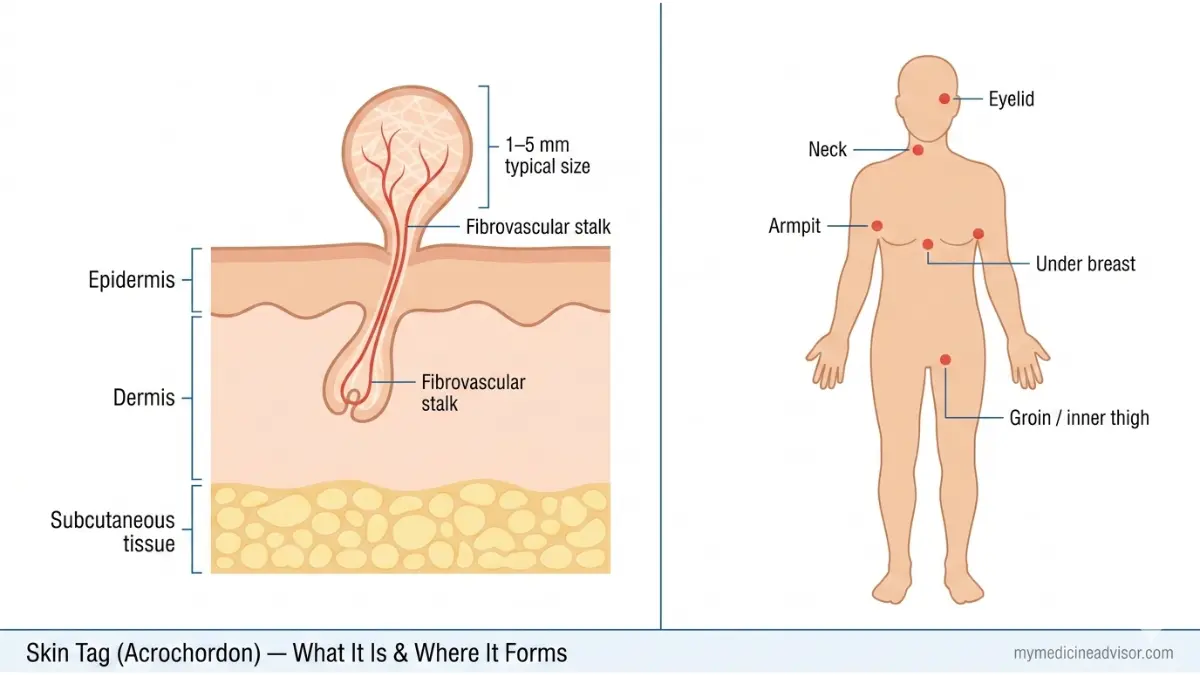
A skin tag (acrochordon) is a small, soft, benign growth of excess skin connected to your body by a thin stalk. They are non-cancerous, painless unless irritated, and extremely common.
Where skin tags typically appear:
- Neck and collar area
- Armpits (axilla)
- Eyelids
- Under the breasts
- Groin and inner thighs
- Around the genitals
According to the NHS skin tags guidance, skin tags tend to form where skin rubs against skin or clothing — which is why they’re more common in people with skin folds, during pregnancy, and with age.
Skin Tag vs. Wart vs. Mole — How to Tell the Difference
Getting the diagnosis right is the first step. Misidentifying a growth is one of the most dangerous DIY mistakes.
| Feature | Skin Tag | Wart | Mole |
|---|---|---|---|
| Texture | Soft, smooth | Rough, cauliflower-like | Flat or slightly raised |
| Color | Skin-tone or slightly darker | Flesh/gray | Tan, brown, or black |
| Attached by stalk? | Yes | No | No |
| Painful? | Rarely | Sometimes | No |
| Cancerous risk? | None | Very low | Possible |
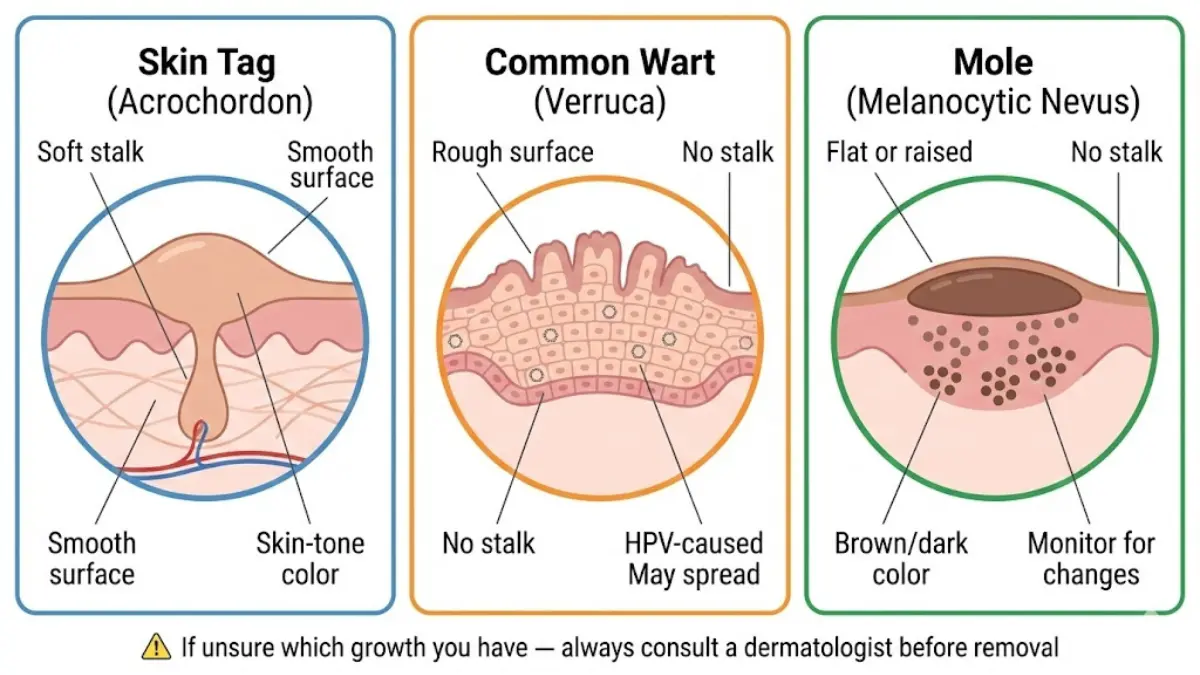
If you are unsure whether a growth is a skin tag, use our free Symptom Checker to document your symptoms before your dermatologist visit. Never attempt self-removal on any growth you haven’t had professionally assessed.
Risk Factors Most People Don’t Know About
Your likelihood of developing skin tags increases significantly with:
- Age — most common after 40
- Obesity or high BMI — increased skin fold friction. If you’re concerned about weight as a risk factor, our BMI Calculator gives you an instant, accurate reading
- Type 2 diabetes and insulin resistance — research consistently links skin tags to insulin resistance and metabolic syndrome (see Section 4)
- Pregnancy — hormonal surges in the second trimester trigger new tag formation
- Family history — genetic predisposition is a confirmed risk factor per NCBI StatPearls
What This Means For You: Multiple new skin tags appearing rapidly — especially if you haven’t been formally diagnosed with diabetes — is a signal worth discussing with your doctor. It can be an early external marker of insulin resistance.
What Doctors Actually Do — 5 Clinical Skin Tag Removal Methods Ranked
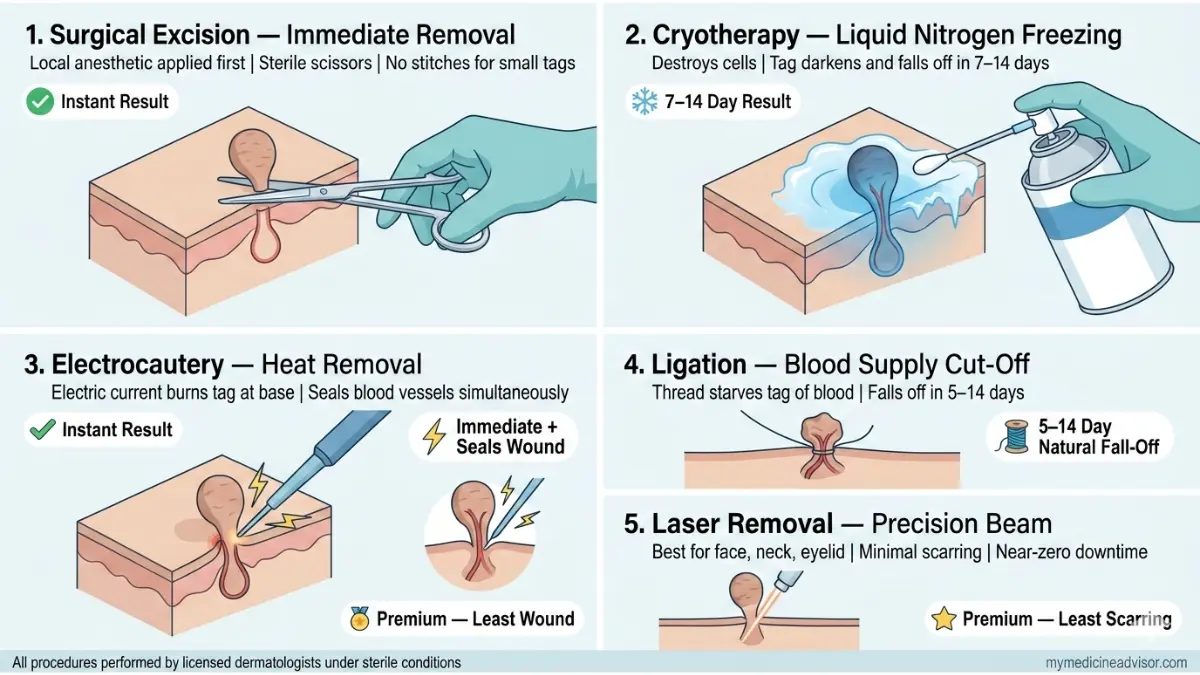
When you visit a dermatologist for skin tag removal, they will assess the size, location, and number of tags before recommending a method. Here are the five standard clinical approaches used in US dermatology offices in 2026, ranked by speed and suitability.
The American Academy of Dermatology (AAD) recommends professional removal for all skin tags in sensitive locations — and strongly advises against at-home removal near the eyes, genitals, or any growth that has changed in color, shape, or size.
1. Surgical Excision (Snipping)
The dermatologist numbs the area with a local anesthetic and snips the tag at its base with sterile surgical scissors or a scalpel. Results are immediate and permanent for that tag.
- Best for: Large tags, any location, definitive single-visit removal
- Pain level: Minimal — numbed before procedure
- Recovery: Minor scabbing for 3–7 days
2. Cryotherapy (Liquid Nitrogen Freezing)
Liquid nitrogen is applied directly to the tag, destroying the cells. The tag turns dark and falls off within 7–14 days.
- Best for: Small, flat tags; multiple tags in one session
- Pain level: Brief sting or burning sensation
- Recovery: Blister forms, then scabs — full healing in 2–4 weeks
3. Electrocautery / Electrosurgery
An electric current heats a fine probe that burns the tag off at the base, sealing the wound simultaneously.
- Best for: Multiple tags; reduces bleeding risk
- Pain level: Mild warmth, numbed
- Recovery: 1–3 days of minor redness
4. Ligation
Surgical thread or a medical band is tied tightly around the tag’s stalk, cutting off its blood supply. The tag dies and falls off within 5–14 days.
- Best for: Stalked tags; lower-impact option
- Pain level: Minimal
- Recovery: Tag falls off naturally; minimal aftercare required
5. Laser Removal
A focused laser beam severs the stalk and seals blood vessels simultaneously.
- Best for: Face, neck, eyelid tags where scarring must be minimized
- Pain level: Near-zero with topical numbing
- Recovery: Near-instant; minimal downtime
2026 Clinical Method Comparison Table
| Method | Speed of Results | Pain (Numbed) | Best Location | US Cost (2026) |
|---|---|---|---|---|
| Surgical Excision | Immediate | Minimal | Anywhere | $100–$500 |
| Cryotherapy | 7–14 days | Mild sting | Small tags, body | $100–$250 |
| Electrocautery | Immediate | Mild warmth | Multiple tags | $150–$300 |
| Ligation | 5–14 days | Minimal | Stalked tags | $100–$200 |
| Laser Removal | Immediate | Near-zero | Face, neck, eyelid | $200–$500 |
⚠️ Eyelid Warning: Skin tag removal on or near the eyelid must only be performed by a dermatologist or ophthalmologist. Standard OTC and at-home methods near the eye carry serious risks of injury, infection, and permanent vision damage. Before any eyelid area procedure, consider taking our free Eye Exam as a baseline visual health check.
DIY Skin Tag Removal — What Works, What’s Dangerous, and What Doctors Say Never to Do
The internet is full of skin tag removal hacks. Some OTC options are medically acceptable. Others have sent people to emergency rooms.
Here is the honest, evidence-based breakdown.
OTC Freeze Kits — The Acceptable Middle Ground
Over-the-counter cryotherapy kits (such as Compound W Skin Tag Remover) are the most medically defensible at-home option. They work similarly to clinical cryotherapy but at lower temperatures.
The limitation: OTC kits do not reach the same freezing temperatures as clinical liquid nitrogen (-195.8°C). This means they are less effective on larger or thicker tags and may require multiple applications.
Acceptable for: Small, thin-stalked tags on low-risk body areas (not face, not near eyes, not genitals). Always read the product instructions and confirm the growth is definitely a skin tag before use.
Tea Tree Oil, Apple Cider Vinegar, Toothpaste — The Verdict
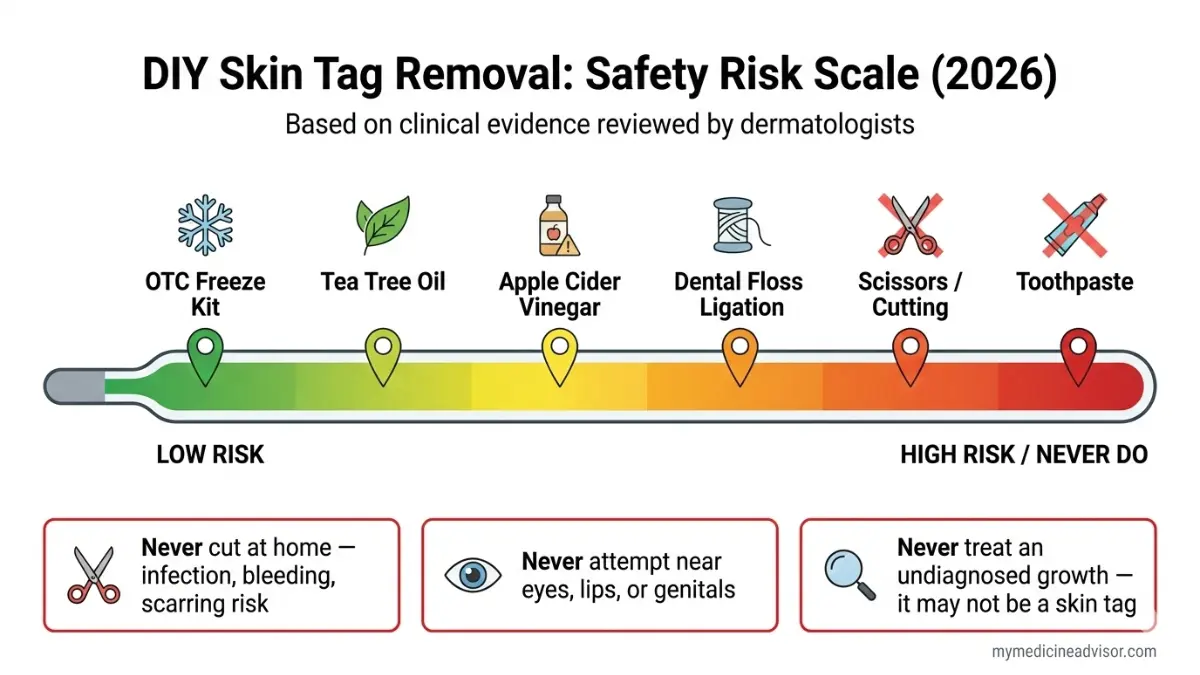
These are the most searched DIY methods online. Here is what the evidence actually shows:
| DIY Method | Scientific Evidence | Safety | Doctor Verdict |
|---|---|---|---|
| OTC Freeze Kits | Moderate (works at lower efficacy) | ⚠️ Acceptable with caution | OK for small, low-risk tags |
| Tea Tree Oil | Anecdotal only; no clinical trials | ✅ Low skin risk | Not recommended, but low harm |
| Apple Cider Vinegar | No clinical evidence; documented burn cases | ❌ Chemical burn risk | Not recommended |
| Toothpaste | No evidence whatsoever | ❌ Skin irritant | Never use |
| Scissors / Cutting | Works — but dangerous | ❌ Infection, bleeding, scarring | Never attempt at home |
| Dental floss ligation | Occasionally effective | ❌ Infection, incomplete removal | Doctor supervision only |
A documented case in dermatology literature describes a teenage patient who applied ACV to a facial mole nightly for three days. The vinegar removed the surface tissue — but also chemically burned the surrounding healthy skin, leaving a scar significantly more visible than the original growth.
The 3 Things Doctors Say You Must Never Do
- Do not cut a skin tag with household scissors. Home environments are not sterile. Tags contain blood vessels. Bleeding, infection, and incomplete removal are common outcomes.
- Do not attempt any removal near your eye, lips, or genitals. These areas have thin, sensitive skin and close proximity to critical structures.
- Do not use any product on a growth that has changed in color, shape, or bled spontaneously. That may not be a skin tag. It may be a sign worth checking — explore our guide to skin cancer warning signs to understand the differences.
Doctor vs. DIY — The Complete Head-to-Head Comparison
This is the section no competitor has built. Here is the honest, side-by-side verdict for 2026.
| Factor | Doctor Removal | DIY / At-Home |
|---|---|---|
| Effectiveness | ✅ 100% removal — permanent | ⚠️ Variable; may require multiple attempts |
| Safety | ✅ Sterile environment, expert technique | ❌ Infection, scarring, incomplete removal risks |
| Pain | Numbed — minimal discomfort | Moderate to significant |
| Cost | $100–$500 out-of-pocket | $10–$50 |
| Eyelid / Face tags | ✅ Safe with specialist | ❌ Do NOT attempt |
| Biopsy if needed | ✅ Can send tissue to pathology | ❌ Not possible |
| Insurance coverage | ✅ If medically necessary | N/A |
| Time to results | 15–30 min appointment, often same-day | Days to weeks |
| Risk of missed diagnosis | None — doctor examines growth | High — cancer look-alikes exist |
When Does Insurance Cover Skin Tag Removal?
Health insurance and Medicare generally classify skin tag removal as cosmetic — meaning it’s not covered unless the tag is causing a medical problem.
Insurance MAY cover removal if the skin tag is:
- Causing persistent pain, bleeding, or infection
- Interfering with body movement (e.g., armpit tag snagging repeatedly)
- Located in an area where its removal is medically indicated
Documentation matters. Your dermatologist must record the medical necessity in writing. Ask your provider directly before the appointment.
Special Cases: Pregnancy and Diabetes
Pregnancy: Hormonal changes during the second trimester frequently trigger new skin tag formation. Women often first notice multiple new tags when monitoring their pregnancy weight gain. Most dermatologists recommend waiting until after delivery before removal unless the tag is causing significant discomfort. Cryotherapy is generally avoided during pregnancy.
Diabetes and Insulin Resistance: Multiple studies have shown a consistent association between skin tags and insulin resistance. According to the CDC’s diabetes data, skin changes are a recognized external sign of metabolic changes related to type 2 diabetes. If you have multiple new skin tags and haven’t been tested for diabetes recently, it is worth raising with your physician. Our Blood Sugar Converter can help you track and interpret your blood sugar readings.
After Skin Tag Removal — Recovery, Aftercare, and Prevention
Most skin tag removal procedures are quick, with minimal downtime. Here is what to expect after each major method.
Recovery Timeline by Method
| Method | Day 1–3 | Day 4–10 | Week 2–4 |
|---|---|---|---|
| Excision | Small scab forms | Scab dries and shrinks | Skin heals; faint mark fades |
| Cryotherapy | Blister may form | Blister darkens, flattens | Tag and blister fall off |
| Electrocautery | Redness, slight crust | Crust falls off | Smooth skin revealed |
| Ligation | Tag darkens | Tag shrivels | Falls off naturally |
| Laser | Minimal redness | Subtle scab (if any) | Fully healed |
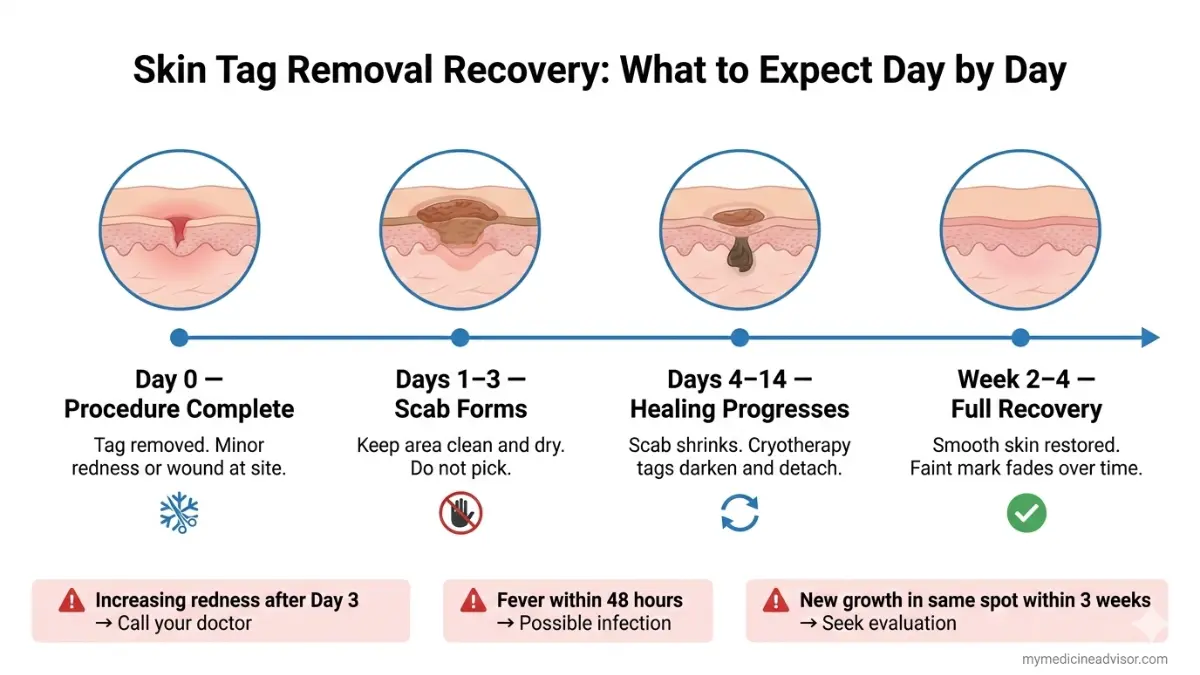
Aftercare Rules That Prevent Complications
- Keep the treatment area clean and dry for the first 24–48 hours
- Apply a thin layer of antibiotic ointment if your dermatologist recommends it
- Do not pick at scabs — this dramatically increases scarring risk
- Avoid direct sun exposure on the treated area for 4–6 weeks
- Watch for signs of infection: increasing redness, warmth, swelling, or discharge
Red Flag Signs — Call Your Doctor Immediately If:
- The removal site is actively bleeding and won’t stop
- You develop fever within 48 hours of the procedure
- The area becomes significantly swollen or produces pus
- A new growth appears in the same spot within 2–3 weeks
Can Skin Tags Be Prevented?
The same tag will not grow back once fully removed. However, your body may produce new ones — especially if the underlying causes remain.
Evidence-based prevention strategies:
- Maintain a healthy body weight. Reduced skin fold friction is the most effective prevention. Our Weight Loss Calculator and Ideal Weight Calculator can help you set and track meaningful targets
- Wear breathable, loose-fitting clothing in friction-prone areas (neck, armpits, groin)
- Manage blood sugar if you have prediabetes or type 2 diabetes — metabolic control is directly linked to reduced skin tag recurrence
- Avoid tight necklaces and collars that rub the neck repeatedly
Expert Verdict — What to Do Based on Your Situation
After reviewing the evidence, here is the clear framework dermatologists follow:
Choose doctor removal when:
- The tag is on your eyelid, face, neck, or genitals
- The growth has changed in size, color, or started bleeding
- You have multiple tags appearing rapidly (rule out diabetes first)
- The tag is larger than 5mm or has a thick stalk
- You want a single-visit, permanent solution
OTC options may be acceptable when:
- The tag is small, thin-stalked, and on a low-risk body area
- You have confirmed it is a skin tag (not a mole, wart, or other growth)
- You follow product instructions carefully and stop immediately if skin irritates
Always avoid DIY when:
- The tag is near the eye, mouth, or genitals
- You have diabetes, a clotting disorder, or compromised immune function
- You are pregnant
For those with a family history of multiple skin tag clusters, it may be worth using our Genetic Risk Assessment Tool to build a clearer picture of your personal health profile. Skin tags that co-occur with conditions like Birt-Hogg-Dubé syndrome are rare but worth monitoring with professional guidance.
If you’re concerned about what a skin growth might be, also read our expert guide on basal cell cancer cure rates and treatment — since basal cell carcinoma is sometimes initially mistaken for a benign skin tag.
⚕️ Key Takeaways:
- Skin tags are benign and affect nearly half of all adults
- Doctor removal is safe, fast, and often costs $100–$300 per session
- OTC freeze kits are the only DIY method with any medical basis — use with caution
- Apple cider vinegar, scissors, and toothpaste have no clinical evidence and documented risks
- Multiple new skin tags may signal insulin resistance — worth discussing with your physician
- Eyelid and genital skin tags always require professional removal
Frequently Asked Questions
1. What is the fastest way to remove a skin tag?
Surgical excision by a dermatologist is the fastest method — the tag is removed in seconds during a single office visit, with same-day results.
2. Does skin tag removal hurt?
Clinical procedures use local anesthetic, so discomfort is minimal. OTC freeze kits cause a brief sting. DIY cutting is significantly more painful and risky.
3. Can I remove a skin tag myself safely?
Only small, thin, confirmed skin tags on low-risk areas may be treated with an OTC cryotherapy kit. All other cases should be handled by a dermatologist.
4. How much does skin tag removal cost in 2026?
Dermatologist removal ranges from $100 to $500 depending on the method and number of tags. Cryotherapy ($100–$250) and ligation ($100–$200) are typically the most affordable clinical options.
5. Will skin tags grow back after removal?
Once fully removed, the same tag will not return. However, new skin tags may develop elsewhere — especially if underlying risk factors like obesity or insulin resistance are not addressed.
6. Does insurance cover skin tag removal?
Generally no — it is considered cosmetic. Coverage may apply if the tag causes pain, bleeding, infection, or functional impairment, provided your doctor documents medical necessity.
7. Can a skin tag be a sign of cancer?
Skin tags themselves are benign and non-cancerous. However, certain skin cancers can mimic the appearance of a skin tag. Any growth that bleeds, grows rapidly, or changes color should be evaluated by a dermatologist before any removal attempt.
8. Is skin tag removal safe during pregnancy?
Most dermatologists recommend waiting until after delivery. Cryotherapy is generally avoided during pregnancy. Surgical excision may be considered in cases of significant discomfort, under specialist guidance.
9. What should I never do to remove a skin tag?
Never cut it with household scissors, apply apple cider vinegar, use toothpaste, or attempt any removal near the eye, genitals, or any growth you haven’t had professionally assessed.
10. How long does it take for a skin tag to fall off after treatment?
Cryotherapy and ligation: 7–14 days. Laser and electrocautery: near-immediate. Surgical excision: immediate removal at the appointment.
11. Are skin tags linked to diabetes?
Yes. Research and CDC guidance on diabetes and skin changes confirm a consistent link between skin tags and insulin resistance. Multiple new skin tags are worth discussing with your physician, particularly if you have other metabolic risk factors.
Medically reviewed by the mymedicineadvisor.com Expert Panel | Sources: NCBI StatPearls — Skin Tag (Acrochordon), American Academy of Dermatology, NHS Skin Tags, CDC Diabetes and Skin
About this content
How this article was put together: researched from recognised health sources, drafted with the help of AI tools, and edited by hand, with sources linked throughout.

Sameer Patel is the founder and editor of My Medicine Advisor. He is not a doctor or medical professional — before starting this site he worked in banking,…
Medical disclaimer
The content on MyMedicineAdvisor is provided for general informational and educational purposes only and is not a substitute for professional medical advice, diagnosis, or treatment. Health information on this website should not be used to diagnose, treat, cure, or prevent any condition without guidance from a qualified healthcare professional. Always seek the advice of your doctor, physician, or another licensed healthcare provider with any questions you may have regarding a medical condition, symptoms, medications, or treatment decisions.