
On This Page – Quick Medical Summary
Skin cancer signs usually come down to three things: a new spot, a changing spot, or a sore that won’t heal. Basal and squamous cell cancers, the most common types, tend to look like shiny pink bumps or rough, scaly patches, while melanoma more often starts as a new or changing dark spot.
None of these signs calls for emergency care. Each one is worth showing to a dermatologist, though, because only a biopsy can confirm skin cancer.
12 skin cancer signs at a glance
Each row pairs a change you might notice with the cancer it most often points to and where it usually shows up.
| What you notice | Most often linked to | Where it tends to appear |
|---|---|---|
| A spot unlike your other moles | Melanoma | Anywhere on the body |
| A mole that grows, changes outline or darkens | Melanoma | A mole you already had |
| Uneven halves, ragged edges, several colors, wider than 6 mm | Melanoma | Moles and dark spots |
| Pigment or redness spreading past a spot’s edge | Melanoma | Skin around a mole |
| A mole that itches, hurts, bleeds, crusts or oozes | Melanoma | Existing moles |
| A pearly bump or a pink growth with a raised rim | Basal cell carcinoma | Face, head, neck, arms |
| A flat, firm, pale or yellow patch like a scar | Basal cell carcinoma | Areas that get regular sun |
| A sore that bleeds, crusts, or heals and comes back | Basal or squamous cell carcinoma, sometimes melanoma | Anywhere |
| A rough patch you can feel | Actinic keratosis (precancer) or squamous cell carcinoma | Face, lips, scalp, backs of hands |
| A firm dome or wart-like lump | Squamous cell carcinoma | Sunny areas, old scars |
| A dark nail streak, or a dark patch on a palm or sole | Acral melanoma | Nails, palms, soles |
| A fast-growing red or pink bump that doesn’t hurt | Merkel cell carcinoma | Sun-exposed skin, mostly after age 50 |
Sources: American Cancer Society (signs of the two most common types, melanoma signs); American Academy of Dermatology; Heath and colleagues, 2008.
When a mole starts to change
A new spot, or one that changes in size, shape or color, is the most important warning sign of melanoma. Melanoma can arise in clear skin or in or near a mole you already have, so both count.
One spot that doesn’t match the rest
Most people’s moles resemble one another. A spot that looks different from all the others is called the ugly duckling sign. Clinicians use it alongside the ABCDE rule to judge pigmented spots during a skin exam (USPSTF skin cancer screening statement).
Uneven halves and ragged edges raise concern
The ABCDE rule describes how a worrying spot looks: asymmetry, an irregular border, color that isn’t uniform, a diameter greater than 6 mm, and evolving, meaning it changes over time. The full ABCDE breakdown covers each letter.
The American Cancer Society notes that some melanomas don’t fit these rules at all, including melanomas with little or no dark color. A pink or skin-colored spot that keeps changing still needs a look.
Color leaking past the edge
Pigment that spreads from a spot’s border into the surrounding skin is a warning sign by itself. So is redness or new swelling just beyond the edge of a mole.
Why would a mole itch or bleed?
A shift in how a mole feels, such as itching, tenderness or pain, can be a melanoma sign. So can a change in its surface: scaliness, oozing, bleeding, or a new bump rising from it.
Shiny bumps and scar-like patches
On the face, head, neck and arms, the most frequent skin cancer often looks nothing like a mole. Basal cell carcinoma grows slowly and rarely spreads beyond the skin, but it can grow deeper if it isn’t treated early.
Some bumps look pearly and translucent
The typical basal cell cancer is a small pink or red bump that looks shiny or pearly and slightly see-through, sometimes with blue, brown or black areas inside it.
A pink growth with a raised rim and a dip
Another form has raised edges around a lower center. Tiny abnormal blood vessels may spread across the surface like the spokes of a wheel.
In people with darker skin, these cancers usually keep the shine and the raised edge but are often darker in color.
What does a scar-like patch feel like?
Firm. This form is flat, pale or yellow, and can resemble a scar while showing only a slight change from normal skin. Some basal cell cancers appear instead as raised reddish patches that itch.
Sores that outlast a week need a look
Basal cell cancers are fragile. They can bleed after shaving or a minor knock, and some form open sores that ooze or crust, heal, then return. Most ordinary cuts and sores heal within a week or so, so a sore still open well past that point is worth showing to a doctor.
Is a rough, scaly patch skin cancer?
It can be the step before it. A rough, scaly patch on sun-damaged skin is often an actinic keratosis, a growth that is not yet cancer, and some actinic keratoses turn into squamous cell carcinoma.
It often starts as a rough feel
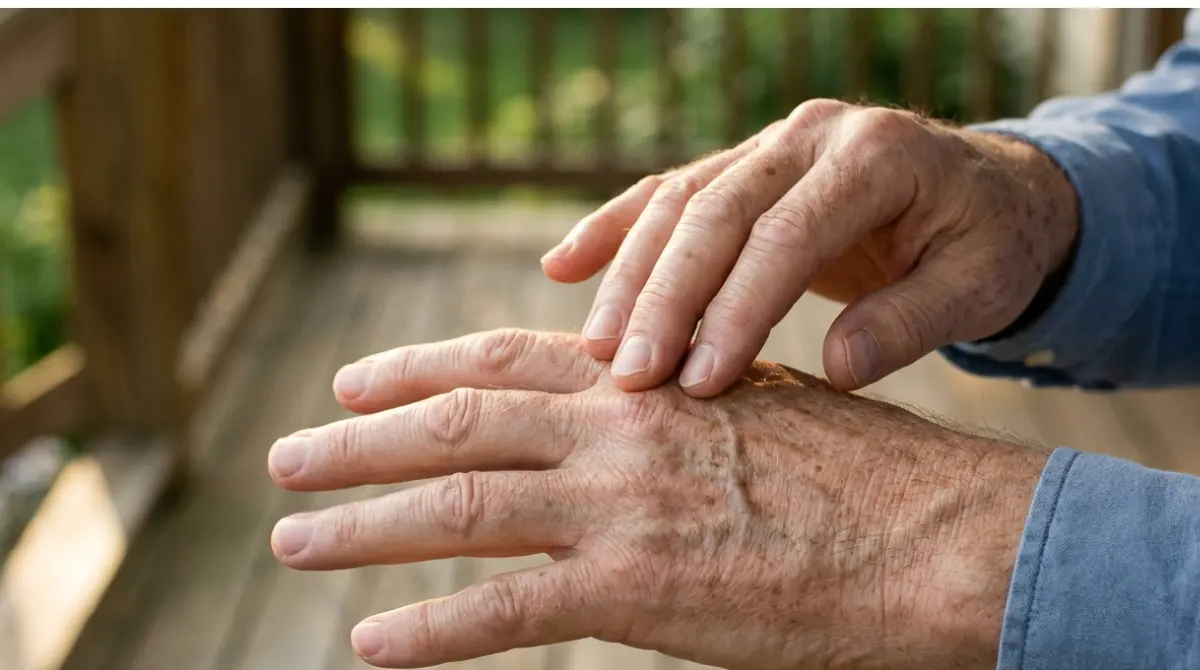
Run your fingertips over your face, lips, scalp and the backs of your hands. An actinic keratosis usually begins as a patch of rough-feeling skin that may hurt when rubbed. Many are dry and pink or red. Some are brown and pass for age spots, but they feel rough where age spots don’t.
A firm, dome-shaped lump
Squamous cell carcinoma often rises as a raised, domed growth. It can also look like a scaly red patch that crusts or bleeds, a wart-like growth, or an open sore.
On lighter skin it usually appears on the face, ears, neck, lips and backs of the hands. On darker skin it more often forms on areas that rarely see the sun, and it can also start in an old scar or a long-standing sore.
Two signs people often miss
Not every skin cancer grows where the sun hits hardest, and not every one is dark or painful.
Dark streaks in nails, spots on palms and soles

Melanoma under a fingernail or toenail can appear as a dark line or streak, and on the palms or soles as a dark, irregular patch. A streak that has just appeared or keeps changing is the one to have checked.
This form, acral melanoma, is the most common type of melanoma among Black people. People with darker skin are often diagnosed at a later stage, when treatment is harder. There is more on melanoma under the nail and how melanoma shows up in skin of color.
Merkel cell carcinoma grows fast and often doesn’t hurt
Merkel cell carcinoma is rare, and its early look is easy to dismiss. A cohort study followed 195 people with it (Heath and colleagues, 2008):
- 88% of tumors were not tender, even though 63% had grown quickly in the previous 3 months.
- 56% were first assumed to be harmless, most often a cyst or an acne-like bump.
The authors summed up the pattern as AEIOU: asymptomatic, expanding rapidly, immune suppression, older than 50, and a UV-exposed site on fair skin. Nearly 9 in 10 tumors had three or more of these features. A red bump that keeps growing without hurting was the combination they flagged as most concerning.
Note: The descriptions and photos on this page show typical examples. Skin cancers can look different from them, so any growth or open sore that worries you deserves a doctor’s look even if it matches nothing here.
Does one of these signs mean you have cancer?
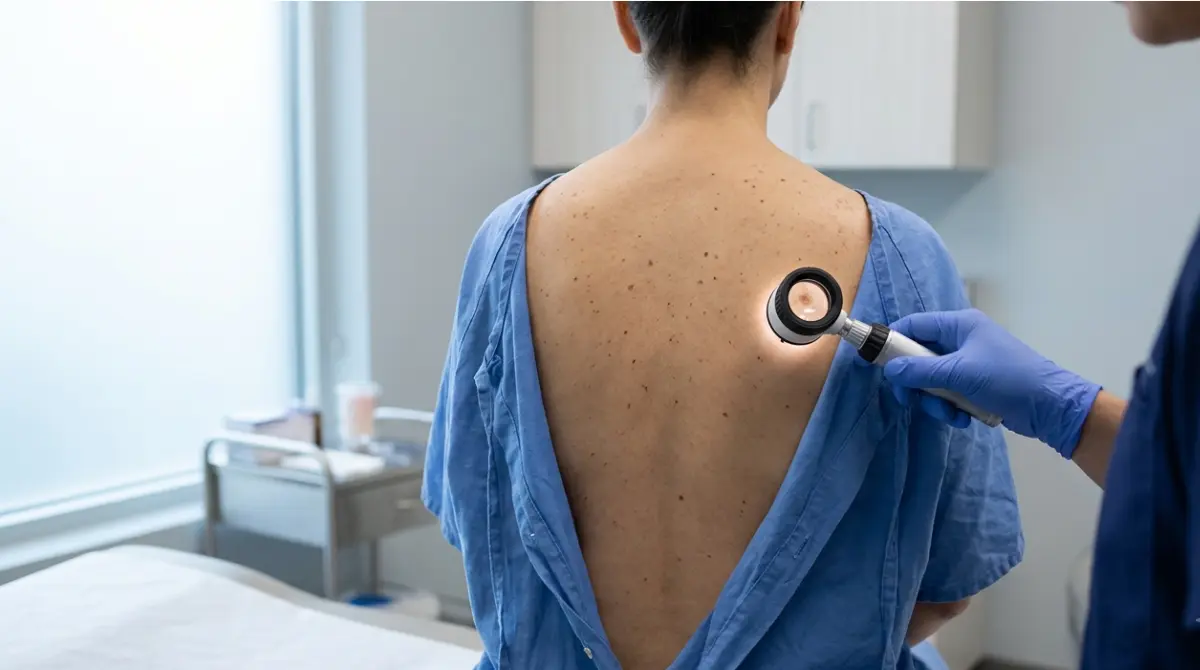
No. A sign means the spot needs a closer look. A dermatologist examines it with the naked eye or a dermatoscope, a handheld magnifying device, and only a biopsy can confirm skin cancer. The guide to what a skin biopsy involves covers that step.
In 2023, the US Preventive Services Task Force found the evidence insufficient to recommend for or against routine skin checks in people without symptoms (final recommendation). That statement excludes people who have noticed a skin growth changing, so it is no reason to wait.
Melanoma makes up about 1% of skin cancers yet causes most skin cancer deaths. Basal and squamous cell cancers are far more common and rarely lead to death or serious harm. They often cause no bothersome symptoms until they have grown large.
At the appointment, ask your doctor three things:
- Which type of skin cancer, if any, does this spot look like?
- Will you biopsy it today, and when will the results come back?
- Is there anything else on my skin you want to check?
If a biopsy does show melanoma, the next questions are about melanoma stages and treatment.
Photograph the spot, then book a skin exam
Take a clear photo of the spot next to a ruler today, so any change is easy to see later. Many doctors recommend checking your own skin about once a month in a well-lit room, with a full-length mirror and a hand mirror for hard-to-see areas.
A body map is a simple outline of the body where you mark each mole, which makes new spots easier to notice. Close checks matter most for people who have had skin cancer before, have many moles, have a strong family history or have a weakened immune system.
When you book, mention if the spot is growing fast or bleeding without an injury. Rapid growth is one of the features that raised concern in the Merkel cell study.
Found this helpful? See more of our guides on Google.
Want to see our guides first on Google?
Found this helpful? See more of our guides on Google.
About this content
How this article was put together: researched from recognised health sources, drafted with the help of AI tools, and edited by hand, with sources linked throughout.

Dr. Pooja Sahu, MBBS, is a medical reviewer for MyMedicineAdvisor. She is a clinical physician whose experience includes serving as a Junior Resident in Nephrology at Dr. Ram…
Medical disclaimer
The content on My Medicine Advisor is provided for general informational and educational purposes only and is not a substitute for professional medical advice, diagnosis, or treatment. Health information on this website should not be used to diagnose, treat, cure, or prevent any condition without guidance from a qualified healthcare professional. Always seek the advice of your doctor, physician, or another licensed healthcare provider with any questions you may have regarding a medical condition, symptoms, medications, or treatment decisions.