
On This Page – Quick Medical Summary
What the anion gap on your blood test actually is
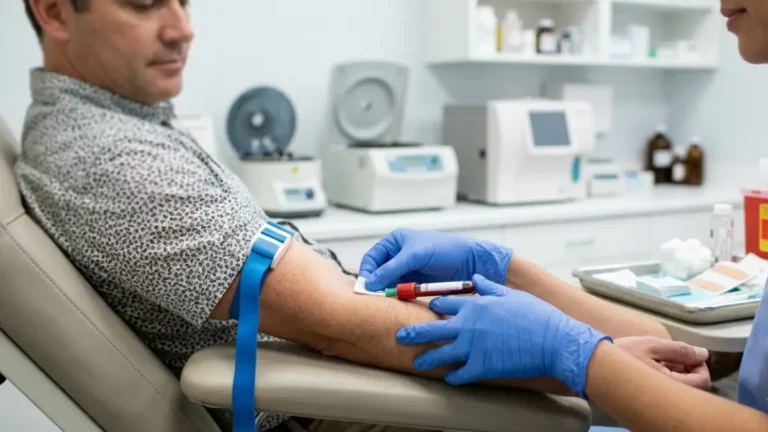
Nobody ran an extra test on you. If your report shows a line labeled anion gap, that number was worked out from results already printed on the page.
Flagged high? The high-result section below explains what it points toward. Flagged low? The albumin section covers most low results. Fast, deep breathing, vomiting you cannot keep down, or new confusion right now? Read the emergency section first and get care today.
According to the National Library of Medicine’s patient page on the anion gap blood test, the gap measures the difference between the negatively and positively charged electrolytes in your blood. A higher number means the blood is more acidic than normal; a lower number means it is not acidic enough. Neither is a diagnosis on its own — it is one line among the eight results on a basic metabolic panel.
ℹ️ Medical Disclaimer: This is general education about a laboratory calculation. It does not diagnose any condition, interpret your results, recommend or adjust medication, or advise on any procedure or insurance decision. Lab values must be read with your history, symptoms, and the rest of your panel by a clinician who can examine you. Consult a board-certified primary care physician — or a nephrologist or endocrinologist if referred — before acting on anything here. Call 911 for emergency symptoms.
Why your report shows a number the lab never measured
Your laboratory measured sodium, chloride, and carbon dioxide, then did subtraction.
Which results your anion gap comes from
The calculation takes the positively charged particles your panel measures — sodium, plus potassium at some laboratories — and subtracts the negatively charged ones, chloride and bicarbonate, printed on most reports as CO2. Find those lines and you have found the ingredients.
Your gap may come from an electrolyte panel, a basic metabolic panel, a comprehensive metabolic panel, or a renal function panel. It is the second BMP value produced by arithmetic rather than measurement; the other value your panel calculates rather than measures works the same way.

Why two labs can report different gaps from the same blood
Some laboratories include potassium in the formula and some leave it out, because potassium contributes comparatively little, per the NIH-hosted clinical reference on how the anion gap works. The same sample, run both ways, yields two different numbers. Both are correct.
🔬 How It Works: There is no literal gap inside your blood. The body carries no net electrical charge, so a leftover number appears only because the panel measures some charged particles and not others — chiefly proteins.
Why “normal” anion gap ranges don’t agree online
There is no single normal anion gap. Published values differ depending on whether potassium sits in the formula and how a laboratory measures the electrolytes — which is why two authoritative sources can print different ranges and both be right.
What different authorities actually publish
| Source | What it publishes as normal | Key clinical detail |
|---|---|---|
| StatPearls, Biochemistry, Anion Gap, NIH-hosted, updated July 2023 | 4–12 mmol/L | Normal gap depends on serum albumin and phosphate |
| StatPearls, Anion Gap and Non-Anion Gap Metabolic Acidosis, NIH-hosted, updated August 2025 | 8–12, or 12–16 with potassium included | Two accepted formulas, two ranges |
| MedlinePlus, National Library of Medicine, updated October 2024 | No range published; states normal results vary by lab | Defers to the testing laboratory |
| Your own report | The range printed beside your result | Set by your lab’s method and reference population |
Figures verified against the cited NIH and NLM pages in July 2026.
Why your own previous result matters more than any published range
The range beside your result is the one your laboratory validated on its own instruments, and it is the only one that applies to you. A figure copied from a search result may sit several points away for reasons unrelated to your health.
Clinicians also compare a gap against the same person’s earlier gap from a time they were well, so older blood work tells you more than any published figure. For how these intervals are built, see how BMP reference ranges are set.
What a high anion gap can point to
A high anion gap usually means acid has built up faster than the body clears it. Reported causes include:
- dehydration
- too much exercise
- kidney disease
- diabetes, including diabetic ketoacidosis
- salicylate poisoning, such as from too much aspirin
- antifreeze poisoning

Acids that build up and widen the gap
Those causes share a mechanism. Acids the panel never measures — lactate, ketones, or the breakdown products of a swallowed poison — accumulate and push the number up, per the clinical reference on high and normal anion gap acidosis. Failing kidneys widen it differently, by retaining acids they would normally excrete.
Because diabetes sits on that list, read your glucose line beside the gap: what a high glucose result can mean covers it, and our blood sugar converter switches between mg/dL and mmol/L.
When a high gap is expected rather than alarming
Some medicines belong here too. Metformin is a recognized cause of lactic acidosis, which is why prescribers watch kidney function in people taking it — see how a metabolic panel monitors medicines. Never change a prescription because of a lab number.
A gap slightly outside your lab’s range, in someone who feels well, is frequently explained by something already on the panel.
✅ Patient Action: Ask your primary care physician: “Is my high anion gap explained by anything else on this panel — my glucose, my kidney results — or does it need follow-up testing?”
What a normal anion gap does not rule out
A gap inside your laboratory’s range is not proof that your acid-base balance is fine.
When acid problems don’t move the gap
🔬 How It Works: Metabolic acidosis always lowers bicarbonate. Because blood carries no net charge, something has to take bicarbonate’s place — either chloride, which the panel measures and which leaves the gap unchanged, or an acid it does not measure, which widens it.
The version that leaves the gap alone is called hyperchloremic acidosis. Its most common causes are diarrhea, which drains bicarbonate through the gut, and renal tubular acidosis. Large volumes of intravenous saline produce it too.
Reading the gap alongside your CO2 and chloride
This is why the number is read with the panel around it. Chloride and CO2 on a metabolic panel carry part of the same story, and what an abnormal BMP result can mean covers the lines beside it. A normal gap next to a low CO2 is worth raising with your primary care physician; ask whether your bicarbonate has shifted since your last panel.
Why a low anion gap usually means albumin or a lab issue
A low anion gap is uncommon enough that providers usually repeat the test first, to confirm the result is accurate.

Low albumin as the usual explanation
When the number holds up on a repeat, the most common cause is a low level of albumin, a protein made by your liver. Low albumin can reflect not eating enough protein, kidney problems, liver disease, heart disease, or some cancers — what causes low albumin and how a panel reads your kidneys cover those routes.
🔬 How It Works: Albumin carries a negative charge and is the largest of the charged particles your panel never measures. Less albumin means fewer unmeasured negatives, so the calculated number shrinks — even when nothing about your acid-base balance has changed.
Why your BMP can’t check the most likely cause
Albumin is not one of the eight results on a basic metabolic panel. Per the albumin blood test page, it sits on a comprehensive metabolic panel — the 14-substance version — alongside total protein and the liver markers. If your panel was a BMP, the likeliest explanation for your low gap is not on the page in front of you.
It cuts the other way too. Because low albumin drags the calculated number down, it can leave a real acid problem looking unremarkable, which is why clinicians adjust the gap for albumin before interpreting it.
Symptoms that mean you should be seen today
Most people reading this have a mildly flagged number and feel well. This section is for the smaller group who do not.

Symptoms reported with acidosis and alkalosis
The National Library of Medicine lists shortness of breath, vomiting, confusion, fatigue, and a very fast heartbeat among the symptoms of acidosis. For alkalosis it lists an irregular heartbeat, irritability, hand tremor, muscle twitching, nausea and vomiting, and numbness or tingling in the face, hands, or feet.
Warning signs of diabetic ketoacidosis
DKA usually starts quietly, with extreme thirst and urinating far more than usual, according to the CDC’s page on diabetic ketoacidosis. Severe signs follow faster: fast, deep breathing, dry skin and mouth, a flushed face, fruity-smelling breath, headache, aching or stiff muscles, exhaustion, nausea and vomiting, and stomach pain. Sometimes DKA is the first noticeable sign of diabetes in someone not yet diagnosed.
⚠️ Clinical Warning: The CDC advises calling 911 or going to the emergency room right away if blood sugar stays at 300 mg/dL or above, breath smells fruity, vomiting prevents you keeping food or drink down, breathing becomes difficult, or several signs of DKA appear together.
✅ Patient Action: With these symptoms and a flagged anion gap, call your primary care physician’s office today and ask: “Should I be seen now, or at my scheduled appointment?” Dangerous values do not sit unread — see how labs handle critical results.
Anion gap questions people ask most
1. Is the anion gap a separate blood test?
No. The anion gap is calculated from results your laboratory already produced, not from a separate blood draw. It may be derived from an electrolyte panel, a basic metabolic panel, a comprehensive metabolic panel, or a renal function panel. If it appears on your report, no additional needle was involved — the laboratory ran the arithmetic on values it had measured.
2. How is the anion gap calculated?
Your laboratory subtracts the negatively charged particles it measured — chloride and bicarbonate, printed on most reports as CO2 — from the positively charged ones, meaning sodium and, at some laboratories, potassium. The leftover figure is your gap. Because potassium contributes comparatively little, many laboratories leave it out entirely, which changes the number.
3. What is a normal anion gap range?
There is no single normal range. Published values differ according to whether potassium is in the formula and how a laboratory measures the electrolytes, so authoritative sources genuinely disagree. The range printed beside your result is the one your laboratory validated on its own instruments, and it is the only one that applies to your result.
4. Is a high anion gap dangerous?
It depends what is driving it. A high gap signals that acid has built up faster than the body clears it, and reported causes range from dehydration and heavy exercise to kidney disease, diabetic ketoacidosis, and poisonings. A number slightly outside range in someone who feels well is often explained by the rest of the panel. Ask your primary care physician to interpret it alongside your other results.
5. Can dehydration raise the anion gap?
Yes. Dehydration appears among the reported causes of a high anion gap, alongside too much exercise, kidney disease, diabetes, salicylate poisoning, and antifreeze poisoning. That does not mean dehydration explains your particular result — the same number has several possible causes, and only your clinician can weigh them against your history and symptoms.
6. Can a normal anion gap still mean acidosis?
Yes. In metabolic acidosis bicarbonate always falls, and if chloride rises to replace it the gap stays normal. This form is called hyperchloremic acidosis, and its most common causes are diarrhea and renal tubular acidosis. A normal gap beside a low CO2 is worth raising with your primary care physician at your next appointment.
7. What causes a low anion gap?
Low results are uncommon enough that providers usually repeat the test first to confirm accuracy. When the result holds, the most common cause is low albumin, which can reflect insufficient dietary protein, kidney problems, liver disease, heart disease, or some cancers. Because albumin is not measured on a basic metabolic panel, confirming it takes another test. Ask your clinician whether your albumin has been checked.
8. When should I call my doctor about my anion gap?
Call the same day if a flagged gap comes with shortness of breath, vomiting, confusion, extreme fatigue, or a very fast heartbeat. Seek emergency care immediately for fruity-smelling breath, fast deep breathing, or several signs of diabetic ketoacidosis together. Otherwise, bring the result to your next scheduled visit with your primary care physician.
What to do with your anion gap result
The most useful thing you can do with this number takes about ten seconds: look at the range printed beside it on your own report, not one you found online, and see where your result falls.
Then write one question for your next appointment. If the gap ran high, ask whether anything else on the panel explains it. If it ran low, ask whether your albumin has been checked. Bring older blood work — your own earlier result beats any published range.
The gap is one line on a panel built to be read as a set. The full basic metabolic panel and what each of the eight results shows puts it back in context.
About this content
How this article was put together: researched from recognised health sources, drafted with the help of AI tools, and edited by hand, with sources linked throughout.

Sameer Patel is the founder and editor of My Medicine Advisor. He is not a doctor or medical professional — before starting this site he worked in banking,…
Medical disclaimer
The content on MyMedicineAdvisor is provided for general informational and educational purposes only and is not a substitute for professional medical advice, diagnosis, or treatment. Health information on this website should not be used to diagnose, treat, cure, or prevent any condition without guidance from a qualified healthcare professional. Always seek the advice of your doctor, physician, or another licensed healthcare provider with any questions you may have regarding a medical condition, symptoms, medications, or treatment decisions.