

On This Page – Quick Medical Summary
The number on your report that isn’t really a test
Non-HDL cholesterol is your total cholesterol minus your HDL. Nothing was drawn or measured for it — it is arithmetic on two numbers already on your lipid panel.
If that line is flagged while your LDL is not, go to the section on how the two disagree. If your report shows no non-HDL line, the section on why it goes missing shows how to work it out. For a healthy figure, go to the levels section.
An unexplained value on a blood test result is unsettling, especially when it is flagged high. This one is not a new diagnosis — it regroups cholesterol you have already been shown, and which lipid panel numbers are measured and which are worked out makes the rest of the report easier to read.
📊 Clinical Data Point: From 2017 to 2020, 86.4 million US adults aged 20 or older had high or borderline-high total cholesterol — 200 mg/dL or above — Source: CDC, Testing for Cholesterol (reviewed May 2024), which also notes it usually produces no symptoms.
ℹ️ Medical Disclaimer: This article is general health education about how one laboratory value is produced and reported. It does not diagnose, set a treatment target, or recommend starting, stopping or adjusting any medication, procedure or insurance decision. Cholesterol targets are individual — consult a board-certified primary care physician or cardiologist before acting on your results.
What the non-HDL number actually contains
Your blood carries cholesterol on several particle types, and they do not all behave alike. HDL carries cholesterol away from artery walls; subtracting it from the total leaves everything in the other group.
Why subtracting HDL leaves the part that builds plaque
The National Library of Medicine’s plain-language cholesterol page defines non-HDL as your total cholesterol minus your HDL, and states it includes LDL and other types such as VLDL. One subtraction gathers the group into a single figure.
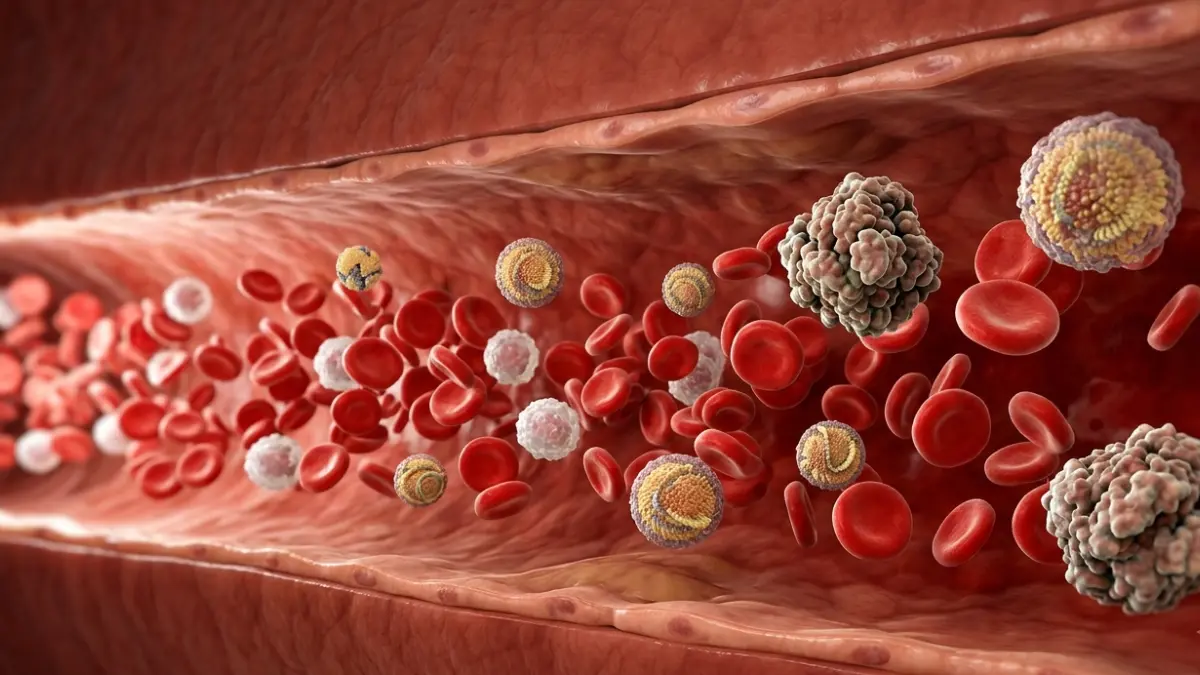
The particles LDL alone doesn’t count
VLDL mainly carries triglycerides, LDL mainly cholesterol. VLDL is not usually reported on a routine cholesterol test because it is difficult to measure directly, so a laboratory estimates it from your triglyceride level.
🔬 How It Works: Your total cholesterol already contains every cholesterol-carrying particle in the sample, helpful and harmful together. Removing the HDL portion leaves what is being deposited rather than cleared. That is the whole mechanism — no assay, no new sample.
Calculated doesn’t mean estimated — and that matters here
Most explanations of non-HDL stop here. Two values on your report are worked out rather than measured — and not the same way.
How each number on your report gets there
MedlinePlus notes your LDL may say “calculated” — estimated from your total cholesterol, HDL and triglycerides — or be measured directly. Non-HDL is different: a subtraction of two values measured on your sample.
| Value | How it reaches the report | What it assumes | Key clinical detail |
|---|---|---|---|
| Total cholesterol | Measured directly | — | Starts the subtraction |
| HDL cholesterol | Measured directly | — | The portion removed |
| Triglycerides | Measured directly | — | Most food-sensitive |
| LDL cholesterol | Estimated, or measured directly | A triglyceride-to-VLDL ratio | Rests on that assumption |
| Non-HDL cholesterol | Subtracting two measured values | Nothing beyond its inputs | Independent of the estimate |
Source: MedlinePlus, Cholesterol Levels (October 2024); 2026 ACC/AHA dyslipidemia guideline.

What the LDL estimate assumes that non-HDL doesn’t
A published comparison of the equations laboratories use to estimate LDL sets out the limits. Friedewald divides triglycerides by a fixed factor of 5, which is not accurate in every person. It is inappropriate at triglycerides of 400 mg/dL or above, and the newer Martin-Hopkins method replaces it with a factor set by your own triglyceride and non-HDL levels.
🔬 How It Works: The empty cell in that table is the point. Non-HDL inherits whatever affects its two inputs and adds nothing of its own — one reason what each value on a lipid panel represents matters before comparing them to a target.
Why your report may not show a non-HDL line
Not every laboratory prints it, and not every description of the test mentions it. The CDC’s page on cholesterol testing lists four checks — LDL, HDL, triglycerides and total cholesterol — and no non-HDL.
Where non-HDL hides on a lab report
How a lab reports a calculated versus a directly measured LDL sits on a MedlinePlus page whose summary lists four measures while its results tables carry a Non-HDL row. Both are correct, answering different questions. A derived value belongs under what results mean rather than what the test measures — which is also why sources count the tests in a lipid panel differently.
How to work out your own non-HDL in one subtraction
- Find the total cholesterol figure on your report, in mg/dL.
- Subtract the HDL figure from it. The result is your non-HDL cholesterol.
As a worked example only: 200 minus 50 gives 150. If the layout is the obstacle, reading a lab report line by line covers the structure.
What counts as a healthy non-HDL level
Two kinds of number get quoted here and are routinely mixed: a desirable level for the general population, and a treatment goal for a specific high-risk group.
Desirable levels for adults and for under-19s
MedlinePlus publishes these as desirable levels — healthy for most people, not targets.
| Group | Desirable non-HDL | Key clinical detail |
|---|---|---|
| Age 19 or younger | Less than 120 mg/dL | Lower than adults |
| Men age 20 or older | Less than 130 mg/dL | Same as women |
| Women age 20 or older | Less than 130 mg/dL | Same as men |
Source: MedlinePlus, Cholesterol Levels: What You Need to Know (May 2025).

Why a treatment goal is a different kind of number
The 2026 dyslipidemia guideline’s key points for clinicians record that LDL and non-HDL goals have been restored to guide lipid-lowering therapy. For secondary prevention in people at very high risk of a cardiovascular event, it recommends LDL below 55 mg/dL and non-HDL below 85 mg/dL. Coronary artery calcium scoring can help set both.
Each pair sits 30 mg/dL apart. That gap reflects cholesterol on triglyceride-rich particles, estimated by the classic convention as triglycerides divided by 5 — about 30 at a triglyceride of 150 mg/dL, the level MedlinePlus calls normal. Your figure depends on your risk; the risk factors that shape a cholesterol target vary, and a genetic risk assessment helps organise family history.
✅ Patient Action: Ask your primary care physician, or cardiologist if you are under cardiac care: “Given my risk category, what non-HDL number are you aiming for?”
When your LDL looks fine and your non-HDL doesn’t
The two can disagree, and that disagreement carries information. It is most likely when triglycerides are raised.
Why the two numbers can disagree
Non-HDL counts cholesterol on triglyceride-rich particles the LDL figure treats separately. The comparison cited earlier found Friedewald underestimates LDL below 70 mg/dL when triglycerides reach 150 mg/dL, and that a non-fasting sample overestimates VLDL. The 2026 guideline was retitled from blood cholesterol to dyslipidemia partly to reflect risk from particles beyond LDL.
What high triglycerides or diabetes change
That guideline states apolipoprotein B testing can be useful once LDL and non-HDL goals are met, particularly with triglycerides above 200 mg/dL, diabetes, or an achieved LDL below 70 mg/dL. It describes apoB as identifying residual risk the standard panel may underestimate. The pattern of high triglycerides alongside low HDL is the common setting, often appearing when blood sugar is drifting upward.

⚠️ Clinical Warning: An LDL result inside the reference range does not establish that your other cholesterol-carrying particles are at goal. Where the two diverge, that is a reason to ask at your next appointment — not to change anything on your own.
Non-HDL and the cholesterol ratio on your report
Some reports print a ratio as well. It is a different kind of measurement, and the difference is worth knowing.
What the ratio tells you that non-HDL doesn’t
A ratio divides total cholesterol by HDL and gives a proportion; non-HDL subtracts one from the other and gives a quantity in mg/dL. As an illustration: 160 total with 40 HDL, and 240 with 60 HDL, both give a ratio of 4 — while their non-HDL figures are 120 and 180.
The 2026 guideline states its restored goals as LDL and non-HDL figures. Fasting rules differ between laboratories, so follow the instructions you were given; when a blood test actually requires fasting explains why.
The one question worth asking
If your result came back high, what to do in the weeks afterwards is the practical next step.
✅ Patient Action: Ask the clinician managing your cholesterol: “Which number are you tracking for me — LDL, non-HDL, or both — and what would change the plan?”
Non-HDL cholesterol: common questions
1. What does non-HDL cholesterol include?
Non-HDL cholesterol includes every cholesterol-carrying particle except HDL. MedlinePlus describes it as your total cholesterol minus your HDL, containing LDL and other types such as VLDL. VLDL mainly carries triglycerides and is not usually reported separately on a routine cholesterol test, because it is difficult to measure. Your non-HDL figure captures it anyway.
2. Why isn’t non-HDL on my lab report?
Not every laboratory prints a non-HDL line, and not every description of the test lists it. Non-HDL cholesterol is derived rather than measured, so it appears under what results mean rather than what the test checks. Its absence is not an error — you can work the figure out from two lines already on the page.
3. Is non-HDL cholesterol better than LDL?
They measure different things, and the 2026 guideline sets goals for both rather than ranking them. Non-HDL cholesterol counts all cholesterol-carrying particles apart from HDL; LDL counts one group and is usually estimated by an equation. Which matters more in your case depends on your risk, so ask the clinician managing your cholesterol.
4. Can non-HDL be high when LDL is normal?
Yes. The two can disagree, most often when triglycerides are raised, because non-HDL cholesterol counts cholesterol on triglyceride-rich particles. A published comparison of the estimating equations found Friedewald underestimates LDL below 70 mg/dL when triglycerides reach 150 mg/dL. Ask the clinician managing your cholesterol what that pattern means for you.
5. Do I need to fast for a non-HDL number?
Follow the preparation instructions your laboratory gave you, since these vary. What is documented is that the Friedewald equation used to estimate LDL requires a fasting sample, because a non-fasting one overestimates the VLDL portion. Non-HDL cholesterol subtracts two directly measured values, so it does not depend on that estimate at all.
6. What non-HDL goal applies after a heart attack or stroke?
For secondary prevention in people at very high risk of a cardiovascular event, the 2026 guideline recommends LDL below 55 mg/dL and non-HDL cholesterol below 85 mg/dL. That is a treatment goal for a defined high-risk group, not a general population figure. Ask your cardiologist which risk category applies to you.
7. Is non-HDL the same as my cholesterol ratio?
No. A ratio divides total cholesterol by HDL and gives a proportion; non-HDL cholesterol subtracts one from the other and gives a quantity in mg/dL. Two reports can share a ratio while their non-HDL figures differ widely. The 2026 guideline states its treatment goals as LDL and non-HDL figures, not ratios.
8. How do I lower non-HDL cholesterol?
Non-HDL cholesterol falls when the particles it counts fall, so measures that lower LDL and triglycerides lower it too. MedlinePlus lists diet, weight management, physical activity and not smoking among factors you can change, with cholesterol-lowering medicines when lifestyle changes are not enough. Ask your primary care physician which applies to your result.
What to do with your non-HDL number
You can now find the figure whether or not your laboratory printed it, and you know what it contains. Neither the desirable level nor the very-high-risk goal is your personal target — that is set against your own risk.
Take the number and one question into your next appointment: which value is being tracked for you, and what would change the plan. How the other lipid panel values fit together covers what was measured and what was worked out.
About this content
How this article was put together: researched from recognised health sources, drafted with the help of AI tools, and edited by hand, with sources linked throughout.

Sameer Patel is the founder and editor of My Medicine Advisor. He is not a doctor or medical professional — before starting this site he worked in banking,…
Medical disclaimer
The content on MyMedicineAdvisor is provided for general informational and educational purposes only and is not a substitute for professional medical advice, diagnosis, or treatment. Health information on this website should not be used to diagnose, treat, cure, or prevent any condition without guidance from a qualified healthcare professional. Always seek the advice of your doctor, physician, or another licensed healthcare provider with any questions you may have regarding a medical condition, symptoms, medications, or treatment decisions.