
On This Page – Quick Medical Summary
About 115.2 million US adults have prediabetes, and roughly 8 in 10 do not know it. Both figures come from CDC surveillance published in early 2026.
Holding a lab result? Go straight to the threshold table — it shows in seconds whether your number sits inside that group. No result yet? The screening section covers who guidelines say should be tested.
Told last week that you are prediabetic? The progression section answers the question you are actually carrying.
ℹ️ Medical Disclaimer: This is general education about prediabetes statistics, blood sugar testing, screening criteria and prevention research. It does not diagnose you, interpret your results, or recommend treatment. Laboratory ranges vary. Consult a primary care physician or endocrinologist first.
How many US adults have prediabetes
About 115.2 million US adults aged 18 and older have prediabetes, per CDC’s National Diabetes Statistics Report, reviewed January 2026 — more than 2 in 5 adults.
What the 115.2 million figure counts
That number is not a tally of diagnosed patients. CDC measures it from national survey bloodwork: anyone whose fasting plasma glucose reads 100 to 125 mg/dL, or whose A1C reads 5.7% to 6.4%. You can sit inside it undiagnosed.
The previous cycle put it at 97.6 million using 2021 data; pages citing 96 or 98 million are superseded.
How many older adults are in that number
Among adults 65 and older, 31.3 million — 52.1% of that age group — have prediabetes.

Why 8 in 10 people with prediabetes never find out
About 8 in 10 adults with prediabetes are unaware of it, per CDC’s prediabetes awareness figures. The condition is found by testing, and most people are never tested.
How much awareness has improved since 2005
Among adults with prediabetes, the age-adjusted share ever told rose from 6.5% in 2005–2008 to 17.4% in 2017–2020 — about ten points in fifteen years.
Why prediabetes produces nothing to notice
Prediabetes and type 2 diabetes often produce no symptoms. That is why CDC frames detection around screening rather than waiting for something to feel wrong. Feeling fine is not evidence that your glucose is normal.
The lab numbers that define prediabetes
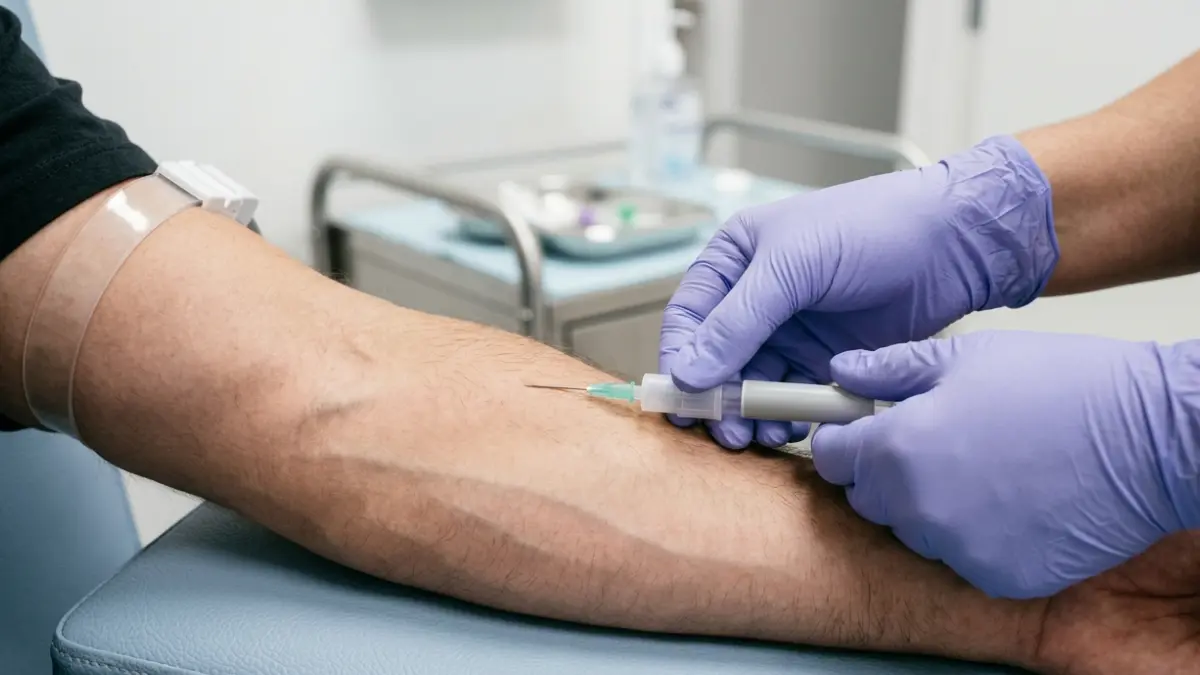
Three blood tests can place you in the prediabetes range, and any one is enough.
A1C, fasting glucose and the 2-hour test, side by side
| Test | Normal | Prediabetes | Diabetes | Key clinical detail |
|---|---|---|---|---|
| A1C | Below 5.7% | 5.7%–6.4% | 6.5% or above | 3-month average; no fasting |
| Fasting blood sugar | 99 mg/dL or below | 100–125 mg/dL | 126 mg/dL or above | Overnight fast needed |
| 2-hour tolerance test | Below 140 mg/dL | 140–199 mg/dL | 200 mg/dL or above | Measured after a glucose drink |
Ranges from CDC’s diagnostic ranges for each test; laboratory ranges vary.
🔬 How It Works: Blood sugar attaches to hemoglobin inside red blood cells, which live about three months. The A1C test measures what share carries that sugar-coated hemoglobin — an average, not a single moment.
What to do if only one value is in range
One value in the band is enough, and the three tests can disagree in the same person. If your fasting result is the flagged one, a fasting glucose of 100 to 125 mg/dL covers what comes next; for A1C, what doctors check after 5.7% to 6.4% does the same.
The full glucose levels chart maps values outside these bands.
⚠️ Clinical Warning: A prediabetes-range reading can coexist with diabetes already past the line. CDC counts 11.0 million US adults as undiagnosed, so ask for a confirmatory test.
✅ Patient Action: Ask your primary care physician: “My A1C is [value] and my fasting glucose is [value] — should either be repeated?”
Who should be screened for prediabetes
The US Preventive Services Task Force screening recommendation advises screening adults aged 35 to 70 who have overweight or obesity.
The age and weight criteria that trigger screening
The Task Force defines overweight as a BMI of 25 or higher and obesity as 30 or higher, and lowered its starting age from 40 to 35 in 2021. The BMI calculator gives you that number.
If you fall outside the criteria
Guidelines define who is screened routinely, not who may be tested. Ask your primary care physician whether your age, BMI and family history warrant testing anyway.
Does prediabetes always become type 2 diabetes
No. In the Diabetes Prevention Program trial, about 11% of the placebo group developed diabetes each year — most did not.
What the prevention trial data shows
Over a mean 2.8 years, intensive lifestyle change cut diabetes risk by 58% and metformin by 31%; for participants aged 60 and older the lifestyle figure reached 71%. The CDC-recognized National Diabetes Prevention Program built its 5% to 7% weight-loss target on that result.
These are cohort rates, not a personal forecast. Metformin appears here only as a trial arm.
Whether blood sugar can return to normal
Ten years on, lifestyle participants stayed about one-third less likely to develop type 2 diabetes. The weight loss calculator converts that target into your own number.
✅ Patient Action: Ask your primary care physician: “Am I eligible for a National DPP lifestyle change program, and is it covered?”
The risks that start before diabetes does
Prediabetes raises the risk of type 2 diabetes, heart disease and stroke, according to CDC. The cardiovascular part surprises people, because nothing in the label points at the heart.
Heart and stroke risk during the prediabetes stage
Risk is elevated, not established disease. That distinction is why the stage is worth catching rather than treating as a diagnosis you already have.
Why acting during this stage is the point
CDC’s position is that losing weight through healthier eating and more activity can cut the risk of developing type 2 diabetes roughly in half.
Common questions about prediabetes statistics
1. How many Americans have prediabetes?
About 115.2 million US adults aged 18 and older have prediabetes, per CDC’s January 2026 report.
2. What percentage with prediabetes don’t know?
About 8 in 10 adults with prediabetes are unaware they have it, according to CDC.
3. Is prediabetes a diagnosis or a lab range?
CDC’s count is measured from lab values, so you can have prediabetes undiagnosed.
4. What A1C level means prediabetes?
An A1C of 5.7% to 6.4% is the prediabetes range. Confirm any result with your physician.
5. What fasting blood sugar is prediabetes?
Fasting blood sugar of 100 to 125 mg/dL indicates prediabetes. Ask your physician about repeat testing.
6. At what age should you get screened?
USPSTF advises screening adults aged 35 to 70 with overweight or obesity. Ask your physician about timing.
7. Does prediabetes always turn into diabetes?
No. About 11% of the Diabetes Prevention Program placebo group developed diabetes yearly. Discuss your own risk with your physician.
8. Can prediabetes go back to normal?
Lifestyle trial participants stayed one-third less likely to develop diabetes at ten years. Ask your physician about programs.
9. Does prediabetes have symptoms?
Prediabetes and type 2 diabetes often produce no symptoms, which is why testing finds it.
10. How many older adults have prediabetes?
31.3 million US adults aged 65 and older have prediabetes — 52.1% of that age group.
11. Does prediabetes raise heart disease risk?
CDC states that prediabetes raises the risk of type 2 diabetes, heart disease and stroke.
The 115.2 million figure is large mainly because most people inside it were never tested. One request at your next appointment — an A1C or a fasting glucose — moves you out of the unaware 8 in 10.
About this content
How this article was put together: researched from recognised health sources, drafted with the help of AI tools, and edited by hand, with sources linked throughout.

Sameer Patel is the founder and editor of My Medicine Advisor. He is not a doctor or medical professional — before starting this site he worked in banking,…
Medical disclaimer
The content on MyMedicineAdvisor is provided for general informational and educational purposes only and is not a substitute for professional medical advice, diagnosis, or treatment. Health information on this website should not be used to diagnose, treat, cure, or prevent any condition without guidance from a qualified healthcare professional. Always seek the advice of your doctor, physician, or another licensed healthcare provider with any questions you may have regarding a medical condition, symptoms, medications, or treatment decisions.