
On This Page – Quick Medical Summary
No blood test can diagnose melanoma or rule it out; a skin biopsy does that. Blood tests come in after the diagnosis, and each one answers a narrower question: how far advanced melanoma has spread (LDH), which drug fits the tumor (BRAF, usually tested on the tumor itself), or whether treatment is affecting your thyroid, liver or blood counts.
A newer test called ctDNA looks for melanoma DNA in the blood. It predicts risk in studies but is not yet part of standard melanoma care. For how melanoma is staged and treated as a whole, see the guide to melanoma symptoms, stages and treatment.
Which melanoma blood test you had, and why
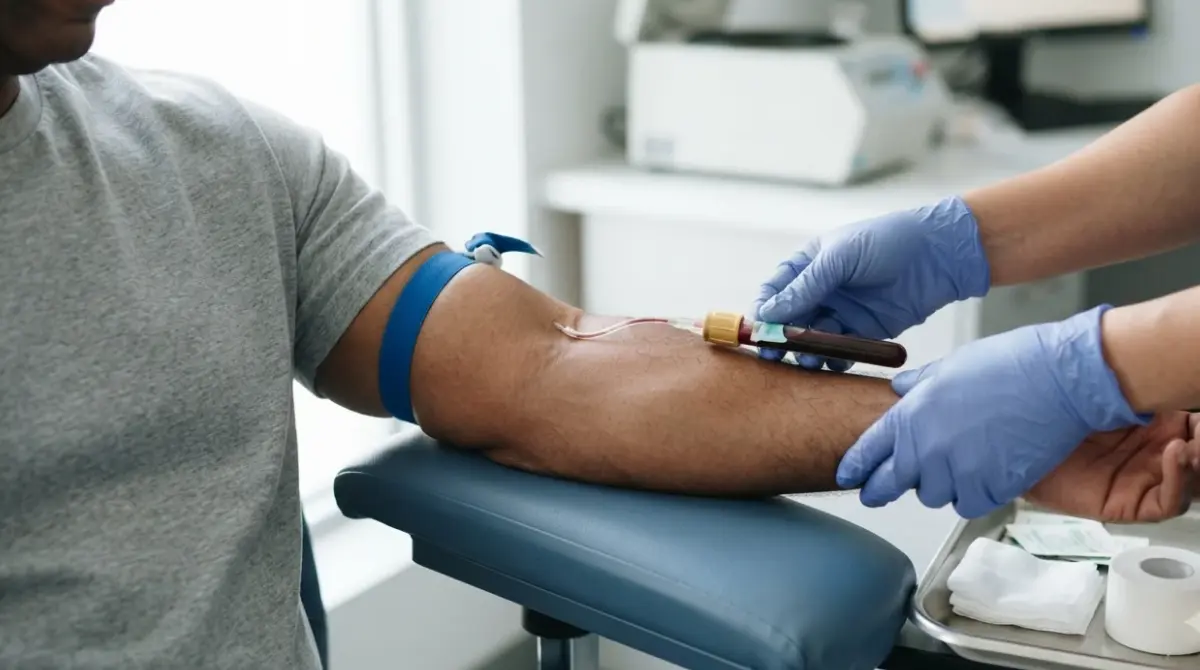
Start with the test’s name on your report, because each one is ordered at a different point in care and answers a different question.
| Test | Sample | Standard care or research | What it answers |
|---|---|---|---|
| LDH (lactate dehydrogenase) | Blood serum | Standard once melanoma is advanced | Part of the stage once there is distant spread |
| BRAF V600 mutation | Tumor tissue, in most cases | Standard for advanced disease | Whether BRAF-targeted drugs are an option |
| ctDNA (circulating tumor DNA) | Blood plasma | Research and specialty labs | Risk that melanoma comes back after surgery |
| CBC, CMP, TSH and free T4 | Blood | Standard during immunotherapy | Whether treatment is affecting blood counts, liver, kidneys or thyroid |
| S100B | Blood serum | Used in parts of Europe; not routine in US care | Tracking advanced melanoma |
Sources: MedlinePlus LDH test, review of BRAF testing in advanced melanoma, SITC 2021 guideline on immunotherapy side effects.
A routine CBC or metabolic panel from a yearly checkup is not designed to look for melanoma. A normal result there says nothing either way about a mole.
LDH counts toward stage only after distant spread
MedlinePlus lists a normal LDH of 125 to 220 IU/L (international units per liter; many reports print this as U/L). Ranges vary by laboratory, so the range printed beside your result is the one that applies.
LDH is an enzyme found in the heart, liver, kidneys, muscles, brain, lungs and blood cells. That is why a high value has many possible sources besides melanoma, including liver disease, muscle injury, a heart attack, pancreatitis and hemolytic anemia, where red blood cells break down faster than normal.
Its job in melanoma is narrow. Under the American Joint Committee on Cancer (AJCC) 8th edition, used in the US since January 1, 2018, LDH only enters the stage once melanoma has spread to distant organs or distant skin and lymph nodes. The M category then carries a (1) if LDH is elevated or a (0) if it is not, as in M1c(1) (AJCC 8th edition review). Under the older 7th edition, any high LDH with distant spread was automatically labeled M1c. The way each M category is defined is laid out in how melanoma stages and M categories work.
For melanoma in situ and early-stage melanoma, LDH is not sensitive or specific enough to find spread, and routine blood tests are not part of standard follow-up after the melanoma is removed.
In stage IV, a high LDH is linked with a harder course, which is why staging records it. It sits alongside other factors that shape the outlook, such as how many places the melanoma has reached, whether the tumor has a BRAF change, and a person’s age and general health.
Reading the LDH line on a sample report
| Draw | LDH result | This lab’s range | Flag |
|---|---|---|---|
| First test | 312 U/L | 125–220 U/L | H |
| Repeat test | 298 U/L | 125–220 U/L | H |
Sample report: invented values for illustration, not from a real patient.
Both results sit above this lab’s upper limit; 312 U/L is about 1.4 times the 220 U/L cutoff. The number alone does not show where the extra LDH is coming from. If scans have already shown melanoma in the liver, the result is written into the stage as M1c(1). If scans show no distant spread, a high LDH does not change the stage at all, and the cause needs looking for elsewhere. Ask your oncologist whether this LDH changes your M category and whether imaging is planned to go with it.
Is BRAF tested in your blood or your tumor?
About half of advanced melanomas carry a change, or mutation, in the BRAF gene, and the most common form by far is V600E (review of BRAF mutation testing). Finding it matters because a BRAF V600 change makes a person eligible for BRAF and MEK inhibitor pills, explained in how BRAF-targeted therapy works in melanoma.
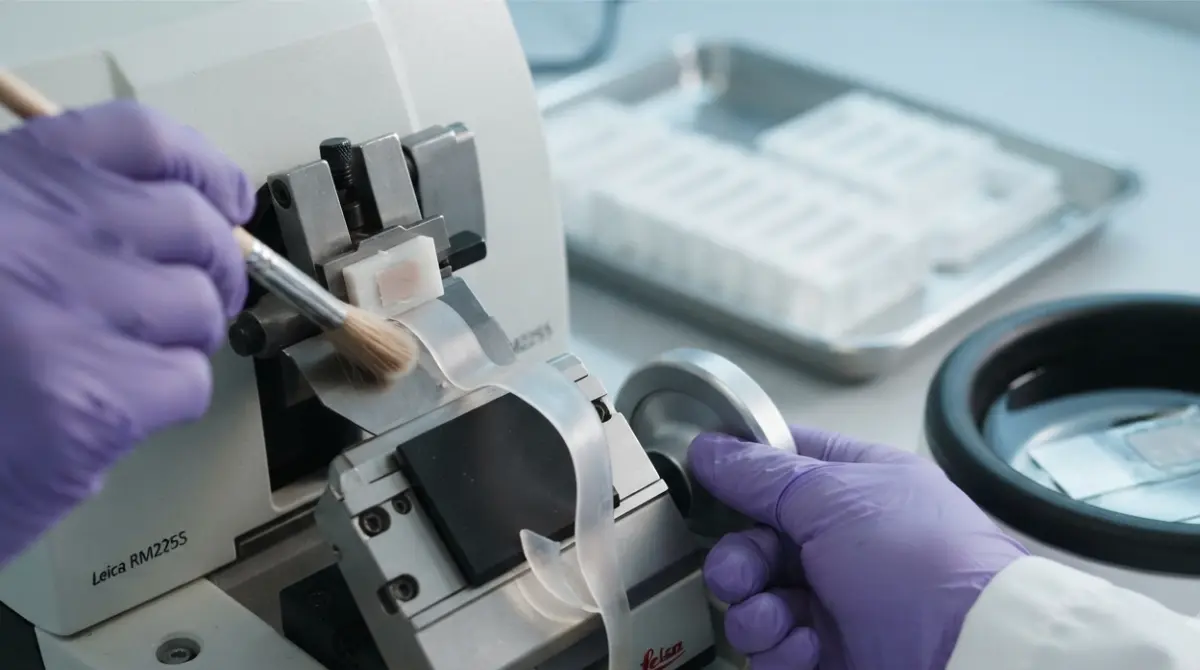
The standard test runs on tumor tissue: the melanoma that was removed, or a biopsy from a spot where it has spread. Blood-based BRAF testing is being studied, but tissue remains the basis for choosing these drugs.
A result of “BRAF V600 not detected”, sometimes written as wild-type, means BRAF-targeted pills are not an option. Immunotherapy or a clinical trial becomes the main path. Ask which BRAF test was used on your tumor and whether it detects V600K as well as V600E, since some tests are built mainly around V600E.
One mix-up comes up often. A BRAF change found in the tumor developed inside the cancer cells and is not passed down in families. Inherited melanoma risk involves different genes and a separate test of your own DNA, covered in whether melanoma runs in families.
What a ctDNA result can and can’t tell you
Circulating tumor DNA is made of small fragments of DNA that melanoma cells shed into the bloodstream, and some labs can measure it from an ordinary blood draw.
A 2025 analysis of the COMBI-AD randomized trial looked at this in people who had surgery for melanoma. The trial enrolled 870 people with stage III melanoma and a BRAF V600 change (Lancet Oncology study). Blood taken after surgery was available for 597 of them, and ctDNA was found in 79, or 13%.
In the placebo group, people with detectable ctDNA had a median recurrence-free survival of 3.7 months, against 24.4 months for those whose ctDNA was undetectable. On dabrafenib plus trametinib, the figures were 16.6 and 68.1 months. These numbers come from people who joined the trial in 2013 and 2014, and like all survival statistics, they describe groups and can’t predict one person’s course.
The same figures show the test’s limit. Among people on placebo with undetectable ctDNA, half had the melanoma return or died within about 24 months, so a negative result does not mean the melanoma is gone. If a ctDNA test is offered, ask whether a positive or negative result would change your treatment or scan schedule, and whether your insurance covers it.
The study’s authors describe ctDNA as an established measure of minimal residual disease, meaning cancer cells left behind after treatment, that is not yet used in melanoma management.
4 blood tests you’ll repeat during immunotherapy
Before the first dose of an immune checkpoint inhibitor such as pembrolizumab or nivolumab, the 2021 SITC guideline recommends a CBC with differential, a comprehensive metabolic panel (CMP), TSH and free T4, then repeating them at intervals through treatment (SITC 2021 guideline).
These drugs release a brake on the immune system, which can then inflame healthy organs. The CBC tracks blood counts. Liver enzymes such as ALT and AST, kidney function and blood sugar all appear on the CMP, and each can shift during treatment. The two thyroid tests watch one of the organs most often affected; a thyroid result flagged during treatment reads the same way as in what a high TSH means.
Get emergency care now if: you are on immunotherapy and your breathing is getting harder, you have chest pain, or you have a seizure or sudden confusion; call 911. New diarrhea, yellowing of the skin or eyes, or dark urine should be reported to your oncology team the same day.
A flagged result on any of these four tests does not automatically stop treatment. Mild problems are often watched closely while treatment continues, and more serious ones may pause it, as described in how immunotherapy for melanoma works.
Bring these questions to your next oncology visit
Write these down and take your latest lab and pathology reports with you.
- Is my LDH above this lab’s range, and does it change my M category?
- Was BRAF tested on my tumor tissue, and did the test cover V600K?
- Would a ctDNA test change my treatment or scan schedule, and is it covered?
- Which blood tests are due before each infusion, and who reviews them before I’m treated?
- Which symptoms should I report the same day, and what number do I call after hours?
If your LDH was flagged high and you have not had scans since, find out at this visit when imaging is planned, because staging reads LDH together with the scan results.
Want to see our guides first on Google?
Found this helpful? See more of our guides on Google.
About this content
How this article was put together: researched from recognised health sources, drafted with the help of AI tools, and edited by hand, with sources linked throughout.

Dr. Pooja Sahu, MBBS, is a medical reviewer for MyMedicineAdvisor. She is a clinical physician whose experience includes serving as a Junior Resident in Nephrology at Dr. Ram…
Medical disclaimer
The content on My Medicine Advisor is provided for general informational and educational purposes only and is not a substitute for professional medical advice, diagnosis, or treatment. Health information on this website should not be used to diagnose, treat, cure, or prevent any condition without guidance from a qualified healthcare professional. Always seek the advice of your doctor, physician, or another licensed healthcare provider with any questions you may have regarding a medical condition, symptoms, medications, or treatment decisions.