
On This Page – Quick Medical Summary
Is my child’s ALT result actually high?
In children, NASPGHAN’s fatty liver guideline sets sex-specific ALT screening limits of 22 U/L for girls and 26 U/L for boys, though your lab’s printed range may differ. Find your situation:
- Slightly high, child well: keep reading.
- Yellow skin, confusion, vomiting blood: emergency section.
- Illness, new medicine, overweight: causes and fatty liver sections.
What ALT measures in a child

🔬 How It Works: ALT is an enzyme found mostly in liver cells. Injury makes it leak into the blood; muscle can release it too.
Why your lab’s range may differ from guideline cutoffs
NASPGHAN says to use sex-specific limits, not an individual lab’s upper limit; the 2025 AASLD practice statement agrees and generally uses above 30 U/L under age 10.
Adult ranges: what an ALT blood test measures.
✅ Patient Action: Ask the pediatrician: “Is this above the sex-specific cutoff, and should we repeat it?”
ℹ️ Medical Disclaimer: This article covers the interpretation of children’s lab results, diagnosis, follow-up testing, medications, treatment of fatty liver disease, and emergency symptoms. It is general education and does not replace an evaluation of your child. Review your child’s result with their pediatrician, or a pediatric gastroenterologist or hepatologist, before acting on it. If your child has emergency symptoms, call 911.
How high is too high? Mild vs. marked ALT elevations
Pediatric reviews group ALT elevations by multiples of the upper limit, and these bands differ from adult tiers.
| Level | Multiple of limit | Key Clinical Detail |
|---|---|---|
| Mild | Up to 2× | Often settles when the cause is short-lived |
| High | 2×–10× | Persisting over 3 months prompts evaluation |
| Very high | Over 10× | Ask how soon your child should be seen |
Source: 2023 pediatric diagnostic-approach review (bands); NASPGHAN 2017 guideline (3-month rule); Nationwide Children’s Hospital.
Mild elevation: under twice the upper limit
At twice the sex-specific limit, NASPGHAN reports 88% sensitivity but only 26% specificity for fatty liver in overweight or obese children 10 and older, so a mild rise means “look closer,” not “diagnosis.”
Marked elevation and the 3-month rule
NASPGHAN advises evaluating ALT that stays above twice the limit for more than 3 months; one result is a starting point.
✅ Patient Action: Ask the pediatrician: “When do we retest, and what would prompt a pediatric gastroenterology referral?”
What causes high ALT in children?
Causes range from short-lived infections to chronic conditions:
- Viral infection (colds, Epstein-Barr virus)
- Medicines, including acetaminophen products
- Fatty liver disease (MASLD)
- Celiac disease, autoimmune hepatitis, Wilson disease, hepatitis B or C
- Muscle injury or disease
Common and often temporary causes

A viral infection can raise enzymes for a week or two. Medicines such as atomoxetine, valproic acid, and acetaminophen products can affect the liver (more on medications that raise ALT); never stop one without asking the prescriber.
Less common liver conditions
Doctors test for these, and for alpha-1 antitrypsin deficiency, when the cause is unclear.
When the source is muscle, not liver
🔬 How It Works: ALT also sits in muscle cells, so strenuous exercise or muscle disease can raise it, and an unexplained rise can be a first sign of muscle disease.
✅ Patient Action: Ask the pediatrician: “Could an illness or medicine explain this, and when should we retest?”
Is it fatty liver? How common it is in children
Fatty liver disease is the most common liver disease in US children, per NASPGHAN.
How common is fatty liver in kids?
📊 Clinical Data Point: Global MASLD prevalence, ages 5–24: 7.0% (95% CI 4.1–11.7), higher in boys; estimates vary with definitions and methods. — Source: Liu et al., BMC Medicine, 2026.
NAFLD is now called MASLD
In 2023, major liver societies renamed NAFLD as MASLD (metabolic dysfunction-associated steatotic liver disease); in children it requires fat confirmed by imaging or biopsy plus a cardiometabolic risk factor. Adult fatty liver: why it pushes ALT high.
Who gets screened, and at what age
AASLD advises screening from age 10 for children with obesity (BMI at or above the 95th percentile) and overweight children (85th percentile or higher) with cardiometabolic risk; NASPGHAN suggests ages 9 to 11. Ask the pediatrician whether your child qualifies.
What happens after a high ALT result?
After a high ALT result, evaluation may include:
- A liver panel (ALT, AST, ALP, GGT)
- Blood tests for specific causes, such as celiac disease and hepatitis B or C
- Muscle enzymes, if a muscle source is suspected
- Imaging, and referral to a pediatric gastroenterologist or hepatologist
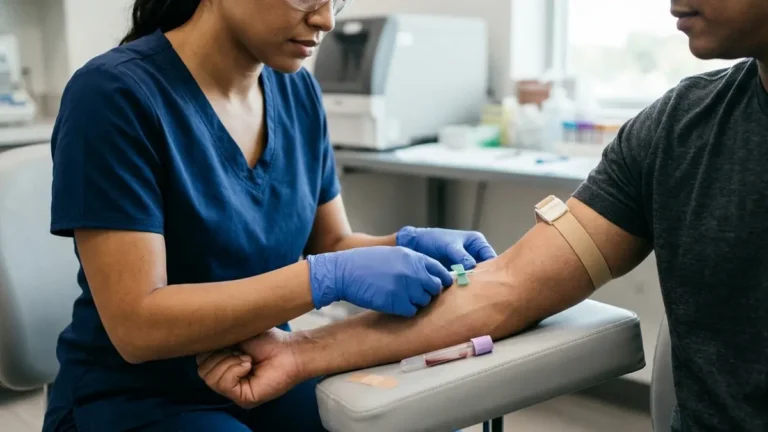
Repeat ALT and other blood tests
MedlinePlus explains what a liver panel includes; our adult guide reads LFT results.
Imaging and referral
AASLD calls ultrasound supportive, not diagnostic; a biopsy may be used when the diagnosis is uncertain.
Treatment depends on the cause
Infection-related rises often settle without treatment. For fatty liver, AASLD emphasizes lifestyle change with dietitian and exercise support; no medicine is approved specifically for MASH, the inflamed form, in children, and your child’s specialist decides on any medicine.
✅ Patient Action: Ask the pediatrician: “Which tests are you ordering, and what result would change the plan?”
When is high ALT in a child an emergency?
Most high ALT results have harmless or treatable causes, but some symptoms need prompt care.
Symptoms that need same-day care
Call your child’s doctor or clinic as soon as possible for yellow skin or eyes, dark urine, or light-colored stools. Go to the emergency room or call 911 for vomiting blood, blood in the stool, or a sudden change in alertness.
If a medicine overdose is possible
⚠️ Clinical Warning: Acetaminophen overdose is one of the most common poisonings, and symptoms may not appear for 12 or more hours. If your child may have taken too much of any medicine, call Poison Help at 1-800-222-1222 or 911 right away. With acetaminophen, treatment within 8 hours gives a very good chance of recovery.
✅ Patient Action: Don’t wait for a callback: ask the pediatrician’s office, “Does this need to be seen today?”
Can high ALT in a child mean serious liver disease?
Usually not: most raised enzymes come from harmless, treatable, or short-lived conditions, but persistent elevation deserves follow-up.
Fibrosis and long-term risk
In a registry of 660 children already diagnosed with fatty liver, fibrosis was most common when peak ALT exceeded 70 U/L. ALT alone can’t stage the disease, and adult FIB-4 cutoffs don’t work in children.
Diabetes and other health checks
NASPGHAN recommends testing children with fatty liver for diabetes at diagnosis and yearly, using fasting glucose or HbA1c.
📊 Clinical Data Point: Prediabetes: 20–23%; type 2 diabetes: 0.8–6.5% of children with fatty liver. Most do not have diabetes. — Source: Gastroenterology review, 2020.
✅ Patient Action: Ask a pediatric gastroenterologist: “Does my child need fibrosis assessment, and how often should we recheck?”
High ALT in children: frequently asked questions
1. What is a high ALT level in children?
High ALT in children is flagged above 22 U/L for girls and 26 U/L for boys in fatty liver screening.
2. What is a normal ALT for a child?
Normal ALT varies by age and sex; screening limits are 22 (girls) and 26 (boys) U/L.
3. What causes high ALT in children?
Common causes of high ALT in children are viral infections, medicines, and fatty liver; celiac disease and autoimmune hepatitis are rarer.
4. Is a high ALT in a child serious?
High ALT in children is often short-lived, but ALT above twice the limit for over 3 months warrants evaluation.
5. Can a cold or virus raise a child’s ALT?
Yes. A cold or Epstein-Barr virus can raise ALT in children for a week or two.
6. Can medicines like acetaminophen raise ALT in children?
Some medicines raise ALT in children, including acetaminophen products and valproic acid; never stop one without asking the prescriber.
7. Does high ALT in a child mean fatty liver?
Not necessarily. Fatty liver is one cause of high ALT in children; diagnosis needs imaging or biopsy. Ask your pediatrician about screening.
8. What tests follow a high ALT in a child?
Doctors may repeat ALT, run a liver panel and cause-specific blood tests, and sometimes image the liver; ask which apply.
9. Can a child’s high ALT go back to normal?
Often, yes, when the cause is short-lived, such as a viral infection; the cause determines whether treatment is needed.
10. When should a child with high ALT see a specialist?
Ask about a pediatric gastroenterologist or hepatologist if high ALT in children stays above twice the limit for over 3 months.
11. Can muscle problems or exercise raise ALT in kids?
Yes. ALT is also stored in muscle, so strenuous exercise or muscle disease can raise it.
Next steps after a high ALT result
A high ALT in your child is a reason to look closer, not a diagnosis. Bring the number, your lab’s upper limit, your child’s age and sex, and any recent illness or medicine to the pediatrician. Yellow skin, confusion, or vomiting blood means seek care now.
About this content
How this article was put together: researched from recognised health sources, drafted with the help of AI tools, and edited by hand, with sources linked throughout.

Sameer Patel is the founder and editor of My Medicine Advisor. He is not a doctor or medical professional — before starting this site he worked in banking,…
Medical disclaimer
The content on MyMedicineAdvisor is provided for general informational and educational purposes only and is not a substitute for professional medical advice, diagnosis, or treatment. Health information on this website should not be used to diagnose, treat, cure, or prevent any condition without guidance from a qualified healthcare professional. Always seek the advice of your doctor, physician, or another licensed healthcare provider with any questions you may have regarding a medical condition, symptoms, medications, or treatment decisions.