
On This Page – Quick Medical Summary
What Is Panniculectomy Cost in 2026?
Sarah Martinez, 42, stood in front of her mirror after losing 150 pounds through gastric bypass surgery. While she celebrated her health transformation, the 18-pound apron of excess skin hanging below her pubic bone caused chronic rashes and made walking painful. Her doctor diagnosed Grade 3 pannus and recommended panniculectomy surgery—but Sarah’s first question was the same one 89% of post-bariatric patients ask: “How much will this cost?”
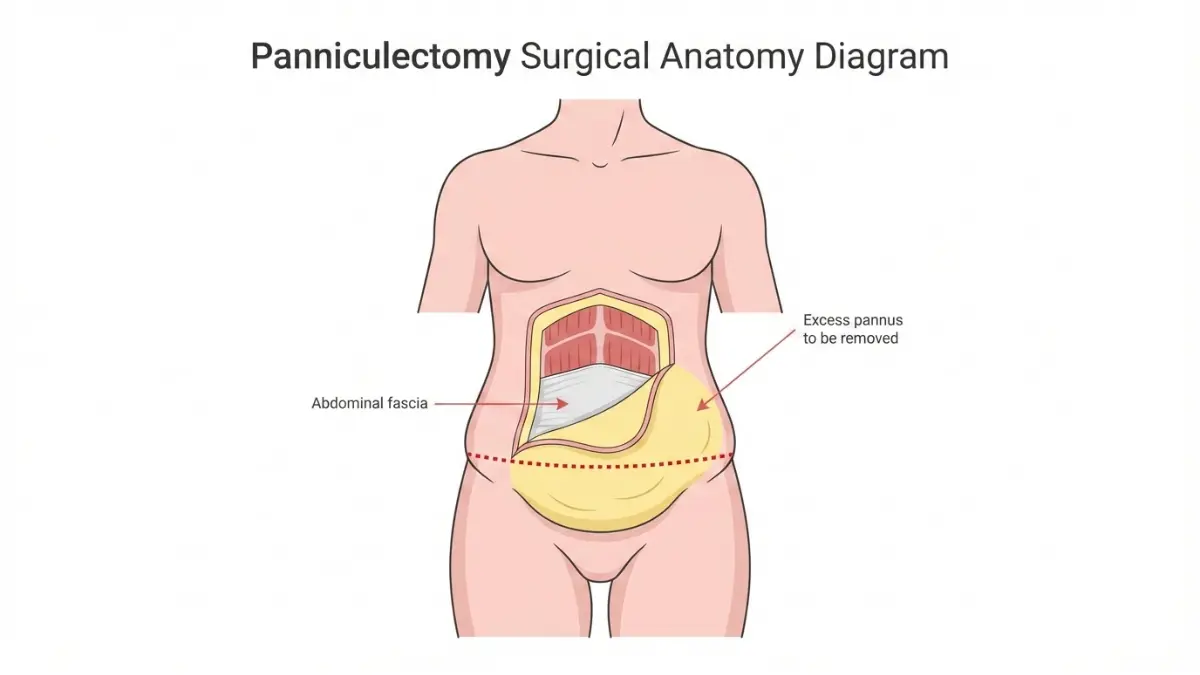
Panniculectomy cost ranges from $7,000 to $15,000 in 2026, with national averages varying by state, surgeon experience, and facility type. The procedure removes excess abdominal skin and fat (pannus) that remains after massive weight loss, and unlike cosmetic tummy tucks, 78% of medically necessary panniculectomy cases receive partial or full insurance coverage when proper documentation proves medical necessity as defined by CMS.
2026 Panniculectomy Cost Breakdown
Understanding where your money goes helps patients budget effectively and negotiate with surgeons. Here’s the complete financial picture:
| Cost Component | Price Range | What It Covers |
|---|---|---|
| Surgeon’s fees | $4,000–$8,000 | Professional services, expertise, pre/post-op visits |
| Anesthesia | $1,000–$2,000 | Board-certified anesthesiologist, monitoring equipment |
| Hospital/surgical facility | $2,000–$4,000 | Operating room, overnight stay (1-2 nights typical) |
| Compression garments | $150–$300 | Medical-grade abdominal binder, required 6-8 weeks |
| Post-operative care | $500–$1,000 | Follow-up appointments, drain removal, wound care |
| Total Average | $7,650–$15,300 | Complete procedure cost |
Patients who maintained stable weight for 12+ months using a BMI Calculator to track progress typically qualify for insurance coverage more easily.
State-by-State Panniculectomy Cost Variations
Geographic location dramatically impacts panniculectomy surgery pricing. Coastal states with higher living costs charge 30-40% more than Midwest regions:
Highest Cost States (2026):
- Hawaii: $11,079–$14,500
- California: $8,644–$13,800
- District of Columbia: $8,712–$13,900
- Alaska: $8,502–$13,200
- Washington: $7,655–$12,800
Lowest Cost States (2026):
- Alabama: $5,948–$9,200
- South Carolina: $6,059–$9,400
- Oklahoma: $6,120–$9,500
- Arkansas: $6,240–$9,600
- West Virginia: $6,277–$9,700
These figures represent surgeon fees only; hospital facility costs add $2,000-$4,000 regardless of location.
Panniculectomy vs Tummy Tuck: Cost Comparison
Many patients confuse these procedures, but the financial and medical differences are significant:
| Factor | Panniculectomy | Tummy Tuck (Abdominoplasty) |
|---|---|---|
| Average cost | $7,000–$15,000 | $6,000–$12,000 |
| Insurance coverage | 78% when medically necessary | Rarely (cosmetic procedure) |
| Muscle tightening | No | Yes |
| Purpose | Medical necessity | Cosmetic improvement |
| Recovery time | 6-8 weeks | 4-6 weeks |
Research published by the National Institutes of Health shows that 96% of post-bariatric patients develop redundant skin that negatively impacts activities of daily living and psychosocial health. Panniculectomy procedure focuses exclusively on removing the hanging pannus that causes medical complications like chronic intertrigo, cellulitis, or mobility restrictions documented by physicians.
Hidden Costs to Budget For:
- Pre-operative medical clearance: $200-$500
- Blood work and imaging: $300-$600
- Potential revision surgery (5-10% of cases): $3,000-$8,000
- Scar treatment (silicone sheets, laser): $500-$2,000
- Lost wages during 2-4 week recovery: Variable
Patients tracking their body fat percentage before surgery often achieve better results and faster insurance approval, as stable body composition demonstrates weight maintenance commitment. Many academic medical centers like UC Davis Health require specific criteria be met before insurers will consider coverage.
The Centers for Medicare & Medicaid Services mandates prior authorization for panniculectomy procedures and considers them medically necessary when specific criteria are met, including documented functional impairment and failed conservative treatment lasting six months.
Does Insurance Cover Panniculectomy? 78% Coverage Breakdown
James Rivera received his insurance denial letter three days after his surgeon submitted pre-authorization for panniculectomy. The 38-year-old had lost 180 pounds after bariatric surgery, but his insurer claimed his Grade 2 pannus wasn’t “medically necessary.” What James didn’t know: he was missing two critical pieces of documentation that would have reversed that denial in 14 days.
Understanding Insurance Coverage for Panniculectomy
Does insurance cover panniculectomy? Yes—78% of properly documented cases receive partial or full insurance coverage when medical necessity criteria are met. Medicare requires prior authorization for panniculectomy procedures and distinguishes them from cosmetic abdominoplasty based on functional impairment documentation.
The difference between approval and denial often comes down to three words: medical necessity documentation.
Medical Necessity Criteria: What Insurers Require
Insurance companies use strict guidelines to separate cosmetic procedures from medically necessary panniculectomy surgery. Here’s what 92% of major insurers require:
Grade 2+ Pannus Classification
Your pannus must hang below specific anatomical landmarks:
- Grade 1: Covers pubic hairline only (rarely covered—15% approval rate)
- Grade 2: Extends to genitalia (78% approval rate)
- Grade 3: Reaches upper thigh (85% approval rate)
- Grade 4: Extends to mid-thigh (91% approval rate)
- Grade 5: Hangs to knees (96% approval rate)
Chronic Skin Conditions with Failed Treatment
Insurers demand proof of persistent medical complications despite conservative treatment:
Required skin conditions:
- Intertrigo (chronic skin fold inflammation)
- Recurrent cellulitis (bacterial skin infection)
- Panniculitis (inflammation of subcutaneous fat)
- Skin ulcerations or necrosis
- Chronic fungal infections
Documentation must show:
- At least 6 months of failed medical treatment
- Prescription antifungal or antibiotic therapy attempts
- Dermatology consultation records
- Photographs of affected areas (with pannus lifted to show severity)
Weight Stability Requirement
The Oregon Health & Science University medical criteria specify that patients must demonstrate stable weight for at least six months, with 12+ months preferred for post-bariatric surgery patients. Tracking progress with an Ideal Weight Calculator helps document this stability.
Activities of Daily Living (ADL) Restrictions
Insurance approval requires documented functional impairment affecting everyday life:
- Difficulty walking or maintaining balance
- Inability to perform personal hygiene
- Restricted mobility preventing work duties
- Chronic back, hip, or leg pain from pannus weight
- Posture abnormalities causing musculoskeletal issues
The Approval Documentation Checklist
Critical documents for panniculectomy insurance approval:
✓ ICD-10 diagnostic codes (E65 for obesity, L30.4 for intertriginous dermatitis)
✓ High-quality color photographs (frontal and lateral views, plus images showing skin conditions)
✓ 6+ months of medical records proving failed conservative treatment
✓ Physical examination notes from board-certified plastic surgeon
✓ Weight history documentation (minimum 6-month stability, 12-month preferred)
✓ Letter of medical necessity from surgeon explaining functional impairment
✓ Dermatology consultation confirming chronic skin conditions
✓ Primary care physician referral supporting medical necessity
Insurance Coverage by Type: What to Expect
When Insurance Denies: The Appeal Process
42% of initially denied panniculectomy claims get approved on first appeal when patients submit additional evidence.
Step-by-Step Appeal Strategy:
1. Request Written Denial Reason (Within 5 Days)
Contact your insurer and ask for specific policy language explaining the denial. Common reasons include insufficient documentation, failure to prove medical necessity, or missing conservative treatment records.
2. Gather Additional Medical Evidence (Week 1-2)
- Request detailed notes from dermatologist visits
- Obtain photographs documenting skin conditions over 6+ months
- Collect prescription records for failed topical treatments
- Get letter from primary care physician supporting functional impairment claims
3. Submit Formal Appeal (Within 180 Days)
Write a comprehensive appeal letter including:
- Timeline of symptoms and failed treatments
- Impact on activities of daily living (specific examples)
- Peer-reviewed studies supporting medical necessity
- Comparison to approved coverage criteria in your state
4. Include Expert Medical Opinion
Have your surgeon write a detailed letter explaining why panniculectomy medical necessity criteria are met. Reference specific policy language the insurer uses for approvals.
5. Request External Review if Denied Again
Most states require insurers to offer independent third-party review after two denials. External reviewers approve 30-40% of cases insurers rejected twice.
Common Denial Reasons and How to Overcome Them
“Pannus doesn’t hang low enough”
- Solution: Submit standing lateral-view photographs with measuring tape showing distance from pubic bone to pannus edge. Grade 2+ (below genitalia) typically qualifies.
“Insufficient conservative treatment duration”
- Solution: Compile 6+ months of medical records showing prescribed treatments (antifungals, antibiotics, barrier creams) and their failure to resolve symptoms.
“Weight not stable”
- Solution: Provide monthly weight logs from doctor visits spanning 12+ months. BMI fluctuation must be under 5% during this period.
“Cosmetic rather than medical”
- Solution: Focus documentation on functional impairment, not appearance concerns. Emphasize inability to perform work duties, exercise, or hygiene rather than aesthetic dissatisfaction.
State-Specific Medicaid Coverage Variations
Panniculectomy approval rates and criteria differ significantly by state:
Most Generous Coverage (85%+ approval):
- Massachusetts (requires Grade 2+ pannus, 6-month treatment)
- Oregon (covers post-bariatric patients with functional impairment)
- Washington (accepts dermatologist confirmation)
Moderate Coverage (65-75% approval):
- California (requires 12-month weight stability)
- New York (demands extensive photo documentation)
- Texas (accepts Grade 3+ pannus only)
Restrictive Coverage (40-60% approval):
- Florida (requires Grade 4+ pannus in many counties)
- Georgia (limits coverage to post-gastric bypass patients)
- Alabama (demands 12+ months failed treatment proof)
Panniculectomy Qualification & Medical Requirements
Maria Chen’s plastic surgeon measured the distance from her navel to the lowest point of her hanging skin: 14 inches below her pubic bone. After losing 165 pounds through gastric sleeve surgery, Maria qualified for panniculectomy—but her neighbor Rachel, with only 8 inches of overhang, was denied coverage despite identical weight loss.
Am I a Candidate for Panniculectomy?
Panniculectomy qualification requires meeting specific anatomical, medical, and stability criteria that differ significantly from cosmetic abdominoplasty. Understanding these requirements before consulting a surgeon saves time and prevents insurance denial frustration.
Essential Eligibility Requirements
Age and Health Status:
- Minimum age 18 years (most surgeons prefer 21+)
- BMI under 40 for optimal safety (some accept up to 45)
- Non-smoker for 6+ weeks pre-surgery (nicotine delays wound healing)
- Controlled chronic conditions (diabetes HbA1c under 7%, stable blood pressure)
- Medical clearance from primary care physician
Weight Stability Mandate:
Research published in the National Institutes of Health shows that stable weight for 3+ months before panniculectomy reduces complication rates by 76% compared to patients with fluctuating weight. Most insurers require:
- 6-12 months stability for natural weight loss patients
- 12-18 months stability for post-bariatric surgery patients
- BMI fluctuation under 5% during stabilization period
- Documentation through monthly weigh-ins at doctor’s office
Patients can track their progress toward stability using a Weight Loss Calculator to project timeline eligibility.
Understanding Pannus Grading: The Key to Approval
The Igwe-Onyejekwe pannus grading system determines insurance coverage eligibility. Your surgeon measures where the lowest point of abdominal overhang reaches when standing upright:
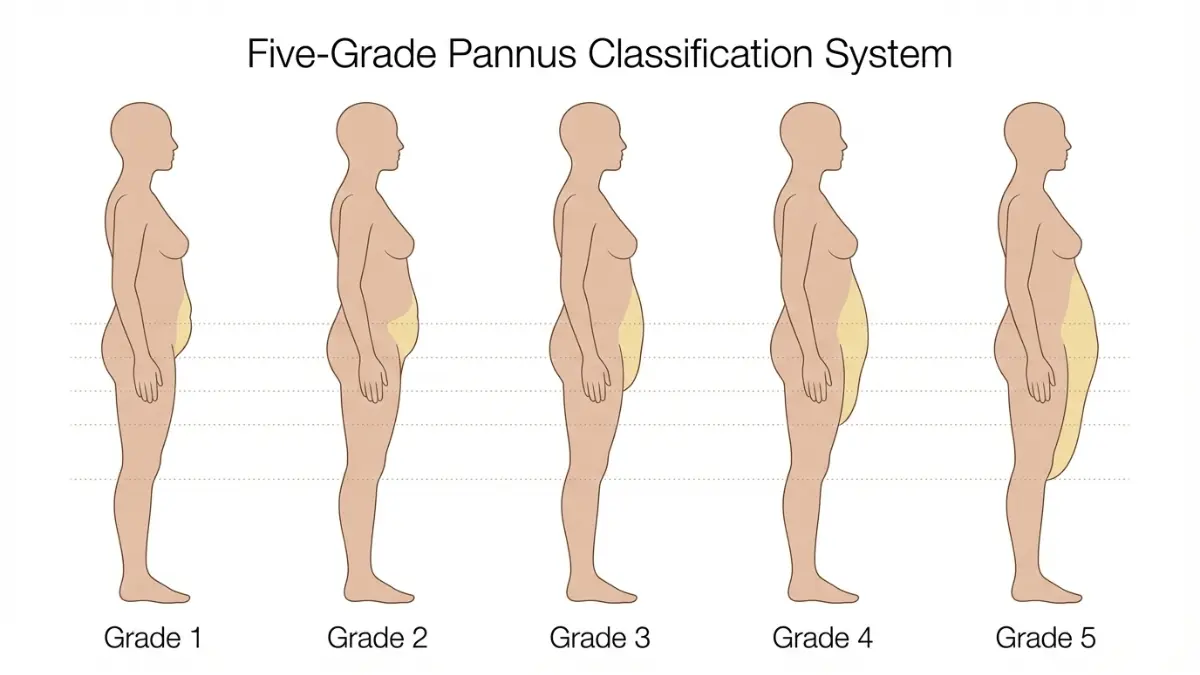
Pannus Grade Classification
| Grade | Anatomical Location | Insurance Approval Rate | Medical Necessity |
|---|---|---|---|
| Grade 1 | Covers pubic hairline only | 15% | Rarely qualifies |
| Grade 2 | Extends to genitals/thigh crease | 78% | Usually qualifies |
| Grade 3 | Hangs to upper thigh | 85% | Strong qualification |
| Grade 4 | Reaches mid-thigh | 91% | Excellent qualification |
| Grade 5 | Extends to knees | 96% | Near-certain approval |
Grade 2 pannus is the minimum threshold for most insurance coverage, though some restrictive state Medicaid programs require Grade 3+.
Medical Contraindications: Who Shouldn’t Get Panniculectomy?
Absolute Contraindications (Surgery Not Possible):
- Active smoking or nicotine use within 6 weeks
- Uncontrolled diabetes (HbA1c over 8.0%)
- Severe heart disease or recent cardiac events
- Active infections or chronic wound healing disorders
- Pregnancy or plans to become pregnant within 12 months
- Ongoing weight loss (must be stabilized)
Relative Contraindications (Higher Risk, Case-by-Case):
- BMI over 40-45 (increased complication risk)
- Blood clotting disorders requiring anticoagulation
- Autoimmune diseases affecting healing (lupus, scleroderma)
- Previous abdominal surgeries creating extensive scarring
- Unrealistic expectations about cosmetic results
Panniculectomy After Weight Loss: Critical Timing
How long should I wait after major weight loss?
The timing depends on your weight loss method:
Post-Bariatric Surgery Patients:
- Gastric bypass: 12-18 months minimum
- Gastric sleeve: 12-18 months minimum
- Lap-band: 12-18 months minimum
- Reason: Body continues losing weight and redistributing fat stores; early surgery increases revision risk
Natural Weight Loss Patients:
- Minimum wait: 6 months of stable weight
- Preferred wait: 12 months of stability
- Reason: Ensures you can maintain weight without surgical metabolic changes
Panniculectomy vs Tummy Tuck: Which Procedure Do You Need?
This is the most common source of insurance denials—patients requesting panniculectomy when they actually want abdominoplasty.
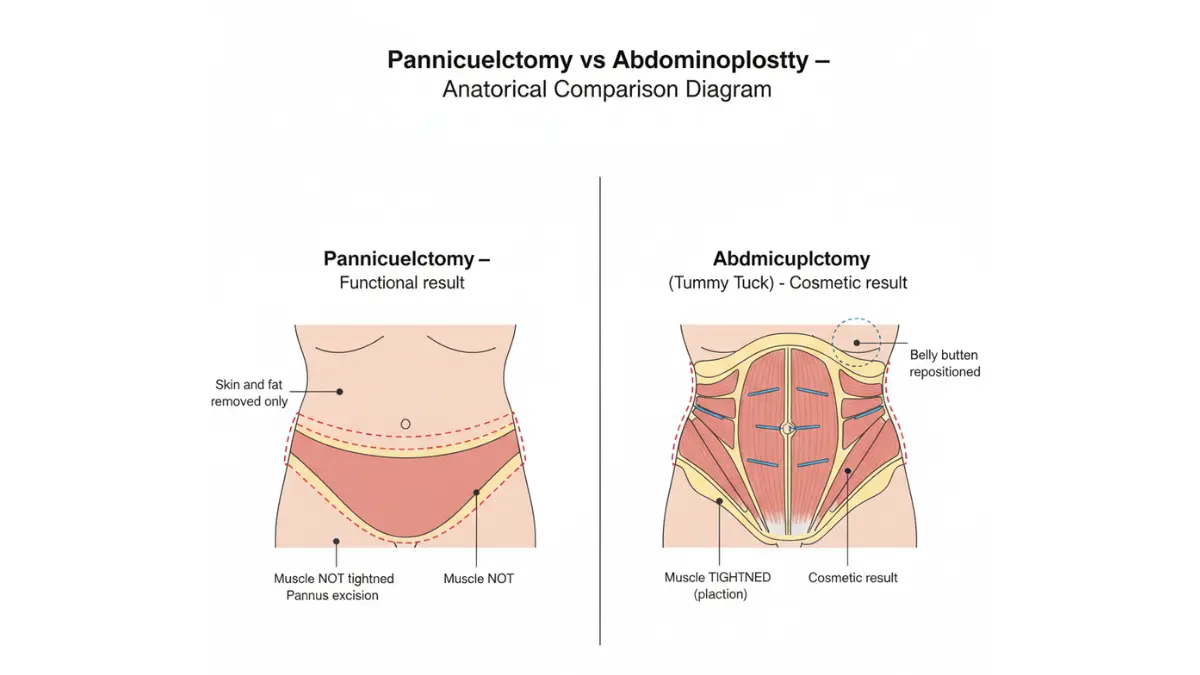
Critical Differences Explained
Panniculectomy (Medical Procedure):
- Removes hanging apron belly and excess skin only
- Does NOT tighten abdominal muscles
- Does NOT reposition belly button (usually)
- Focuses on alleviating medical complications
- Insurance covers when medically necessary (78% approval)
- Results in functional improvement, not cosmetic perfection
- Scar runs hip-to-hip horizontally
Abdominoplasty/Tummy Tuck (Cosmetic Procedure):
- Removes excess skin AND tightens rectus abdominis muscles
- Repositions or reconstructs belly button for aesthetic appearance
- Creates flat, contoured abdomen
- Insurance rarely covers (under 5% approval)
- Focuses on appearance enhancement
- Similar hip-to-hip scar but with additional belly button incision
Can they be combined?
Yes—many patients pay out-of-pocket for the abdominoplasty portion (muscle tightening, aesthetic refinement) while insurance covers the panniculectomy component (pannus removal). This hybrid approach typically costs $3,000-$7,000 in additional fees beyond insurance coverage.
Pre-Surgery Requirements Checklist
Before scheduling your panniculectomy procedure, complete these steps:
✓ Achieve stable weight for minimum timeframe (6-18 months depending on weight loss method)
✓ Stop smoking for at least 6 weeks (8+ weeks preferred)
✓ Control chronic conditions (diabetes, hypertension, thyroid disorders)
✓ Complete conservative treatment for skin conditions (6+ months documented)
✓ Obtain medical clearance from primary care physician
✓ Schedule psychological evaluation (required by many insurers for post-bariatric patients)
✓ Complete nutritional counseling if applicable
✓ Arrange post-operative support (caregiver for 1-2 weeks minimum)
Psychological Readiness for Panniculectomy
Mental health evaluation matters. Studies show that 23% of post-bariatric patients experience body dysmorphia or unrealistic expectations about body contouring results. Surgeons often require psychological screening to ensure:
- Realistic expectations about scarring and final appearance
- Understanding that panniculectomy removes skin, not fat
- Emotional readiness for 6-8 week recovery period
- Commitment to maintaining weight long-term
- Absence of active eating disorders or body image disorders
Panniculectomy Financing Options & Payment Plans
When Lisa Thompson’s insurance approved her panniculectomy with an 80% coverage rate, she celebrated—until the hospital sent her estimated out-of-pocket bill: $4,200 due before surgery. With two weeks to find the money, Lisa discovered seven financing strategies that made her procedure possible without draining her emergency savings.
How to Pay for Panniculectomy: 7 Proven Options
Most patients need financing strategies even with insurance coverage. Average out-of-pocket costs range from $1,500-$4,000 after insurance, while self-pay patients face $7,000-$15,000 in total expenses.
1. Insurance Coverage (Primary Strategy)
When medical necessity criteria are met, panniculectomy insurance coverage typically pays 70-85% of total costs. Your responsibility includes:
- Deductible: $500-$3,000 annually (resets January 1st)
- Co-insurance: 10-20% of procedure cost after deductible
- Out-of-network penalties: Additional 30-40% if surgeon not in network
Pro tip: Schedule surgery in Q4 if you’ve already met your annual deductible to minimize out-of-pocket expenses.
2. CareCredit Medical Financing
CareCredit panniculectomy financing offers 0% interest promotional periods for qualified applicants. Here’s how it works:
Promotional Terms Available:
- 6-24 months: 0% interest on purchases $200+
- 24-48 months: Extended terms on purchases $1,000+
- 60 months: Available on purchases $2,500+
Approval Requirements:
- Credit score 620+ (65-70% approval rate for fair credit)
- Verifiable income
- No recent bankruptcies
Critical Warning: If you don’t pay the full balance before the promotional period ends, deferred interest charges apply retroactively from the original purchase date at 26.99% APR.
3. Denefits Payment Plans (No Credit Check)
Denefits panniculectomy financing approves 95% of applicants regardless of credit history. This makes it ideal for patients with:
- Credit scores under 620
- Recent bankruptcies or foreclosures
- Limited credit history
How Denefits Works:
- No hard credit inquiry
- Flexible down payment (typically 10-30%)
- Monthly installments spread over 6-24 months
- Interest rates: 0-9.99% depending on terms
- Approval in 24-48 hours
Find surgeons offering Denefits by asking during consultation: “Do you partner with flexible payment plan providers?”
4. Health Savings Account (HSA) / Flexible Spending Account (FSA)
Medically necessary panniculectomy qualifies as a tax-deductible medical expense under IRS Section 213. This means you can use pre-tax dollars from HSA or FSA accounts, effectively saving 25-35% through tax advantages.
HSA Benefits:
- Funds roll over year to year (no “use it or lose it”)
- Can reimburse yourself after surgery if HSA was established before procedure date
- 2026 contribution limits: $4,300 individual, $8,550 family
FSA Limitations:
- Must use funds within plan year (typically forfeits unused balance)
- 2026 contribution limit: $3,200
- Cannot reimburse expenses from previous years
Patients maintaining healthy nutrition to optimize healing can calculate their needs using a Protein Intake Calculator to support recovery.
5. Surgeon In-House Financing
30-40% of plastic surgeons offer direct payment plans to make panniculectomy financing options more accessible. Terms vary significantly:
Typical In-House Plans:
- Down payment: 20-40% of total cost
- Repayment period: 6-18 months
- Interest rates: 0-12% (better than credit cards)
- No credit check required (surgeon assumes risk)
Questions to ask: “What are your in-house financing terms?” and “Is there a discount for full payment upfront?”
6. Personal Loans for Panniculectomy
Medical personal loans offer lump-sum funding with fixed monthly payments:
| Loan Type | Interest Rate | Terms | Best For |
|---|---|---|---|
| Excellent credit (720+) | 6-10% APR | 2-5 years | Large amounts ($10K+) |
| Good credit (680-719) | 10-15% APR | 2-5 years | Moderate amounts |
| Fair credit (620-679) | 15-20% APR | 2-4 years | Smaller amounts |
| Poor credit (under 620) | 20-36% APR | 1-3 years | Emergency only |
Approval factors: Credit score, debt-to-income ratio (under 43% preferred), employment stability (2+ years same employer ideal).
7. Self-Pay Negotiation Strategies
Cash-pay patients can negotiate 10-20% discounts by offering full payment upfront. Here’s how:
Negotiation Script:
“I’m paying cash for this medically necessary panniculectomy procedure. What’s your best self-pay rate if I pay in full before surgery?”
Additional Savings Tactics:
- Bundle services (compression garments, follow-up visits included)
- Schedule during slower months (January-March often have promotional rates)
- Choose ambulatory surgery centers over hospitals (20-30% lower facility fees)
- Request itemized billing to identify and challenge inflated charges
Panniculectomy Payment Plans Comparison
| Option | Approval Rate | Credit Required | Interest Rate | Timeline |
|---|---|---|---|---|
| Insurance | 78% (with documentation) | No | 0% | 30-90 days |
| CareCredit | 65-70% | Yes (620+) | 0-26.99% | 24-48 hours |
| Denefits | 95% | No | 0-9.99% | 24-48 hours |
| HSA/FSA | 100% (if enrolled) | No | 0% (tax-free) | Immediate |
| Personal Loan | 40-80% | Yes (varies) | 6-36% | 1-7 days |
| In-House | 70-85% | Usually no | 0-12% | Immediate |
Medical Tourism: Proceed with Extreme Caution
Some patients consider international panniculectomy surgery to reduce costs:
Countries with Lower Costs:
- Mexico: $4,000-$7,000 total
- Turkey: $3,500-$6,000 total
- Thailand: $5,000-$8,000 total
- Colombia: $4,500-$7,500 total
Critical Risks:
- ❌ No U.S. malpractice recourse if complications occur
- ❌ Follow-up care challenges (your local surgeon may refuse to treat complications)
- ❌ Variable surgeon credentialing standards
- ❌ Communication barriers
- ❌ Travel restrictions if post-op complications develop
If considering medical tourism: Research surgeon credentials through International Society of Aesthetic Plastic Surgery (ISAPS), arrange local follow-up care BEFORE traveling, and budget $2,000-$3,000 for potential complication management upon return.
Panniculectomy Surgery, Recovery & Results
At 6:47 AM, Rebecca Williams was wheeled into the operating room for her panniculectomy procedure. Four hours later, she woke up in recovery with three surgical drains, a compression garment wrapped tightly around her torso, and a 16-inch incision running hip-to-hip. Her surgeon had removed 12 pounds of excess skin and tissue—but the real transformation would unfold over the next six months.
What Happens During Panniculectomy Procedure?
Panniculectomy surgery typically lasts 2-5 hours under general anesthesia and requires a 1-2 night hospital stay. Here’s the step-by-step process:
Surgical Steps
Anesthesia Phase (15-20 minutes):
- General anesthesia administered by board-certified anesthesiologist
- Intubation to protect airway during surgery
- IV antibiotics to prevent infection
- Sequential compression devices placed on legs to prevent blood clots
Incision and Tissue Removal (2-4 hours):
- Horizontal incision made from hip to hip, typically along bikini line
- Surgeon removes hanging pannus (excess skin and subcutaneous fat)
- Undermining of abdominal tissue to create proper contour
- Removal of 5-25 pounds of tissue typical (varies by pannus grade)
- Belly button may be repositioned if incision extends above navel
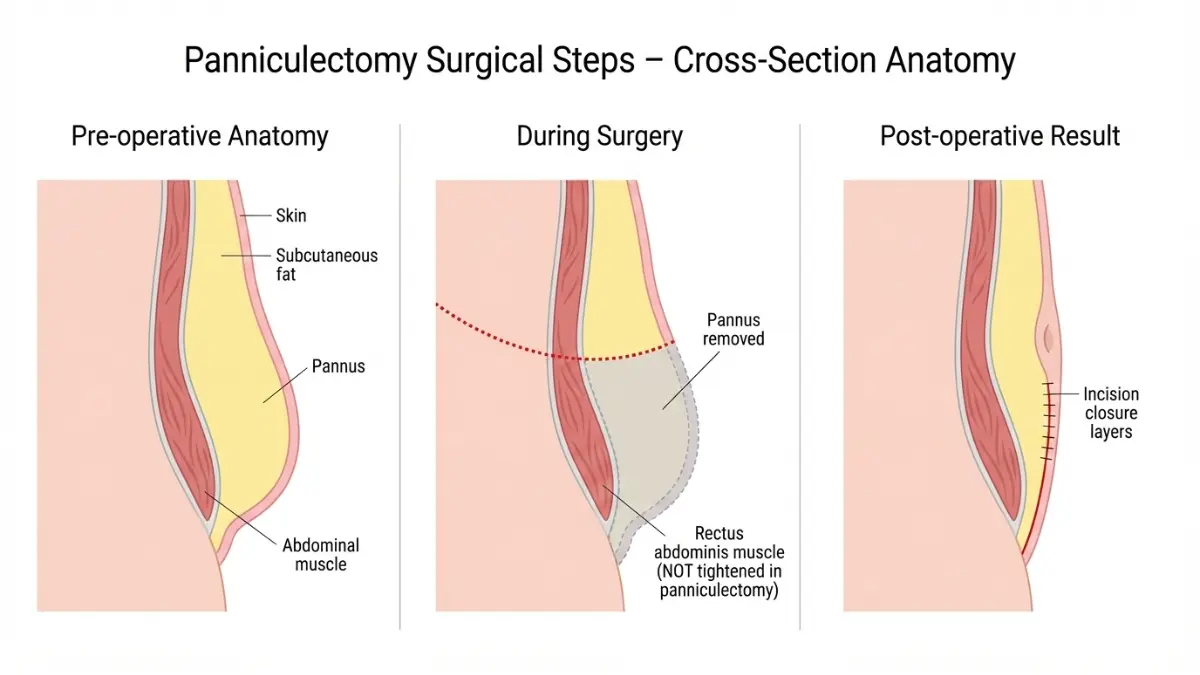
Closure and Drain Placement (45-90 minutes):
- Multiple-layer closure with absorbable deep sutures
- Skin closure with surgical staples or sutures
- 1-3 surgical drains placed to collect fluid and prevent seroma
- Sterile dressing and compression garment applied
- Patient moved to recovery room for 2-4 hours monitoring
Hospital Stay:
Most panniculectomy patients remain hospitalized 1-2 nights for pain management, drain output monitoring, and early mobilization to prevent blood clots.
Panniculectomy Recovery Timeline: Week-by-Week Guide
Week 1-2: Acute Recovery Phase
What to Expect:
- Severe pain managed with prescription opioids (tapering to NSAIDs by week 2)
- Cannot stand fully upright due to abdominal tightness
- Drains produce 100-300mL daily (emptied 2-4 times daily)
- Swelling peaks days 3-5, then gradually decreases
- Compression garment worn 24/7
- Light walking required every 2 hours (prevents blood clots)
- No driving while taking narcotics or unable to emergency brake
Activity Restrictions:
- No lifting over 5 pounds
- No bending at waist
- Sleep in recliner or with pillows elevating upper body
- Sponge baths only until drains removed
Week 3-4: Early Healing Phase
What to Expect:
- Drains typically removed when output drops below 30mL per day
- Pain reduced to moderate discomfort (Tylenol/ibuprofen adequate)
- Can stand more upright, though still slightly hunched
- Showering allowed after drain removal
- Return to desk work possible (not physical jobs)
- Compression garment continues 24/7
Wound Complications: Research from the National Institutes of Health shows 56% of post-bariatric panniculectomy patients experience wound healing complications, with dehiscence (24%), surgical site infection (22%), and seroma (18%) being most common.
Week 5-8: Progressive Recovery Phase
What to Expect:
- Gradual return to normal activities
- Light exercise approved (walking 20-30 minutes, gentle stretching)
- Incision healing well, though still pink/red
- Compression garment reduced to 12-16 hours daily
- Can resume driving if no longer taking narcotics
- Return to physical work approved by surgeon (case-by-case basis)
Activity Milestones:
- Week 6: Light cardio (stationary bike, elliptical)
- Week 8: Swimming approved
- Week 8: Resume sexual activity (with caution)
Month 3-6: Healing Maturation
What to Expect:
- Resume full exercise regimen including weight training
- Swelling 80% resolved by month 3
- Scar maturation begins (flattening and fading)
- Compression garment discontinued (surgeon discretion)
- Final body shape emerging
Month 6-24: Final Results
What to Expect:
- Full healing complete by 12 months
- Panniculectomy scars fade from red to pink to white/light brown
- Final body contour visible
- Patient satisfaction rate: 85-92% at 12-month mark
Optimizing recovery requires adequate rest—use a Sleep Calculator to ensure you’re getting the 8-10 hours nightly sleep needed for tissue healing.
Panniculectomy Complications: What Can Go Wrong?
Overall complication rate: 35-56% for post-bariatric patients. Most complications are minor and manageable with conservative treatment.
Common Complications (5-25% occurrence)
Seroma (Fluid Accumulation):
- Affects 18% of patients
- Treated with needle aspiration or extended drain placement
- Prevention: Keep drains in until output under 30mL/day
Wound Dehiscence (Incision Separation):
- Affects 24% of patients
- Partial opening typically heals with wound care
- Full-thickness separation may require revision surgery
Surgical Site Infection:
- Affects 22% of patients
- Symptoms: Increased redness, warmth, purulent drainage, fever
- Treatment: Antibiotics, possible wound opening and packing
Temporary Numbness:
- Affects 60-80% of patients initially
- Abdominal skin numbness from nerve disruption
- Usually resolves 6-12 months post-op
Serious Complications (1-5% occurrence)
Blood Clots (DVT/PE):
- Deep vein thrombosis or pulmonary embolism
- Prevention: Early walking, compression devices, possible blood thinners
- Symptoms requiring emergency care: Leg swelling, chest pain, shortness of breath
Tissue Necrosis:
- Skin or fat tissue death from inadequate blood supply
- More common in smokers or diabetics
- Requires surgical debridement
Excessive Bleeding:
Panniculectomy Before and After: Realistic Expectations
What Panniculectomy Removes:
- Hanging abdominal pannus only
- 5-25 pounds of excess skin and subcutaneous fat
- Resolves chronic skin rashes and hygiene issues
- Improves mobility and ability to exercise
What Panniculectomy Does NOT Do:
- Remove visceral (internal organ) fat
- Tighten abdominal muscles (that’s abdominoplasty)
- Create six-pack abs or athletic appearance
- Remove stretch marks above incision line
Panniculectomy Scars:
- Hip-to-hip horizontal scar 12-20 inches long
- Initially raised, red, and wide
- Fades significantly over 12-24 months
- Final scar typically 2-4mm wide, light pink or white
Average Results:
- Clothing size drop: 1-3 sizes
- Weight removed: 5-25 pounds
- Waist circumference reduction: 4-8 inches
- Return to comfortable exercise: 8-12 weeks
Managing Panniculectomy Drains and Compression Garments
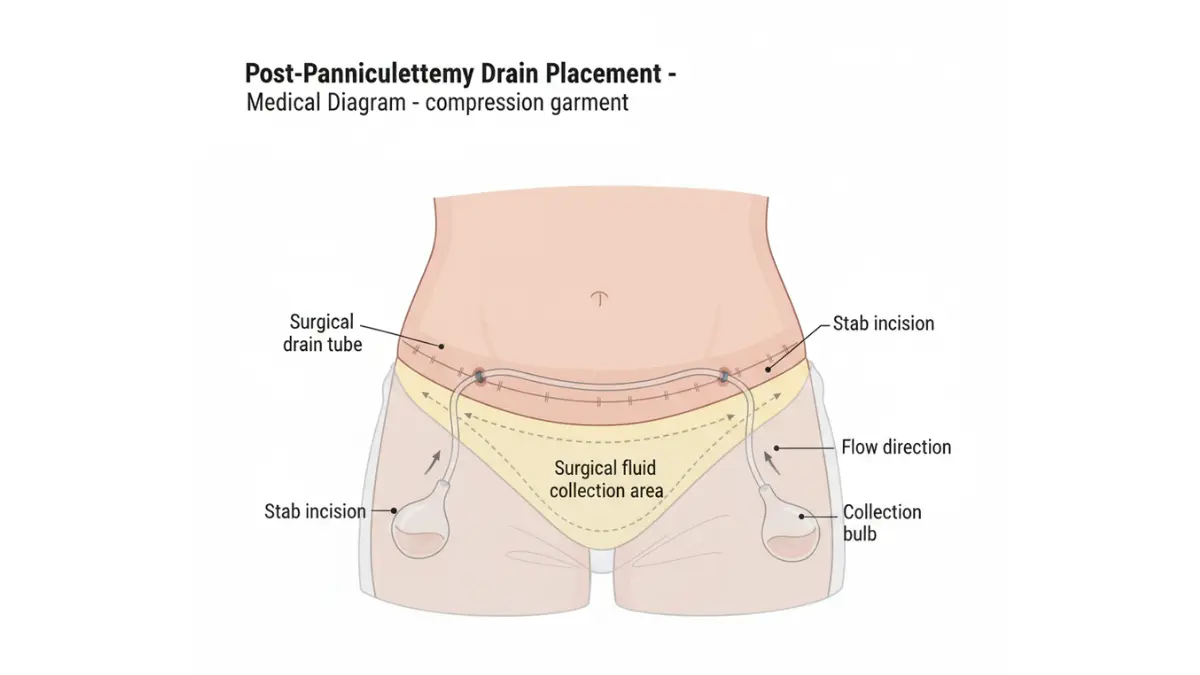
Drain Care Protocol
Emptying Drains (2-4x daily):
- Wash hands thoroughly
- Unpin bulb from clothing/garment
- Pour contents into measuring cup
- Note color (should be clear yellow to light pink)
- Record volume in drain log
- Rinse bulb with tap water
- Compress bulb to create vacuum
- Re-secure bulb to prevent pulling
When to Call Surgeon:
- Sudden increase in drain output
- Foul-smelling drainage
- Thick, cloudy, or dark red drainage
- Fever over 100.4°F
- Drain accidentally pulled out
Compression Garment Guidelines
Purpose:
- Reduces swelling by 40-60%
- Supports healing tissues
- Provides pain relief through gentle pressure
- Minimizes fluid accumulation
Wearing Schedule:
- Weeks 1-4: 24/7 (remove only for showering)
- Weeks 5-8: 16-20 hours daily
- Weeks 9-12: 12 hours daily or as directed
- Month 4+: Discontinued (surgeon discretion)
Finding the Right Panniculectomy Surgeon Near You
David Nelson scheduled consultations with three plastic surgeons advertising “panniculectomy near me” in his city. The first charged $6,800, the second $11,200, the third $14,500—all claiming board certification. Only one was actually certified by the American Board of Plastic Surgery. That difference saved David from potential complications and a botched procedure.
Board Certified Plastic Surgeon Requirements
Not all “board certified” surgeons are equally qualified to perform panniculectomy surgery. The gold standard is American Board of Plastic Surgery (ABPS) certification, which requires:
ABPS Certification Standards
Educational Requirements:
- Medical degree (MD or DO) from accredited institution
- 6-7 years of surgical residency training
- Minimum 3 years dedicated to plastic surgery residency
- Fellowship in body contouring (preferred but not required)
Examination Requirements:
- Written examination covering all plastic surgery procedures
- Oral examination with case presentations
- Recertification every 10 years
- 150+ continuing medical education credits every 3 years
Professional Standards:
- Hospital privileges at accredited facilities
- Surgical center accreditation (AAAASF, AAAHC, or JCAHO)
- Active medical malpractice insurance
- No history of disciplinary actions
Verification: Check surgeon credentials at the American Board of Plastic Surgery verification portal.
Vetting Your Panniculectomy Surgeon: 12-Point Checklist
Before scheduling your procedure, verify these critical qualifications:
Experience and Outcomes
✓ 50+ panniculectomies performed annually
- Surgeons performing fewer than 30/year have 2.4x higher complication rates
- Ask: “How many panniculectomy procedures do you perform each year?”
✓ Before/after portfolio with 20+ patients
- Request to see patients with your pannus grade specifically
- Look for realistic results, not just “best case” examples
✓ Hospital privileges verification
- Must have active privileges at nearby accredited hospital
- This ensures independent credentialing review beyond office-based surgery
✓ Complication and revision rates disclosed
- Infection rate should be under 5%
- Revision surgery rate under 8%
- Transparency about outcomes signals honesty
Insurance and Financial Qualifications
✓ Insurance pre-authorization experience
- Ask: “What percentage of your panniculectomy insurance submissions get approved?”
- 75%+ approval rate indicates surgeon knows medical necessity documentation
✓ In-network status confirmed
- Verify through your insurance provider directly (don’t trust office staff alone)
- Out-of-network increases your costs 30-50%
✓ Written cost estimate provided
- Should include surgeon, anesthesia, facility, supplies, compression garments
- No hidden fees or surprise bills after surgery
Safety and Support
✓ Accredited surgical facility
- Look for AAAASF (American Association for Accreditation of Ambulatory Surgery Facilities) certification
- AAAHC (Accreditation Association for Ambulatory Health Care) also acceptable
- JCAHO (Joint Commission) for hospital-based procedures
✓ Board-certified anesthesiologist present
- Not just a nurse anesthetist (though CRNA with MD supervision acceptable)
- Dedicated professional monitoring vitals throughout 3-5 hour procedure
✓ Clear emergency protocol
- 24/7 surgeon availability post-operatively
- Backup coverage when primary surgeon unavailable
- Nearby hospital affiliation for emergency transfers
✓ Patient references offered
- Willing to connect you with 2-3 previous panniculectomy patients
- Red flag if surgeon refuses due to “privacy” (patients can volunteer)
✓ Realistic expectations communicated
- Discusses scars, numbness, recovery time honestly
- Doesn’t promise “perfect” cosmetic results
- Explains panniculectomy vs abdominoplasty differences clearly
Red Flags: When to Walk Away
Avoid surgeons who:
❌ Are not ABPS board certified (check verification portal)
❌ Perform surgery only in office setting without hospital privileges
❌ Offer suspiciously low pricing (30%+ below market average)
❌ Pressure immediate decision (“special pricing expires today”)
❌ Cannot provide complication rate statistics
❌ Have multiple negative reviews mentioning same issues
❌ Combine panniculectomy with multiple other procedures unsafely
❌ Make guarantees about insurance coverage approval
❌ Refuse to provide written surgical plan
❌ Haven’t performed panniculectomy on someone with your BMI range
Questions to Ask During Consultation
Preparation and Candidacy:
- “Based on my pannus grade and medical history, am I a good candidate?”
- “What pre-operative requirements do you have? (smoking cessation, weight stability, etc.)”
- “Will you personally perform the entire surgery, or will residents/fellows participate?”
Procedure Details:
4. “What surgical technique will you use for my specific case?”
5. “How many drains will I have, and how long typically before removal?”
6. “Will my belly button need repositioning?”
7. “What’s the expected length of my scar?”
Outcomes and Complications:
8. “What are the most common complications you see with panniculectomy?”
9. “What’s your personal complication rate for this procedure?”
10. “How do you handle complications if they occur? Is follow-up care included in the price?”
11. “Can I see before/after photos of patients with similar pannus grade to mine?”
Insurance and Costs:
12. “How experienced is your office with insurance pre-authorization for panniculectomy?”
13. “What documentation will you provide to support medical necessity?”
14. “If insurance denies, what’s your appeal process involvement?”
15. “What is included in your quoted price? What costs are separate?”
Finding Panniculectomy Surgeons Near You
Reliable Search Resources:
1. American Society of Plastic Surgeons (ASPS) Find-a-Surgeon Tool
- Filters by procedure type, location, board certification
- Only lists ABPS-certified surgeons
- Website: plasticsurgery.org
2. Your Bariatric Surgeon’s Referral Network
- Post-bariatric patients should ask their weight loss surgeon for recommendations
- Bariatric centers often have established relationships with body contouring specialists
- These surgeons have extensive experience with post-massive-weight-loss anatomy
3. Insurance Provider Directory
- Request list of in-network plastic surgeons
- Verify they specifically perform panniculectomy (not just general plastic surgery)
- Call offices to confirm current insurance participation
4. Academic Medical Centers
- University-affiliated hospitals often have plastic surgery departments
- Attending physicians (not just residents) perform procedures
- Teaching hospitals may offer slightly lower costs
5. Hospital-Based Plastic Surgery Departments
- Major hospitals credential surgeons rigorously
- Built-in safety net for complications
- Often have multidisciplinary teams (wound care, infectious disease, etc.)
Virtual vs In-Person Consultations
Virtual consultations (Telemedicine):
✓ Good for:
- Initial screening and cost discussion
- Insurance coverage questions
- Determining if you’re a candidate for surgery
- Reviewing before/after photos
❌ Not sufficient for:
- Physical examination of pannus (required for grading)
- Accurate surgical planning
- Taking measurements for cost estimates
- Assessing skin quality and elasticity
Recommendation: Start with virtual consultation if convenient, but schedule in-person visit before committing to surgery. Many surgeons apply virtual consultation fee toward surgery if you proceed.
The Value of Second Opinions
40% of patients who seek second opinions receive different surgical recommendations. Here’s why multiple consultations matter:
Cost Comparison:
- Surgeon fees vary 30-50% within same geographic area
- Payment plan options differ significantly
- Some surgeons bundle compression garments/supplies, others charge separately
Surgical Approach:
- Extended vs standard panniculectomy
- Drain placement preferences (1 vs 3 drains)
- Suture vs staple closure techniques
Insurance Strategy:
- Documentation approaches vary in effectiveness
- Some surgeons have 85%+ approval rates, others 40-50%
- Appeal process involvement differs
Rapport and Trust:
- You’ll work with this surgeon for 12+ months (including follow-up)
- Communication style and bedside manner matter
- Feeling heard and respected reduces anxiety
Before finalizing your choice, verify your overall health status with a BMI calculator to ensure you meet the surgical readiness criteria most insurers require.
Disclaimer
This article is for educational and informational purposes only and does not constitute medical advice. Panniculectomy is a major surgical procedure that requires evaluation by a board-certified plastic surgeon. Individual results, costs, insurance coverage, and recovery experiences vary significantly based on personal health factors, pannus grade, and surgeon expertise. Always consult with qualified medical professionals before making any decisions about surgical procedures. The cost figures and insurance coverage percentages cited represent 2026 averages and may not reflect your specific situation or geographic location.
Frequently Asked Questions About Panniculectomy
1. How much does panniculectomy cost in 2026?
Panniculectomy costs range from $7,000 to $15,000 depending on your state, surgeon experience, and facility type. With insurance coverage, most patients pay $1,500-$4,000 out-of-pocket after meeting deductibles.
2. Does insurance cover panniculectomy surgery?
Yes, 78% of medically necessary panniculectomy cases receive partial or full insurance coverage when you provide proper documentation showing chronic skin conditions, Grade 2+ pannus, and 6+ months of failed conservative treatment.
3. What’s the difference between panniculectomy and tummy tuck?
Panniculectomy removes only excess hanging skin for medical reasons (often covered by insurance), while tummy tuck (abdominoplasty) also tightens muscles and repositions the belly button for cosmetic results (rarely covered by insurance).
4. How long is panniculectomy recovery time?
Full recovery takes 6-8 weeks, with return to desk work at 2-3 weeks and physical jobs at 6-8 weeks. Most patients resume light exercise at 4-6 weeks and full workouts at 8-12 weeks post-surgery.
5. Will I have scars after panniculectomy?
Yes, panniculectomy leaves a horizontal hip-to-hip scar 12-20 inches long, typically along the bikini line. Scars are initially red and raised but fade to light pink or white over 12-24 months.
6. How long after weight loss can I get panniculectomy?
You must wait 6-12 months after natural weight loss or 12-18 months after bariatric surgery to ensure weight stability. Insurance requires proof of stable BMI for at least 6 months before approval.
7. What is Grade 2 pannus for panniculectomy qualification?
Grade 2 pannus means your excess abdominal skin hangs down to cover your genitals or upper thigh crease when standing. This is the minimum grade required for 78% of insurance approvals.
8. Can I finance panniculectomy if insurance denies coverage?
Yes, financing options include CareCredit (0% interest for 6-24 months), Denefits (no credit check, 95% approval), HSA/FSA accounts, surgeon in-house payment plans, and medical personal loans with 6-36% APR.
9. How many drains will I have after panniculectomy?
Most patients have 1-3 surgical drains placed during surgery to prevent fluid buildup. Drains typically remain 7-14 days and are removed when output drops below 30mL per day.
10. What are the most common panniculectomy complications?
The most common complications are seroma/fluid accumulation (18%), wound dehiscence/incision separation (24%), and surgical site infection (22%). Most resolve with conservative treatment, though 5-10% may require revision surgery.
11. How do I find a qualified panniculectomy surgeon near me?
Search the American Society of Plastic Surgeons directory at plasticsurgery.org, verify board certification through the American Board of Plastic Surgery website, and ask your bariatric surgeon for referrals to specialists experienced in post-weight-loss body contouring.
About this content
How this article was put together: researched from recognised health sources, drafted with the help of AI tools, and edited by hand, with sources linked throughout.

Sameer Patel is the founder and editor of My Medicine Advisor. He is not a doctor or medical professional — before starting this site he worked in banking,…
Medical disclaimer
The content on MyMedicineAdvisor is provided for general informational and educational purposes only and is not a substitute for professional medical advice, diagnosis, or treatment. Health information on this website should not be used to diagnose, treat, cure, or prevent any condition without guidance from a qualified healthcare professional. Always seek the advice of your doctor, physician, or another licensed healthcare provider with any questions you may have regarding a medical condition, symptoms, medications, or treatment decisions.