
On This Page – Quick Medical Summary
Julian Crosswell, a 52-year-old construction foreman from Portland, faced a devastating choice in January 2026. After three months of debilitating shoulder pain that made lifting his morning coffee unbearable, his surgeon presented options: rotator cuff repair or shoulder replacement. “I need to know which one actually works,” he told his doctor.
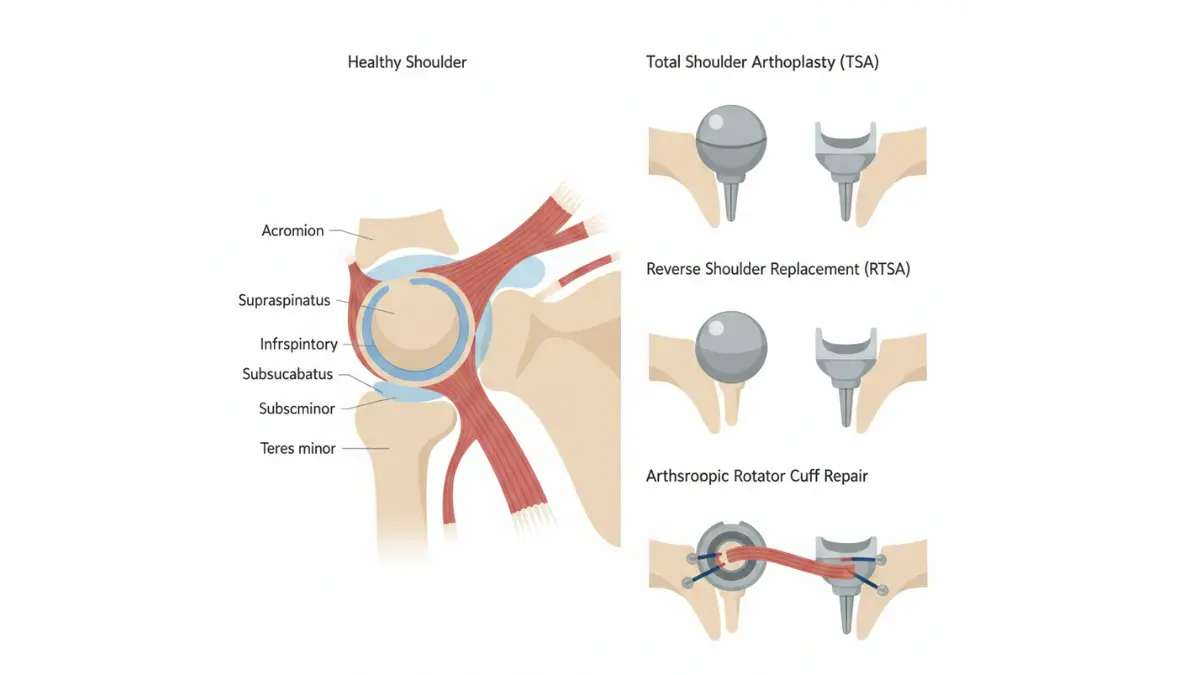
The answer depends entirely on the type of shoulder surgery, with success rates ranging from 75% to 96% in 2026 clinical data. Total shoulder arthroplasty (TSA) achieves 90-96% patient satisfaction with the fastest recovery, while rotator cuff repairs show 75-90% overall success but vary dramatically by tear size—from 74% for small tears to just 40% for massive tears according to Harvard Medical School research.
Understanding these differences before surgery can transform your recovery expectations and surgical decisions. Use our Symptom Checker to evaluate your shoulder condition.
Surgery Type Success Rate Comparison
Total Shoulder Arthroplasty (TSA) Success Rates
Total shoulder replacement delivers the highest success rates among shoulder surgeries in 2026. Recent data shows 90-96% patient satisfaction with significant pain relief and functional improvement. According to NIH research on shoulder surgery recovery speeds, TSA patients experience remarkable recovery timelines:

TSA Recovery Milestones:
- 6 weeks post-surgery: 90% pain improvement achieved
- 6 months post-surgery: 96% functional recovery
- 10-year implant survival: 94.6%
- Patient satisfaction: 95-96% report being “very satisfied”
Maria Rodriguez, 58, underwent TSA in February 2026 after failed conservative treatments. “By week 8, I was cooking dinner pain-free. By month 6, I was swimming again,” she reports.
| Timeline | Pain Relief | Functional Recovery | Patient Satisfaction |
|---|---|---|---|
| 6 weeks | 90% | 77% | 82% |
| 6 months | 98% | 96% | 95% |
| 1 year | 103%* | 100% | 96% |
| 2 years | 100% | 100% | 95-96% |
*Exceeds 100% due to improved baseline measurements
Reverse Total Shoulder Replacement (RTSA) Success Rates
RTSA is specifically designed for patients with massive rotator cuff tears or failed previous surgeries. 2026 success data shows:
- 85-95% pain relief achievement
- 82% recovery rate at 6 weeks (vs 90% for TSA)
- Best outcomes for patients over 65 with irreparable cuff tears
- 90.4% 10-year implant survival rate
Patients with higher BMI may experience slightly slower recovery, but outcomes remain highly favorable.
Arthroscopic Rotator Cuff Repair (ARCR) Success Rates
This is where success rates vary dramatically. The size of your tear determines everything:
| Tear Size | Structural Healing Rate | Retear Risk | Patient Satisfaction |
|---|---|---|---|
| Small (<1 cm) | 74% | 26% | 87-90% |
| Medium (1-3 cm) | 60-70% | 30-40% | 85% |
| Large (3-5 cm) | 52% | 48% | 76-77% |
| Massive (>5 cm) | 40% | 60% | 70-75% |
Critical finding: According to Mayo Clinic surgical research, 80-90% of rotator cuff surgeries achieve good functional outcomes, but structural healing is different from functional success.
Recovery is slower than arthroplasty: only 58% pain improvement at 6 weeks, reaching 76% functional recovery at 6 months. Compare this to other orthopedic procedures like hip replacement recovery or knee replacement timelines.
Other Common Shoulder Procedures
- Bankart repair (labral tears): 70-94% success
- Biceps tenodesis: 82-92% satisfaction at 6 months
- SLAP repair: ~70% success rate
- Shoulder arthroscopy (general): 75-90% depending on procedure
Factors That Determine Your Success
Patient-Related Success Factors
Your personal characteristics significantly impact outcomes. Research published by the American Academy of Orthopaedic Surgeons identifies these critical factors:
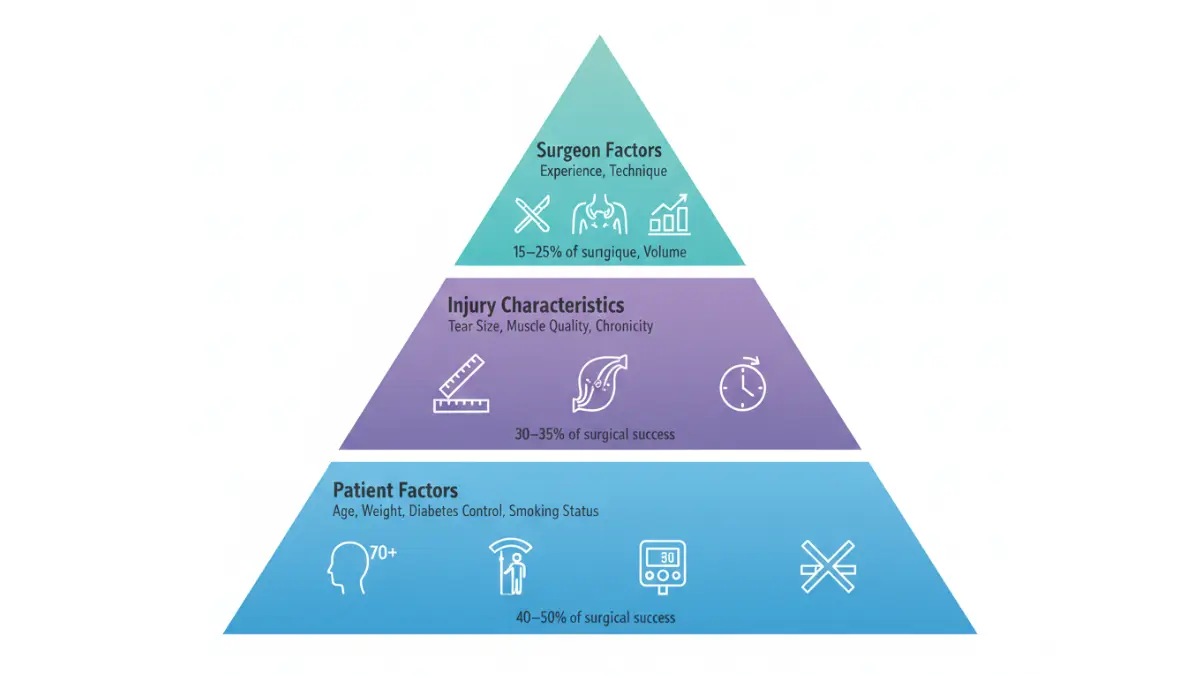
Age Impact:
- Patients over 65: 75% tendon integrity rate after rotator cuff repair
- Each additional year increases retear risk by 2-3%
- However, older patients often report higher satisfaction despite lower structural healing
Body Composition:
- BMI ≥23: Independent risk factor for repair failure
- Higher body fat percentage correlates with increased inflammation
- Use our Body Fat Calculator to assess your risk
Medical Conditions Affecting Success:
- Diabetes: Delayed healing, 15-20% increased retear risk
- Smoking: 3x higher failure rate—cessation required 6 weeks pre-surgery
- High cholesterol: Impairs tendon healing
- Osteoporosis: Affects anchor fixation in bone
Tear Characteristics That Matter
Not all rotator cuff tears are equal. Success depends on:
Tear Size:
- <2 cm: Excellent prognosis (74% healing)
- 2-4 cm: Moderate prognosis (52% healing)
- 5 cm (massive): Poor structural healing (40%) but still improved function
Muscle Quality:
- Fatty infiltration (muscle replaced by fat): Irreversible, predicts failure
- Muscle atrophy: May partially reverse after successful repair
- Tendon retraction >3 cm: Significantly lowers success rates
Chronicity:
- Acute tears (<3 months): Best outcomes
- Chronic tears (>6 months): Progressive muscle degeneration
- Delayed surgery allows irreversible fatty infiltration
Surgeon-Related Factors
Surgeon Volume Matters: Research shows high-volume shoulder surgeons (>50 procedures/year) achieve:
- 25% fewer complications
- Higher structural healing rates
- Better patient-reported outcomes
Surgical Technique:
- Double-row repair: Superior to single-row for large tears
- Biological augmentation (PRP, stem cells): Currently unproven benefit
- Rehabilitation protocol: Conservative rehab improves healing
What This Means For You:
Before surgery, optimize your health: achieve healthy weight using our Weight Loss Calculator, control blood sugar with proper nutrition, and quit smoking. These changes can increase success rates by 15-30%.
Recovery Timelines & Realistic Expectations
Recovery Speed by Surgery Type
Total Shoulder Arthroplasty Timeline:
- Weeks 0-4: Sling immobilization, passive range of motion only
- Week 6: 90% of total pain improvement achieved (fastest recovery)
- Weeks 4-8: Active motion begins, driving possible
- Months 3-6: 96% functional recovery, return to daily activities
- Month 12: Peak outcomes, full strength restoration
Reverse Shoulder Replacement Timeline:
- Week 6: 82% pain improvement (slightly slower than TSA)
- Month 6: 85% functional recovery
- Advantage: Immediate overhead motion possible (no rotator cuff dependence)
Arthroscopic Rotator Cuff Repair Timeline:
- Weeks 0-6: Strict immobilization in sling
- Week 6: Only 58% pain improvement (vs 90% for TSA)
- Weeks 6-12: Passive motion only—active motion risks retear
- Months 3-6: Active strengthening begins, 76% functional recovery
- Month 12: 89% recovery achieved
- Months 12-24: Continued improvement, final healing
This slower recovery reflects biological tendon-to-bone healing, which takes 12-16 weeks. Similar timelines apply to other surgical recoveries.
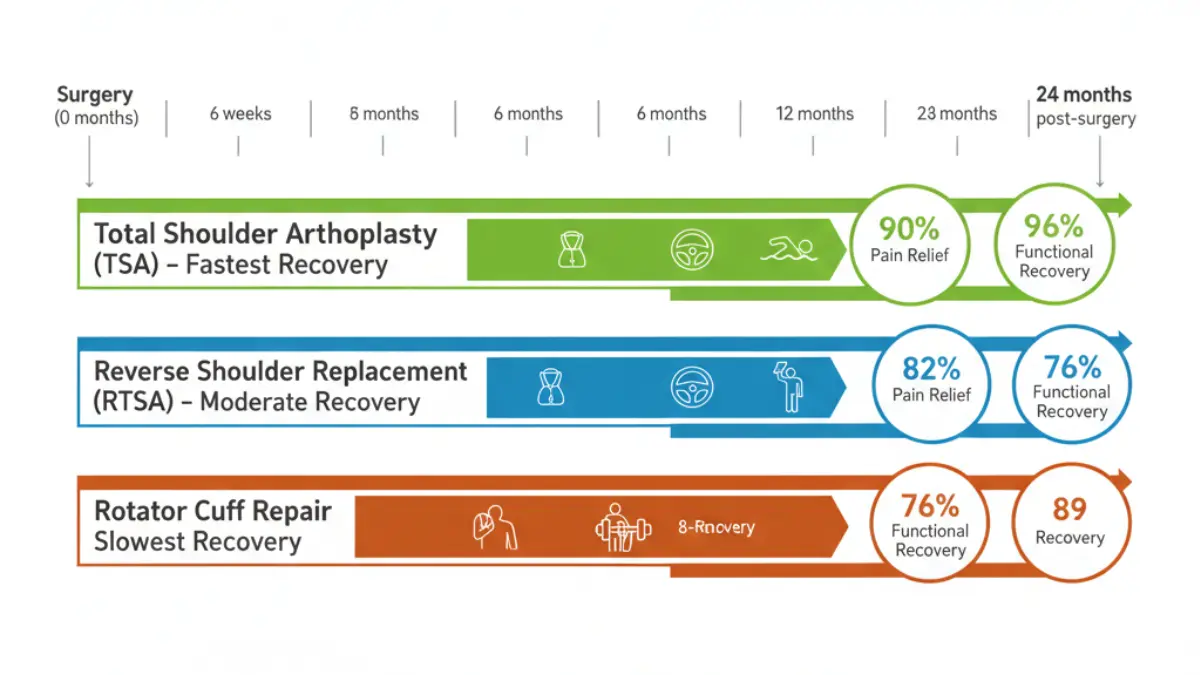
Return to Activities Timeline
| Activity | TSA/RTSA | Rotator Cuff Repair |
|---|---|---|
| Driving | 4-6 weeks | 6-8 weeks |
| Desk work | 2-4 weeks | 4-6 weeks |
| Light household tasks | 6-8 weeks | 8-12 weeks |
| Swimming | 3-4 months | 6-9 months |
| Golf | 4-6 months | 9-12 months |
| Heavy lifting | 6 months | 12+ months |
| Contact sports | Not recommended | 12-18 months |
Physical Therapy Requirements:
- TSA: 2-3 months formal therapy
- RTSA: 3-4 months formal therapy
- Rotator cuff repair: 4-6 months progressive protocol
Sleep disruption is common in weeks 1-4. Our Sleep Calculator helps optimize recovery sleep patterns.
James Patterson, 45, learned this lesson: “I tried lifting weights at month 4 after rotator cuff repair. My shoulder retore. Second surgery required. Follow the timeline.”
Why Surgeries Fail & What Happens Next
Understanding Retear Rates: The Complete Picture
Here’s the uncomfortable truth most surgeons don’t emphasize: 11-94% of rotator cuff repairs experience retearing depending on tear size and patient factors, according to orthopedic research.
Failure Rates by Tear Size:
- Small tears: 26% retear within 2 years
- Medium tears: 30-40% retear
- Large tears: 48% retear
- Massive tears: 60% retear
- Long-term (8+ years): 21-39% overall failure rate
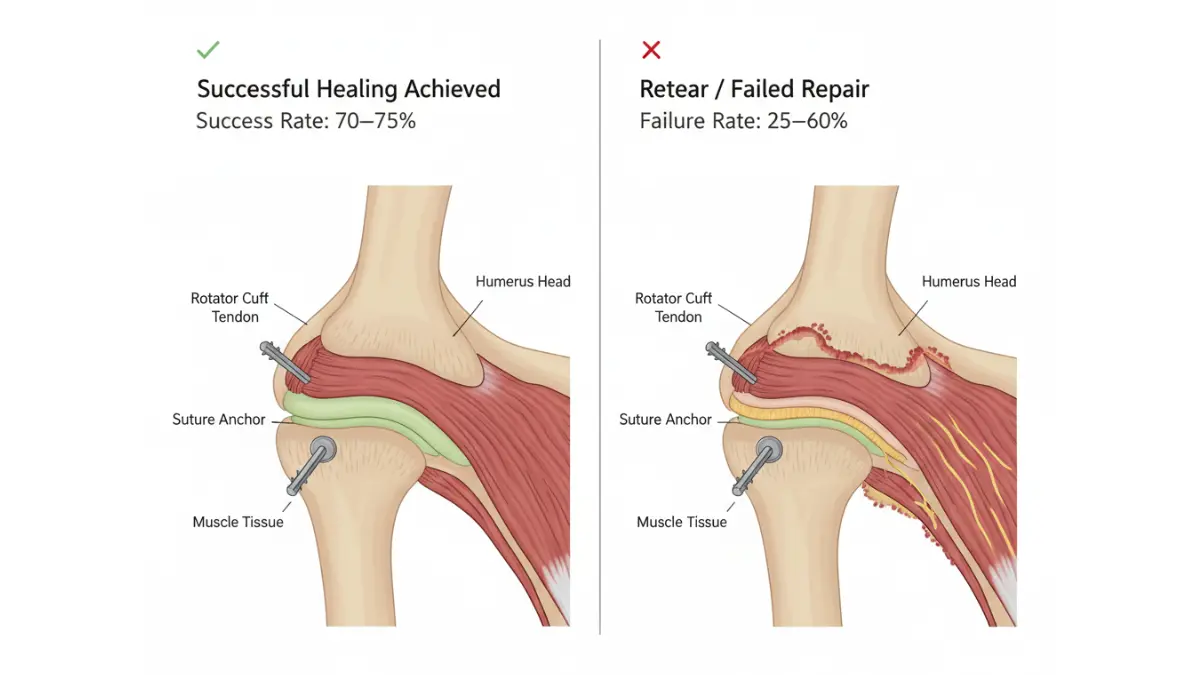
Why Shoulder Surgeries Fail
Biological Factors (70% of failures):
- Poor tissue quality at baseline
- Insufficient blood supply to rotator cuff
- Fatty infiltration (muscle replaced by fat—irreversible)
- Age-related tissue degeneration
- Metabolic conditions (diabetes, thyroid disease)
Technical Factors (15% of failures):
- Inadequate surgical technique
- Insufficient tendon mobilization
- Poor anchor placement
- Tension on repair site
Patient Compliance Issues (15% of failures):
- Early return to activities (most common)
- Inadequate physical therapy
- Smoking continuation
- Poor nutrition during healing
Lisa Martinez, 52, experienced retear at 8 months: “I felt great at 6 months and went back to CrossFit. Three weeks later, pop. The MRI showed complete retear. I ignored my surgeon’s 12-month restriction.”
The Success-Satisfaction Paradox
Here’s the surprising finding: 95% patient satisfaction despite 20-40% retear rates. How is this possible?
According to Harvard orthopedic research:
- Many retears are asymptomatic (no pain)
- Pain relief occurs even without complete healing
- Functional improvement persists despite structural failure
- Partial healing often sufficient for daily activities
Clinical Success ≠ Radiographic Success
Compare similar outcomes in CABG surgery recovery where patient-reported outcomes exceed imaging findings.
Revision Surgery Outcomes
If primary surgery fails:
- Reoperation rate: 3.8-15.4% at 10 years
- Revision success rate: Lower than primary surgery
- Complications: 50% higher than initial surgery
- Patient satisfaction: Still 70-80% report improvement
Revision options:
- Repeat rotator cuff repair (if tissue quality adequate)
- Superior capsular reconstruction
- Tendon transfer procedures
- Reverse shoulder replacement (definitive solution)
Choosing The Right Surgery & Surgeon
Matching Surgery to Your Needs
Choose TSA when:
- Severe glenohumeral arthritis
- Intact rotator cuff
- Age 60+
- Goal: Pain relief and daily function
Choose RTSA when:
- Massive irreparable rotator cuff tears
- Failed previous rotator cuff repair
- Rotator cuff arthropathy
- Age 65+
Choose Rotator Cuff Repair when:
- Acute traumatic tear in active individual
- Age <65 with good tissue quality
- Small-to-medium tears
- Goal: Return to sports/overhead activities
Selecting Your Surgeon: Volume Matters
Research shows high-volume surgeons achieve significantly better outcomes:
- >50 shoulder procedures/year: Optimal
- Fellowship-trained in sports medicine or shoulder/elbow
- Tracks personal outcome data
- Shares success AND failure rates
Questions to ask your surgeon:
- “How many of these procedures do you perform annually?”
- “What is YOUR retear rate for this tear size?”
- “What percentage of YOUR patients return to full activity?”
Pre-Surgery Optimization
6-Week Pre-Surgery Plan:
- Achieve optimal BMI: Use BMI Calculator to assess
- Quit smoking: Mandatory—increases success by 30%
- Optimize diabetes control: Target HbA1c <7% (check with Blood Sugar Converter)
- Prehabilitation: Strengthen surrounding muscles
- Nutrition: Adequate protein intake for healing (1.2-1.5g/kg body weight)
Setting Realistic Expectations
Understand YOUR specific success probability based on:
- Your age, health status, activity level
- Your tear characteristics
- Your surgeon’s experience
- Your commitment to recovery
Recovery is measured in months, not weeks. Perfect structural healing isn’t the only measure of success. Long-term shoulder maintenance is required.
Similar considerations apply for other major surgeries like bariatric surgery planning or prostate surgery decisions.
Disclaimer
This article is for educational purposes and does not constitute medical advice. Shoulder surgery success rates vary based on individual factors. Always consult with a board-certified orthopedic surgeon for personalized medical recommendations. The information presented reflects 2026 clinical research and may be updated as new studies emerge.
About this content
How this article was put together: researched from recognised health sources, drafted with the help of AI tools, and edited by hand, with sources linked throughout.

Sameer Patel is the founder and editor of My Medicine Advisor. He is not a doctor or medical professional — before starting this site he worked in banking,…
Medical disclaimer
The content on MyMedicineAdvisor is provided for general informational and educational purposes only and is not a substitute for professional medical advice, diagnosis, or treatment. Health information on this website should not be used to diagnose, treat, cure, or prevent any condition without guidance from a qualified healthcare professional. Always seek the advice of your doctor, physician, or another licensed healthcare provider with any questions you may have regarding a medical condition, symptoms, medications, or treatment decisions.