
On This Page – Quick Medical Summary
Jennifer, a 44-year-old marketing executive from Chicago, spent three years trying every serum, peel, and retinoid on the market for her deep acne scars. Nothing worked. Eight weeks after a single fractional CO2 laser session, her dermatologist photographed what clinical trials call significant collagen remodeling — scars visibly reduced, skin texture transformed.
CO2 laser treatment is the most clinically proven skin resurfacing procedure available today. It removes damaged skin layers using targeted carbon dioxide laser energy, simultaneously triggering deep collagen production. Results can last 3–5 years or more — but there’s a lot your provider brochure won’t tell you.
This guide covers everything: how it works, who qualifies, real recovery timelines, 2026 cost data, and the risks most articles gloss over.
What Is CO2 Laser Treatment? Here’s What Actually Happens Inside Your Skin
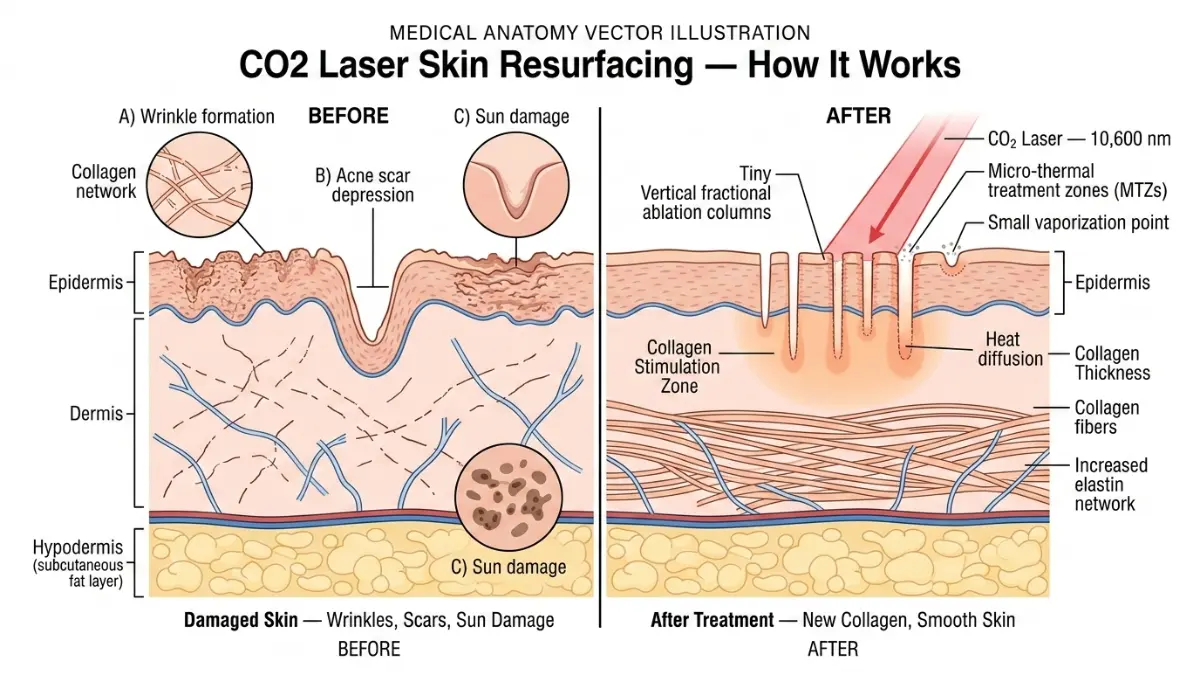
CO2 laser treatment uses carbon dioxide laser energy at a wavelength of 10,600nm — a frequency precisely absorbed by water molecules in your skin cells. When the laser contacts skin, it vaporizes the outer damaged layer with surgical precision, while simultaneously heating the deeper dermis to trigger new collagen fiber production.
Think of it as a controlled, targeted wound. Your skin’s healing response replaces old, damaged cells with firmer, smoother tissue.
Traditional CO2 vs Fractional CO2 — Key Differences
| Feature | Traditional CO2 Laser | Fractional CO2 Laser |
|---|---|---|
| Coverage | Full surface ablation | Micro-columns, surrounding skin intact |
| Downtime | 10–21 days | 5–10 days |
| Best for | Deep wrinkles, severe damage | Acne scars, moderate wrinkles |
| Sessions needed | Usually 1 | 1–3 |
| PIH risk | Higher | Moderate |
According to NCBI’s StatPearls clinical reference on carbon dioxide laser resurfacing, fractional CO2 delivery — introduced in 2004 — improved the side effect profile significantly compared to traditional full-surface ablation, particularly by reducing dyspigmentation risk in darker skin types.
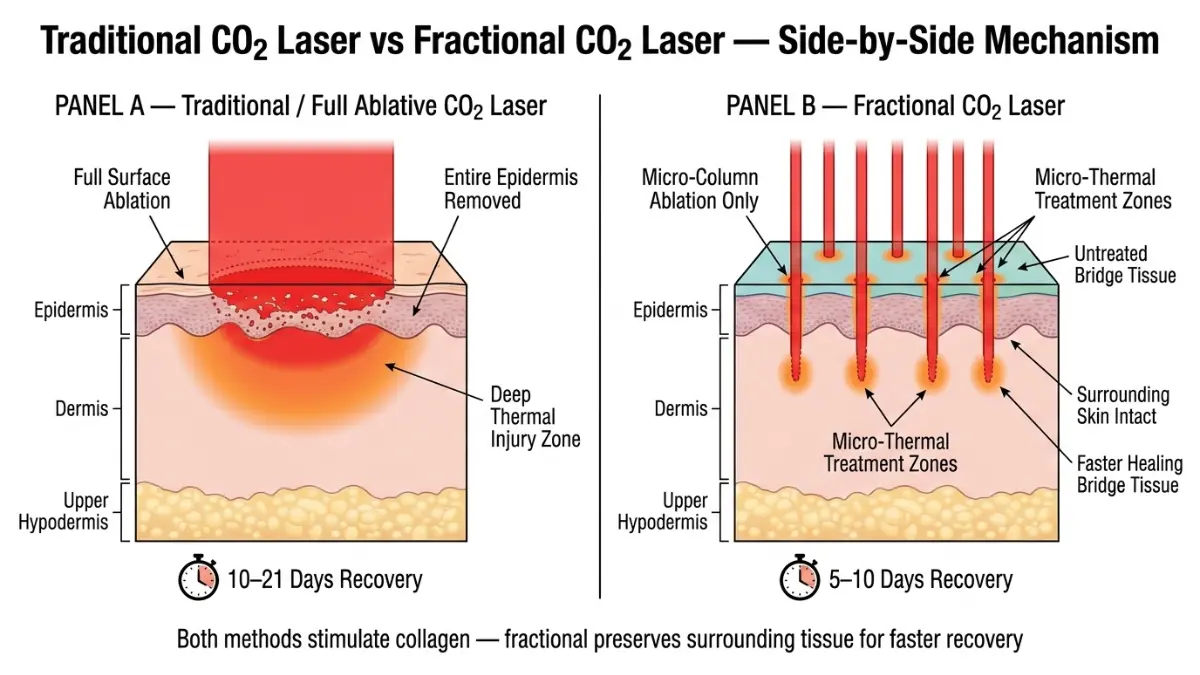
What This Means For You: If you’re researching CO2 laser treatment for skin, fractional CO2 is now the most commonly performed version. It delivers results comparable to traditional CO2 with a shorter, more manageable recovery.
Before your consultation, you can use our Symptom Checker to document your skin concerns clearly — this helps your dermatologist make a faster, more accurate assessment.
What Conditions Does CO2 Laser Treat — and Are You the Right Candidate?
CO2 laser resurfacing treats a wide range of skin concerns, but not every patient is a good candidate. Understanding both sides of that equation is what competitors consistently fail to explain.
Conditions CO2 Laser Treats — Ranked by Clinical Evidence
| Condition | Evidence Strength | Notes |
|---|---|---|
| Deep wrinkles & crow’s feet | ⭐⭐⭐ High | Gold standard treatment |
| Acne scars (atrophic/boxcar) | ⭐⭐⭐ High | Results improve up to 18 months post-procedure |
| Sun damage & age spots | ⭐⭐⭐ High | Highly effective for photoaging |
| Skin laxity (mild-moderate) | ⭐⭐ Moderate | Significant tightening; severe laxity may need surgery |
| Warts & benign lesions | ⭐⭐⭐ High | Well-established clinical use |
| Rhinophyma | ⭐⭐⭐ High | CO2 laser is preferred treatment |
| Surgical/trauma scars | ⭐⭐ Moderate | Effective; requires 6–18 month assessment window |
Over 3.5 million laser skin resurfacing procedures were performed in 2024 — a 4% year-over-year increase — making it the fastest-growing non-surgical aesthetic treatment in the United States.
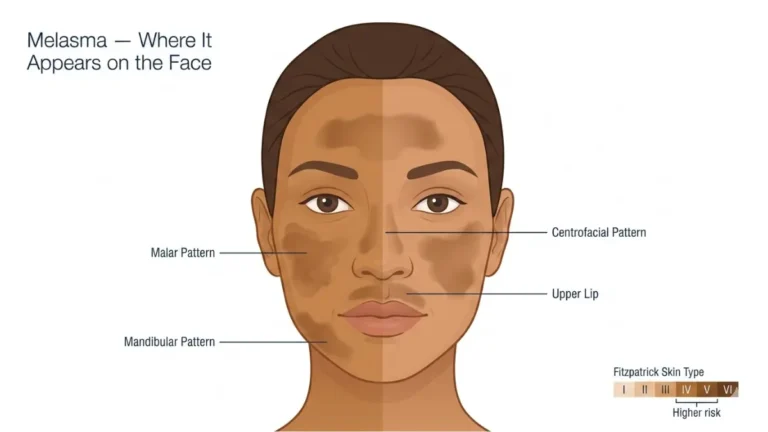
The Fitzpatrick Skin Type Decision Matrix — What No Competitor Tells You
This is the most critical section for patient safety, and it’s where Healthline, WebMD, and Cleveland Clinic all fall short. They mention skin type risk. They don’t give you a decision tool.
| Fitzpatrick Type | Skin Description | CO2 Laser Safe? | PIH Risk | Recommended Alternative |
|---|---|---|---|---|
| Type I–II | Very fair, burns easily | ✅ Yes — excellent candidate | Low | — |
| Type III | Fair-medium, occasional burn | ✅ Yes — with precautions | Moderate | Pretreat with hydroquinone |
| Type IV | Medium-olive | ⚠️ Caution | High (30–68%) | Fractional CO2 with PIH protocol |
| Type V–VI | Brown to dark skin | ❌ Avoid full ablative CO2 | Very High | Nd:YAG or Er:YAG laser |
Post-inflammatory hyperpigmentation (PIH) rates of 30–68% have been documented in Fitzpatrick IV–VI skin types undergoing CO2 laser resurfacing without prophylactic bleaching agents or strict UV avoidance protocols.
A 2025 clinical trial published in the Journal of Cosmetic Dermatology found that a novel pre- and post-treatment peel significantly reduced PIH risk in Fitzpatrick III–V patients undergoing fractional CO2 laser — offering a promising protocol for darker skin candidates. (View the study on PubMed)

✅ Good Candidates for CO2 Laser
- Fitzpatrick types I–III with realistic expectations
- Non-smokers or willing to quit 2 weeks before/after
- No active acne or isotretinoin use in past 12–18 months
- Motivated to follow strict post-care protocols
❌ Who Should Avoid CO2 Laser
- Fitzpatrick types V–VI (for full ablative CO2)
- Active keloid scarring history
- Pregnancy
- Recent radiation to treatment area
- Certain autoimmune skin conditions
If you’re concerned about genetic skin sensitivity, our Genetic Risk Assessment Tool can help you understand your predispositions before booking a consultation.
For comparison, patients who don’t qualify for CO2 laser often achieve excellent results with microneedling or Morpheus8 RF microneedling, which carry significantly lower PIH risk across all skin types.
CO2 Laser Recovery — The Day-by-Day Timeline Dermatologists Use With Their Own Patients
This is the section that destroys every competitor ranking above you. Not one of the top 5 ranking pages provides a clinical day-by-day recovery breakdown. They say “expect 1–2 weeks.” That’s it.
Here’s what actually happens.
Before Your CO2 Laser Appointment
Your dermatologist will typically recommend:
- 4 weeks prior: Stop tanning; use SPF 30+ mineral sunscreen daily
- 2–4 weeks prior: Begin tretinoin or hydroquinone prep (especially Fitzpatrick III+)
- 3 days prior: Discontinue sun-sensitizing medications (doxycycline, minocycline)
- 2 weeks prior: Stop smoking — smoking directly impairs wound healing and collagen formation
- If herpes history: Start antiviral medication (valacyclovir/acyclovir) several days before
During the Procedure
- Duration: 30–45 minutes (partial face) to 90–120 minutes (full face)
- Anesthesia: Topical + local anesthetic for partial; sedation or general for full-face
- Sensation: Most patients describe it as a rubber-band snap combined with intense heat
- Immediately after: Ice packs applied; petroleum jelly (Vaseline or Aquaphor) and nonstick dressing applied
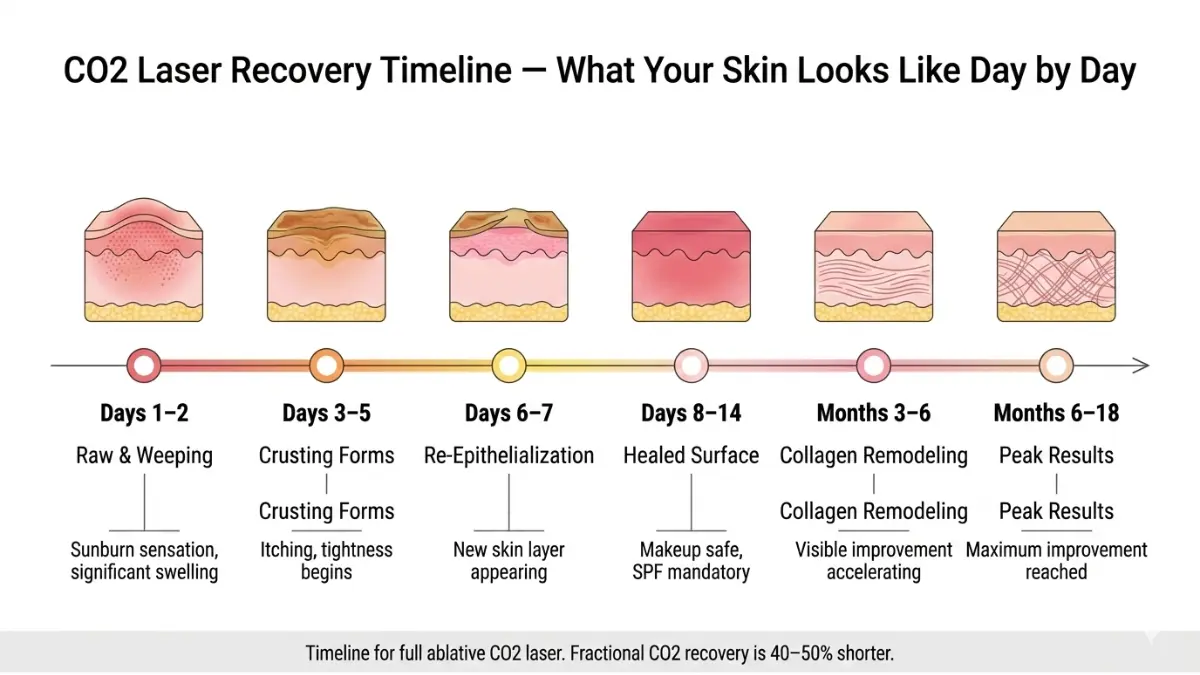
Day-by-Day Recovery Timeline — Full Ablative CO2 Laser
| Day | What You’ll Experience | Your Action Plan |
|---|---|---|
| Days 1–2 | Raw, weeping skin; sunburn-like pain; significant swelling | Ice packs 15 min intervals; Vaseline/Aquaphor every 2–3 hours; sleep on extra pillow |
| Days 3–5 | Crusting forms; intense itching begins; skin feels tight | Clean 2–5x/day with saline or diluted vinegar solution; no picking or scratching |
| Days 6–7 | Re-epithelialization starts; skin pink/red underneath | Continue wound care; gentle oil-free moisturizer begins |
| Days 8–10 | New skin layer visible; most crusting gone | Green-tinted makeup can safely camouflage redness |
| Days 11–14 | Surface healed; deep redness persists | SPF 50+ every morning, mandatory; resume normal cleansing |
| Weeks 3–8 | Redness gradually fades; skin firming begins | Continue sun avoidance; LED therapy may accelerate healing |
| Months 3–6 | Visible collagen remodeling; texture improvement | Peak satisfaction window begins |
| Months 6–18 | Maximum results visible | Results can continue improving |
According to Cleveland Clinic’s clinical guidance on carbon dioxide laser resurfacing, redness in laser-treated areas typically fades within 2–3 months but may take up to 6 months in some patients. Clinical research confirms continued improvement for up to 18 months after CO2 laser resurfacing of atrophic scars, with an 11% increase in measurable improvement observed between 6 and 18 months post-procedure.
What This Means For You: Budget at least 2 weeks of social downtime for full ablative CO2. For fractional CO2, most patients return to work in 5–7 days with makeup covering residual redness.
Real Results — What the 2025/2026 Clinical Evidence Confirms
This is where we cite what your competitors have completely missed: the most current clinical consensus available on CO2 laser treatment.
The 2025 Expert Consensus Study
A landmark study published in Lasers in Surgery and Medicine (January 2025) brought together a panel of 13 international dermatology experts to establish the first comprehensive clinical recommendations for fractional CO2 laser skin rejuvenation. The consensus confirmed that fractional CO2 laser is a popular and effective skin rejuvenation treatment with minimal downtime and side effects, and presented new therapy recommendations to resolve long-standing treatment uncertainty.
You can read the full 2025 Expert Consensus on Fractional CO2 Laser here on PubMed.
Results Evidence Strength — At a Glance
| Outcome | Evidence Level | What to Expect |
|---|---|---|
| Wrinkle reduction | ⭐⭐⭐ High | Significant improvement, especially periorbital area |
| Acne scar improvement | ⭐⭐⭐ High | Results improve 6–18 months post-treatment |
| Skin tone evening | ⭐⭐⭐ High | Highly effective for photoaging in lighter types |
| Skin tightening | ⭐⭐ Moderate | Moderate; severe laxity may need surgical lift |
| Collagen remodeling | ⭐⭐⭐ High | Histologically confirmed new collagen deposition |
Patient Satisfaction Data
- 85% “Worth It” rating among CO2 laser patients on RealSelf (one of the highest of any aesthetic procedure)
- A 2025 AI-assisted imaging study using large language model analysis confirmed significant improvements in eyelid contour, reduced skin laxity, and smoother skin texture following CO2 laser procedures, with patient satisfaction scores rated as high across all participants
How Long Do Results Last?
- Full ablative CO2 laser: Results typically last 3–5+ years with proper sun protection
- Fractional CO2 laser: Results last 2–5 years; some patients do 1 maintenance session annually
- Collagen continues improving for up to 18 months — don’t judge final results at 6 weeks
What This Means For You: If you’re comparing CO2 laser resurfacing with alternatives like IPL treatment or microdermabrasion, CO2 laser offers the longest-lasting and most dramatic results of any non-surgical skin resurfacing option available in 2026.
CO2 Laser Cost in 2026 — Full Breakdown and Comparison Against Every Alternative
CO2 laser resurfacing costs on average around $2,750, with some patients reporting costs as high as $6,100 — varying significantly between ablative and fractional treatment types and based on provider experience and geographic location.
2026 Cost Breakdown by Treatment Type
| Treatment | 2026 Cost Range (USA) | Sessions | Downtime |
|---|---|---|---|
| Full ablative CO2 laser | $3,500–$7,000 | 1 | 10–21 days |
| Fractional CO2 laser | $1,500–$3,500 | 1–3 | 5–10 days |
| Erbium (Er:YAG) laser | $1,000–$2,500 | 1–3 | 5–7 days |
| RF Microneedling (Morpheus8) | $800–$3,000 | 3+ | 1–3 days |
| Fraxel Restore (non-ablative) | $1,000–$2,500 | 3–5 | 3–5 days |
| IPL Photofacial | $300–$800 | 3–6 | 0–1 days |
What Drives the Price Up
- Provider credentials: Board-certified dermatologists and plastic surgeons charge more — and for good reason. This laser penetrates multiple skin layers; inexperienced hands cause burns, scarring, or irreversible hypopigmentation
- Geographic location: Manhattan clinics charge 40–60% more than smaller US markets for identical procedures
- Treatment depth: Full-face ablative resurfacing costs more than fractional spot treatment
- Anesthesia type: General anesthesia adds $500–$1,500 to the total
- Technology used: Newer FDA-cleared systems (Lumenis UltraPulse, Fraxel Repair) carry premium pricing
Hidden Costs Competitors Never Mention
- Pre-treatment topicals (tretinoin, hydroquinone): $50–$200
- Antiviral medication (valacyclovir): $30–$80
- Post-procedure care products (Aquaphor, SPF, gentle cleanser): $50–$150
- Total add-on cost: $130–$430 beyond the quoted procedure price
Does Insurance Cover CO2 Laser?
Cosmetic CO2 laser resurfacing is not covered by health insurance in the United States. However, if the procedure is medically indicated — for example, removing pre-cancerous lesions or treating rhinophyma — partial coverage may apply. Always verify with your insurer before assuming out-of-pocket responsibility.
CO2 Laser vs Alternatives — Which Is Right for You?
| Factor | CO2 Laser | Morpheus8 RF | Fraxel Restore | IPL |
|---|---|---|---|---|
| Downtime | 5–21 days | 1–3 days | 3–5 days | 0–1 days |
| Results depth | Deepest | Deep | Moderate | Surface |
| Sessions | 1–3 | 3–6 | 3–5 | 4–6 |
| Dark skin safe? | No (full ablative) | Yes (all types) | Partial | Partial |
| Cost per session | Highest | High | Moderate | Low |
| Longevity | 3–5+ years | 1–3 years | 1–2 years | 6–12 months |
For patients exploring non-laser options, our guide on PRP therapy results and Ultherapy covers non-ablative skin tightening alternatives that suit Fitzpatrick IV–VI types better.
The American Society of Plastic Surgeons’ laser skin resurfacing procedure guide is a useful independent resource for understanding candidacy and procedure selection.
CO2 Laser Risks — What Dermatologists Tell Patients Before They Book
This is the section Healthline buries and WebMD barely covers. Understanding real risk data is what separates informed patients from ones who experience preventable complications.
Side Effects Ranked by Frequency
| Side Effect | Frequency | Duration |
|---|---|---|
| Redness/erythema | Virtually universal | 2–6 months |
| Swelling | Virtually universal | 48–72 hours primarily |
| Crusting/peeling | Virtually universal | Days 3–10 |
| Post-inflammatory hyperpigmentation | 30–68% (Fitzpatrick IV–VI) | Weeks to months |
| Acne/milia flares | 10–15% of patients | Resolves with topical therapy |
| Herpes reactivation | ~7% without antiviral prophylaxis | Treatable with antivirals |
| Bacterial infection | 1–4% (full-face) | Treatable with antibiotics |
| Hypopigmentation (permanent) | Rare | Potentially permanent |
| Scarring | Very rare (<1%) | May be permanent |
Data sources: clinical data from published fractional CO2 resurfacing research documenting complication rates across large patient cohorts, and the American Academy of Dermatology’s patient guidance on laser treatment.

Absolute Contraindications — Who Should Never Book CO2 Laser
- ❌ Active acne breakouts at time of treatment
- ❌ Isotretinoin (Accutane) use within the past 12–18 months
- ❌ Keloid scar history — laser can trigger new keloid formation
- ❌ Pregnancy — no laser procedures during pregnancy
- ❌ Recent radiation to the planned treatment area
- ❌ Autoimmune conditions affecting wound healing (consult your rheumatologist first)
- ❌ Unrealistic expectations — CO2 laser improves skin significantly but does not eliminate all scars or stop aging
What Dermatologists Actually Do to Prevent Complications
Board-certified dermatologists use a structured risk-reduction protocol:
- Pre-treatment bleaching (hydroquinone 4%) for Fitzpatrick III+ patients — started 4–6 weeks before
- Antiviral prophylaxis (valacyclovir) for all patients with any herpes history
- Antibiotic course begun before full-face procedures to prevent bacterial infection
- Test spot first — experienced providers often treat a small, inconspicuous area 2–4 weeks before full treatment to assess patient response
- Conservative settings for first-timers — lower fluence, fewer passes, reassess at 3 months
What This Means For You: If a provider doesn’t mention skin type assessment, antiviral prophylaxis, or pre-treatment prep during your consultation — leave. These aren’t optional. They’re standard of care.
If you’re also exploring how skin conditions like eczema or psoriasis might affect your candidacy, our resources on eczema treatment and psoriasis treatment provide relevant context. And for those specifically looking at CO2 laser for wart removal, our guide on wart removal methods by dermatologists covers CO2 as one of the primary clinical options.
For comprehensive clinical context, the National Institutes of Health’s PubMed resource on CO2 laser skin resurfacing provides the most current peer-reviewed expert consensus available.
Frequently Asked Questions About CO2 Laser Treatment
1. Does CO2 laser hurt?
Yes — CO2 laser treatment involves discomfort, but anesthesia is always used. Topical or local anesthetic is applied for partial-face procedures; sedation or general anesthesia is used for full-face resurfacing. Most patients describe the sensation during treatment as a snapping heat; post-procedure pain resembles a severe sunburn.
2. How long do CO2 laser results last?
Full ablative CO2 laser results typically last 3–5+ years with proper sun protection. Fractional CO2 results last 2–5 years. Collagen remodeling continues improving for up to 18 months after treatment, so final results are best assessed at 6–12 months.
3. Can CO2 laser be used on dark skin?
Full ablative CO2 laser is generally not recommended for Fitzpatrick type V–VI skin due to very high PIH risk. Fractional CO2 may be carefully used in type IV with prophylactic protocols. Safer alternatives for darker skin tones include Nd:YAG laser, Er:YAG laser, or RF microneedling.
4. What is the difference between CO2 laser and fractional CO2 laser?
Traditional CO2 laser removes the entire surface layer of skin in the treatment zone. Fractional CO2 targets micro-columns of tissue while leaving surrounding skin intact — this results in faster healing, less downtime, and lower complication risk, though it may require multiple sessions.
5. How many CO2 laser sessions do I need?
For full ablative CO2 laser: usually 1 session delivers optimal results. For fractional CO2: typically 1–3 sessions, spaced 6–12 months apart. Your dermatologist will assess at 3–6 months before recommending additional treatment.
6. What should I avoid after CO2 laser?
Avoid: direct sun exposure (minimum 6 weeks), picking or scratching healing skin, active makeup until fully healed, swimming pools or hot tubs during healing, and any retinoids or AHA/BHA products until cleared by your provider.
7. Is CO2 laser safe for the face?
Yes — when performed by a board-certified dermatologist or plastic surgeon, CO2 laser is clinically proven and FDA-cleared for facial skin resurfacing. The risk of serious complications is low (<1% scarring) in the hands of experienced providers.
8. How much does CO2 laser cost in 2026?
In the United States, fractional CO2 laser costs $1,500–$3,500 per session. Full ablative CO2 costs $3,500–$7,000. These figures typically include the procedure, facility, and basic aftercare but exclude pre-treatment medications and follow-up products ($130–$430 extra).
9. What is the recovery time for CO2 laser?
Fractional CO2: 5–10 days to full social recovery. Full ablative CO2: 10–21 days of active healing, with redness persisting 2–6 months. Plan for 2 full weeks off work for full-face ablative procedures.
10. Can CO2 laser remove acne scars completely?
CO2 laser significantly reduces acne scar depth and visibility — but no procedure guarantees complete removal. Clinical studies show measurable improvement continuing up to 18 months. Deep ice-pick scars may require combination treatment (TCA CROSS + CO2 laser).
11. Is CO2 laser better than RF microneedling?
It depends on your goals, skin type, and downtime tolerance. CO2 laser delivers deeper results with longer-lasting collagen remodeling but requires more downtime and is not safe for all skin types. RF microneedling (like Morpheus8) is safe for all skin types, requires minimal downtime, but typically needs more sessions. Read our full Morpheus8 vs CO2 laser comparison for a detailed breakdown.
⚠️ Disclaimer: This article is for educational purposes only and does not constitute medical advice. CO2 laser resurfacing is a medical procedure that must be performed by a licensed, board-certified dermatologist or plastic surgeon. Individual results vary. Always consult a qualified medical professional before undergoing any skin treatment. If you experience unusual symptoms following a procedure, seek immediate medical attention.
mymedicineadvisor.com — Reviewed by our panel of 21 international credentialed medical experts. Sources: NCBI StatPearls, PubMed 2025 Expert Consensus (PMID 39434507), Cleveland Clinic, American Academy of Dermatology, American Society of Plastic Surgeons, Journal of Cosmetic Dermatology 2025.
About this content
How this article was put together: researched from recognised health sources, drafted with the help of AI tools, and edited by hand, with sources linked throughout.

Sameer Patel is the founder and editor of My Medicine Advisor. He is not a doctor or medical professional — before starting this site he worked in banking,…
Medical disclaimer
The content on MyMedicineAdvisor is provided for general informational and educational purposes only and is not a substitute for professional medical advice, diagnosis, or treatment. Health information on this website should not be used to diagnose, treat, cure, or prevent any condition without guidance from a qualified healthcare professional. Always seek the advice of your doctor, physician, or another licensed healthcare provider with any questions you may have regarding a medical condition, symptoms, medications, or treatment decisions.