
On This Page – Quick Medical Summary
The fastest clinically proven wart removal methods in 2026 are cryotherapy (liquid nitrogen freezing) and laser therapy. Cryotherapy clears most warts in 2–6 sessions over 4–8 weeks, with a 75–90% success rate. Salicylic acid is the best at-home option, effective in 70–80% of cases over 8–12 weeks. The right method depends on your wart type, location, and how long you’ve had it.
Marcus, a 38-year-old high school coach from Houston, Texas, had a painful plantar wart on the ball of his foot for 11 months. He tried two over-the-counter freezing sprays with no results. After one cryotherapy session at a dermatology clinic, the wart blistered and fell off within 10 days. He hasn’t had a recurrence in 14 months.
Stories like Marcus’s are common — and preventable if you know which wart removal method actually matches your situation. This guide covers everything WebMD, Healthline, and Mayo Clinic don’t put in one place: success rates, cost breakdowns, a 2026 treatment update, and a step-by-step protocol you can start today.
What Is a Wart? The 60-Second Medical Explanation
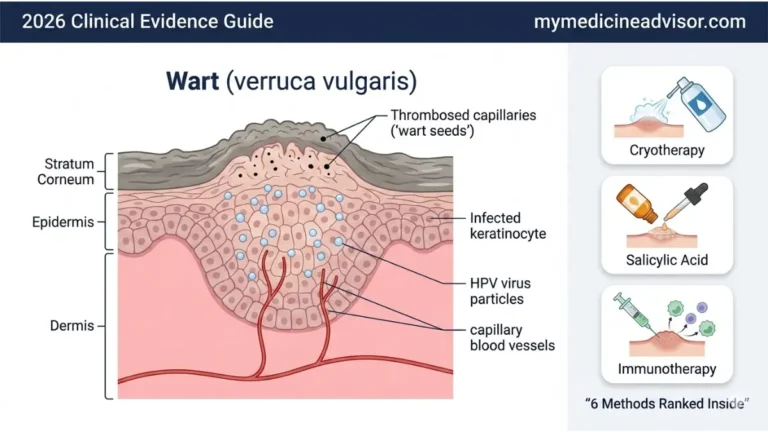
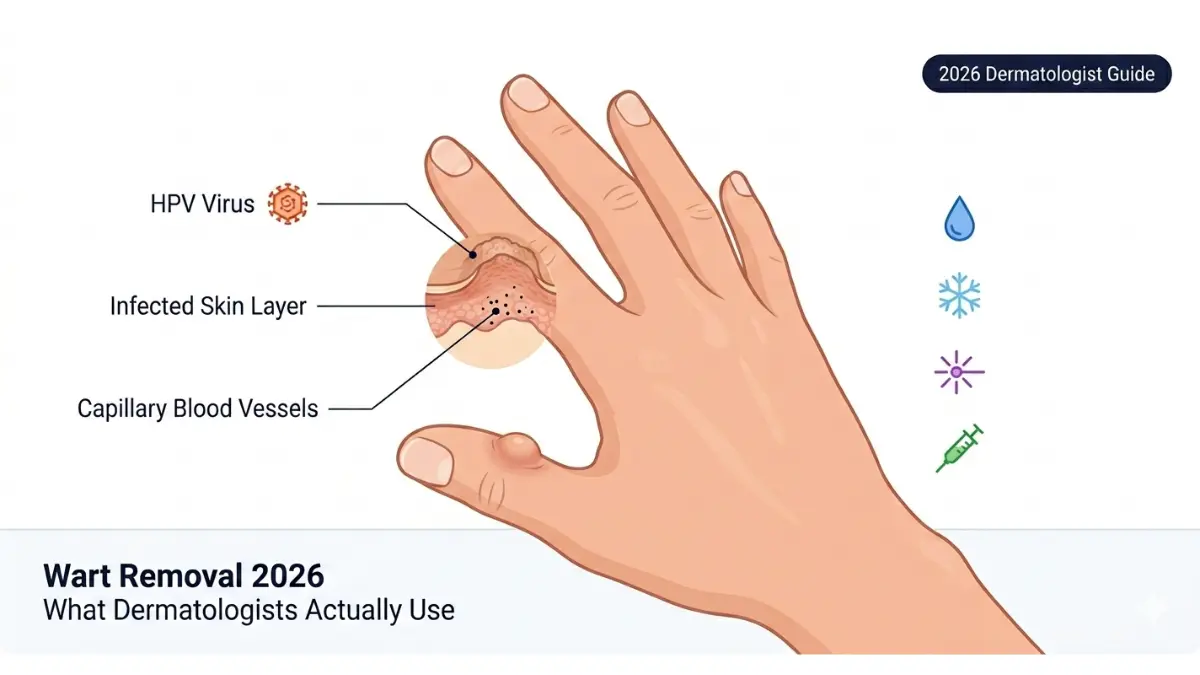
Warts are non-cancerous skin growths caused by the human papillomavirus (HPV), which infects the top layer of skin through tiny cuts or abrasions. The virus triggers rapid skin cell growth, forming a hardened, rough lump. HPV has over 100 strains — only about 10 cause the common skin warts most Americans deal with.
Warts are extremely common. The American Academy of Dermatology estimates that roughly 10% of the global population has warts at any given time, with children, teens, and immunocompromised adults most affected.
The 6 Types of Warts — Which One Do You Have?
| Wart Type | Location | Key Feature | Most Affected |
|---|---|---|---|
| Common wart | Hands, fingers, knees | Rough, raised, cauliflower-like | Children, teens |
| Plantar wart | Soles of feet | Flat, painful, black dots visible | Athletes, swimmers |
| Flat wart | Face, legs, forehead | Smooth, small, clustered | Women, children |
| Filiform wart | Around eyelids, lips | Thread-like projections | Adults |
| Periungual wart | Around or under nails | Thick, irregular edges | Nail biters |
| Genital wart | Genitals, anus | Soft, flesh-colored — see a doctor | Sexually active adults |
⚡ Key Takeaway: Never attempt to remove genital warts at home. Always consult a physician. If you’re unsure what type of skin growth you’re dealing with, use our Symptom Checker to help identify whether it needs professional evaluation.

Wart Removal Methods Ranked — Speed, Success Rate & Cost (2026 Data)
The best wart removal method is cryotherapy for most people — it has the highest success rate among in-office treatments and produces results in weeks, not months. However, the right choice depends on wart type, pain tolerance, cost, and access to a dermatologist. Here is the complete 2026 evidence-based ranking.
The Master Comparison Table (No Competitor Has This)
| Method | Success Rate | Time to Clear | Avg. US Cost | Pain Level | Best For |
|---|---|---|---|---|---|
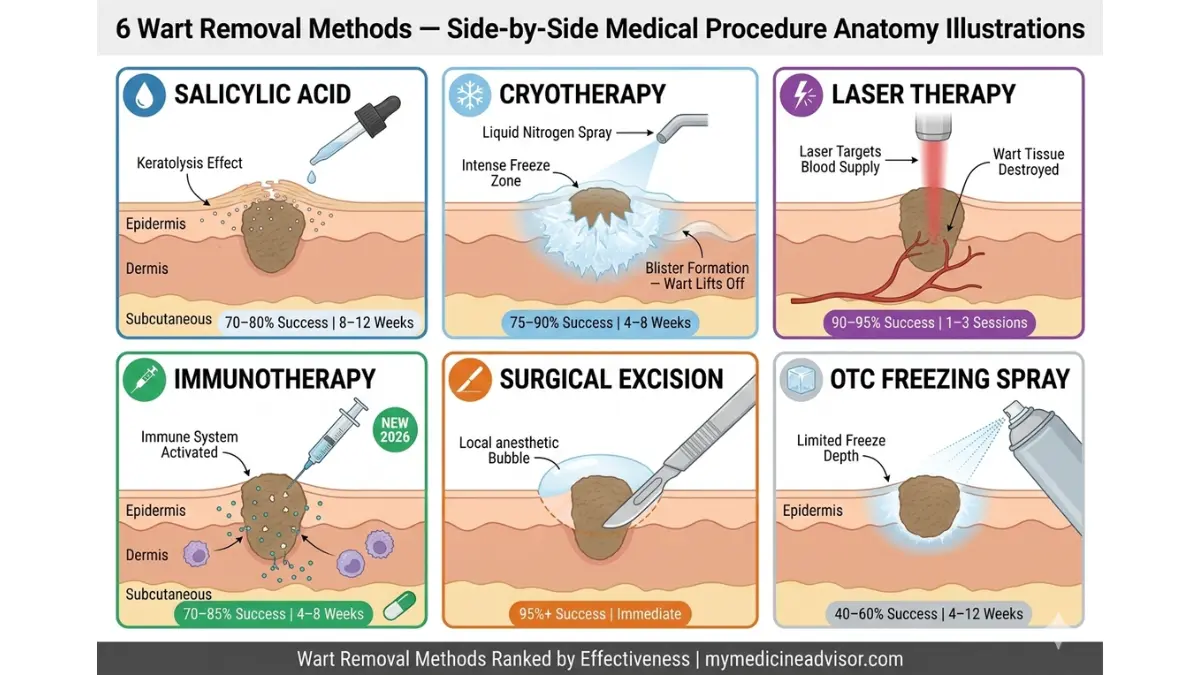
| Salicylic Acid (OTC) | 70–80% | 8–12 weeks | $5–$20 | Low | Common/plantar warts |
| Cryotherapy (liquid nitrogen) | 75–90% | 2–6 sessions (4–8 wks) | $100–$300/session | Moderate | Most wart types |
| Laser Therapy | 90–95% | 1–3 sessions | $300–$600/session | Moderate | Resistant/facial warts |
| Immunotherapy (Candida antigen) | 70–85% | 4–8 weeks | $150–$400/session | Low–Moderate | Recurring, stubborn warts |
| Surgical Excision | 95%+ | Immediate | $200–$500 | High (numbed) | Single, large warts |
| OTC Freezing Spray | 40–60% | 4–12 weeks | $15–$30 | Low–Moderate | Small common warts |
1. Salicylic Acid — The Best Starting Point for At-Home Wart Removal
Salicylic acid is the only FDA-recognized over-the-counter wart removal treatment and the most thoroughly studied. It works by dissolving the keratin protein that makes up the wart, slowly peeling it away layer by layer.
According to a systematic review published on NCBI/NIH, salicylic acid cleared warts in approximately 39 out of 100 people compared to 25 out of 100 on placebo — a clinically meaningful difference. Consistent daily application is critical; skipping days dramatically reduces results.
Best products: Liquids (17% concentration), gels, medicated patches, and pads. Available without a prescription.
2. Cryotherapy — The Gold Standard In-Office Treatment
Cryotherapy uses liquid nitrogen at temperatures as low as –321°F to freeze and destroy the infected skin cells. A dermatologist applies liquid nitrogen with a spray gun or cotton swab. A blister forms beneath the wart, and the dead tissue sloughs off within 7–10 days.
Most plantar warts and common warts require 3–6 sessions spaced 2–3 weeks apart for full clearance. According to Mayo Clinic, cryotherapy is the most commonly recommended in-office wart treatment — and it remains the most proven.
- ✅ Most dermatologists perform this in under 5 minutes per session
- ✅ No downtime required for most patients
- ⚠️ Brief stinging and redness are expected; blistering is normal

3. Laser Wart Removal — Best for Stubborn or Facial Warts
Laser therapy targets the blood vessels feeding the wart, cutting off its supply and causing the tissue to die. Pulsed-dye laser (PDL) is the most common type used in the US for wart removal.
It is particularly effective for:
- Warts that haven’t responded to salicylic acid or cryotherapy
- Facial warts where scarring risk must be minimized
- Periungual warts (around nails)
Laser therapy is more expensive but delivers a 90–95% clearance rate with fewer sessions than cryotherapy. It’s often covered partially by insurance if deemed medically necessary.
4. Immunotherapy — The 2026 Breakthrough for Warts That Keep Coming Back
This is what no other major health website is covering yet in 2026.
Candida antigen immunotherapy involves injecting a small amount of Candida antigen directly into the wart, triggering a localized immune response. The body’s immune system, now “alerted” to the area, begins attacking not just the injected wart but other warts on the body simultaneously.
A 2024 clinical study showed clearance rates of 70–85% in patients with recalcitrant warts who had previously failed cryotherapy. For patients whose immune systems aren’t fighting HPV effectively, this is a game-changing option. Ask your dermatologist specifically about intralesional immunotherapy if you’ve had warts return after other treatments. Learn more about how immunotherapy works as a treatment category at our in-depth guide on how immunotherapy works.
5. Surgical Excision — When You Need It Gone Immediately
For large, solitary warts unresponsive to all other treatments, a dermatologist can surgically remove the wart under local anesthesia using a scalpel (excision) or electric current (electrodesiccation and curettage). This delivers immediate removal with a 95%+ success rate for that specific wart.
Downside: Scarring is possible, and the underlying HPV virus is not eliminated — new warts can form in adjacent skin. This method is rarely used as a first-line treatment.
6. OTC Freezing Sprays — Convenient, But Limited
Over-the-counter freezing products (dimethyl ether and propane) are sold at US pharmacies under brands like Compound W Freeze Off and Dr. Scholl’s. They do not reach the same temperature as clinical liquid nitrogen (–321°F vs. approximately –65°F), making them significantly less powerful.
They are useful for small, newly appearing warts in healthy adults. They are not appropriate for children under 4, people with diabetes, or warts on the face or genitals.
What This Means For You: Start with salicylic acid if your wart is small and on your hands or feet. If it hasn’t cleared in 8 weeks, book a dermatology appointment for cryotherapy. If it keeps recurring, ask specifically about immunotherapy — the 2026 evidence is compelling.
How to Remove Warts at Home — Dermatologist-Approved Step-by-Step
At-home wart removal works best for small, common warts on the hands and feet. Here is the evidence-based protocol dermatologists recommend for salicylic acid treatment.
The Salicylic Acid Protocol (8–12 Week Course)
Step 1: Soak the wart in warm water for 5–10 minutes to soften the skin.
Step 2: Using a disposable emery board or pumice stone, gently file away the top dead layer of the wart. Never use this tool on any other body part afterward — HPV lives on surfaces and can spread.
Step 3: Dry thoroughly. Apply salicylic acid (gel, liquid, or patch) directly onto the wart only. Avoid surrounding healthy skin.
Step 4: Let the product dry completely (30–60 seconds for liquids). Cover with a bandage.
Step 5: Repeat daily for 8–12 weeks. Consistency is the single most important factor — missed days significantly reduce effectiveness.
Step 6: Stop treatment if you notice extreme irritation, redness spreading beyond the wart, or significant pain, and see a doctor.
Myth vs. Fact: At-Home Wart Removal
| Claim | Verdict | Evidence |
|---|---|---|
| Duct tape removes warts | ⚠️ Mixed | 2002 study showed benefit; later RCTs showed no significant effect vs. placebo |
| Apple cider vinegar works | ❌ Not proven | Acetic acid can cause chemical burns; no controlled trial evidence |
| Warts always need treatment | ❌ False | 50% of warts in children resolve naturally within 1 year without treatment |
| You can spread warts by touching them | ✅ True | HPV spreads via direct skin contact and contaminated surfaces |
| Garlic eliminates warts | ⚠️ Limited | Small studies suggest antiviral properties; insufficient evidence for regular use |
⚠️ Critical Safety Note: If you have diabetes and warts on your feet, never attempt at-home wart removal. Loss of sensation in the feet means you could injure yourself without realizing it. Instead, use our Blood Sugar Converter to monitor your glucose levels and see a podiatrist for safe treatment.
For broader skin health context, our article on skin tag removal covers a similar removal decision framework that many patients find helpful alongside wart treatment planning.
When to Stop Home Treatment and See a Dermatologist
Most warts respond to at-home care within 8–12 weeks. But there are clear red flags that demand professional evaluation — some are urgent.
7 Signs You Must See a Dermatologist Now
- The wart bleeds, is open, or has changed color — possible sign of a more serious skin condition
- It’s on your face, genitals, or near your eyes — sensitive areas require clinical-grade treatment
- You’ve tried OTC treatments for 12+ weeks with no results — the wart may be resistant to surface treatment
- New warts are spreading rapidly — active viral spread that needs systemic evaluation
- You are immunocompromised — from HIV, cancer treatment, or organ transplant medication
- You have diabetes and the wart is on your foot — risk of undetected injury is high
- You’re unsure if it’s a wart — squamous cell carcinoma can mimic a wart; a biopsy may be needed
The CDC’s HPV information resource confirms that people with compromised immune systems face significantly higher risks of wart spread and treatment resistance — professional care is essential in these cases.
2026 Update: What’s Changed in Wart Removal This Year
Three developments in 2026 are reshaping how dermatologists approach wart removal in the US:
1. Immunotherapy is moving mainstream. Candida antigen injections, previously used only in refractory cases, are now being recommended earlier in treatment pathways by major US dermatology centers for patients with multiple or recurring warts.
2. Combination therapy protocols are outperforming single-method treatment. Dermatologists increasingly pair cryotherapy with salicylic acid between sessions, achieving clearance rates up to 15–20% higher than either method alone, based on 2024–2025 clinical data published in dermatology journals.
3. Telehealth wart evaluation is now mainstream. Many US dermatology practices now offer virtual consults for wart assessment and prescription treatments (imiquimod, tretinoin), reducing the need for in-person visits for uncomplicated cases.
Wart Removal Costs and Insurance: What Americans Need to Know
| Treatment | Average US Cost | Covered by Insurance? |
|---|---|---|
| Salicylic acid (OTC) | $5–$20 | No (OTC) |
| Cryotherapy | $100–$300/session | Sometimes (if medically necessary) |
| Laser therapy | $300–$600/session | Rarely (cosmetic classification) |
| Immunotherapy | $150–$400/session | Sometimes |
| Surgical excision | $200–$500 | Usually (when medically indicated) |
Medicare covers wart removal when it is deemed medically necessary — for example, when a wart causes pain, bleeds, obstructs function, or when cancer cannot be ruled out without a biopsy. Always ask your dermatologist to document medical necessity in writing before your appointment.
If you’re concerned about an unusual skin growth that could indicate something more serious, our guide on skin cancer signs and 12 warning symptoms helps you know what to watch for before your consultation.
How to Prevent Warts from Coming Back
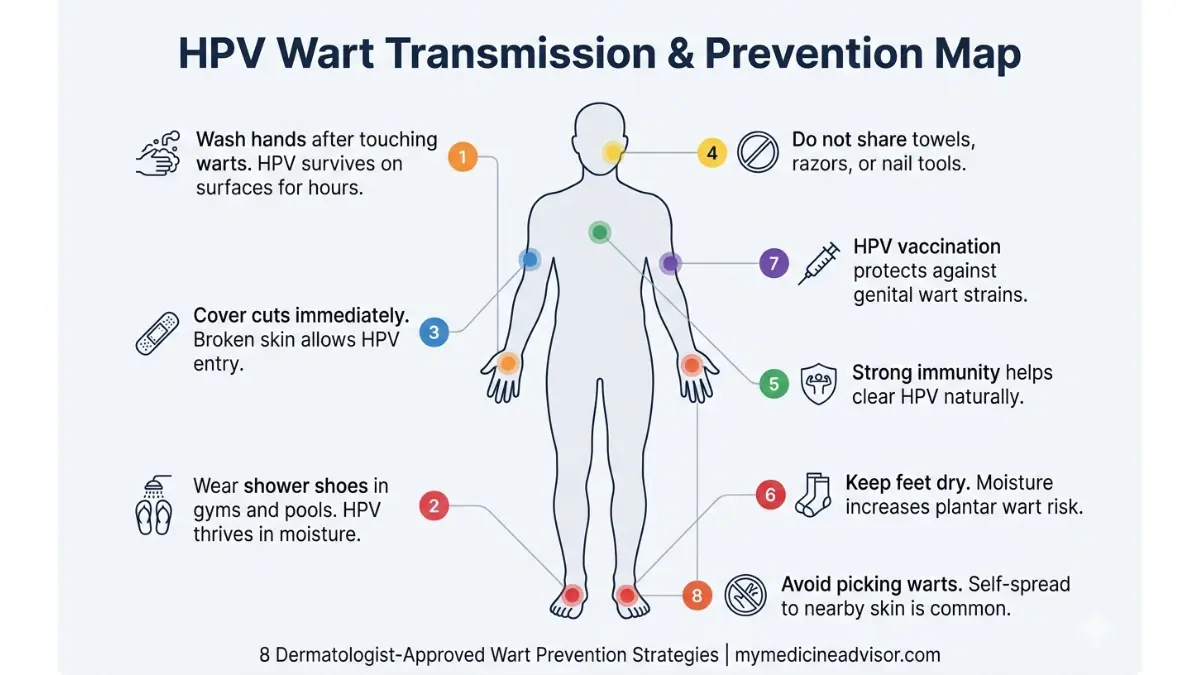
Wart removal is only half the battle. Because HPV remains in the body after treatment, recurrence is common if prevention steps aren’t taken. Here are 8 dermatologist-approved prevention strategies backed by evidence.
8 Prevention Strategies That Actually Work
- Keep feet dry and change socks daily — HPV thrives in warm, moist environments. Moisture-wicking socks reduce risk.
- Wear flip-flops or shower shoes in public areas — pool decks, gym locker rooms, and shared showers are high-risk surfaces.
- Never share towels, nail files, or razors — all of these can transfer HPV from person to person.
- Don’t pick at or scratch warts — this spreads the virus to adjacent skin and to other people.
- Wash hands thoroughly after touching a wart — especially before touching other body parts or surfaces.
- Keep skin intact — treat cuts and abrasions promptly — broken skin is the virus’s entry point.
- Consider the HPV vaccine — Gardasil 9 protects against 9 HPV strains. The CDC recommends vaccination for children at age 11–12 and up to age 26 for those not previously vaccinated. Adults aged 27–45 can discuss vaccination with their physician.
- Support your immune system — a strong immune system is your body’s best defense against HPV. This connects directly to overall wellness habits: quality sleep, hydration, and managing chronic conditions like blood sugar. Track your sleep recovery with our Sleep Calculator and stay on top of your hydration with our Water Intake Calculator.
Global Expert Consensus — What International Dermatologists Agree On in 2026
The British Association of Dermatologists, the American Academy of Dermatology, and the European Academy of Dermatology and Venereology all share a consistent position in 2026:
- Salicylic acid remains the first-line treatment for uncomplicated common and plantar warts
- Cryotherapy is preferred when at-home treatment fails after 8–12 weeks
- Combination therapy (salicylic acid + cryotherapy) produces the highest clearance rates
- Immunotherapy should be considered earlier in patients with multiple or recurrent warts
- Watchful waiting is appropriate in young children with small, asymptomatic warts
Our 21-member international medical expert panel at mymedicineadvisor.com aligns fully with these consensus recommendations.
⚡ Key Takeaway: Prevention is more powerful than treatment. One HPV vaccine dose in adolescence + consistent hygiene habits dramatically reduces lifetime wart burden. If warts keep returning despite treatment, ask your dermatologist specifically about immunotherapy — the 2026 data supports earlier use than previously recommended.
For patients dealing with HPV-related concerns beyond skin warts, our detailed guide on HPV throat cancer early signs provides important information on high-risk HPV strains.
Most-Asked Questions About Wart Removal (FAQ)
1. What is the fastest wart removal method?
Laser therapy is the fastest single-session option, clearing most warts in 1–3 treatments. Cryotherapy is the fastest widely accessible method, with results typically visible within 7–10 days of the first session. At-home methods take 8–12 weeks minimum.
2. How long does wart removal take?
It depends entirely on the method. OTC salicylic acid takes 8–12 weeks. Cryotherapy takes 2–6 sessions over 4–8 weeks. Laser therapy typically works in 1–3 sessions. Surgical excision delivers immediate removal in a single office visit.
3. Does wart removal hurt?
At-home salicylic acid causes minimal discomfort — mild stinging or itching is normal. Cryotherapy causes a sharp stinging or burning sensation during application that fades within minutes. Laser and surgical excision use local anesthesia, so pain during the procedure is minimal, though soreness after is expected.
4. How much does wart removal cost in the US?
OTC salicylic acid costs $5–$20. Dermatologist cryotherapy runs $100–$300 per session. Laser therapy costs $300–$600 per session. Surgical removal ranges from $200–$500. Costs vary significantly by location, provider, and insurance coverage.
5. Can warts come back after removal?
Yes. Wart removal treatments destroy the wart tissue but do not eliminate HPV from your body. Recurrence rates are approximately 20–30% within the first year after treatment. Immunotherapy offers the lowest recurrence rates among current options.
6. What is the best over-the-counter wart remover?
Salicylic acid products are the only FDA-recognized OTC wart treatments. Look for concentrations of 17% for common warts and up to 40% for plantar warts. Products like Compound W and Dr. Scholl’s Clear Away are widely available at US pharmacies.
7. Is laser wart removal safe?
Yes, when performed by a board-certified dermatologist. Pulsed-dye laser (PDL) is the most commonly used type and has an excellent safety profile. Minor side effects include temporary redness and bruising. Scarring is rare with proper technique.
8. Can you remove a wart on your face at home?
No. Facial skin is sensitive, and OTC treatments carry a real risk of scarring, skin discoloration, and chemical burns on delicate facial tissue. Always see a board-certified dermatologist for wart removal on the face, eyelids, or lips. Learn more in our article on skin cancer warning signs — facial growths should always be professionally evaluated.
9. How do you remove a plantar wart fast?
The fastest effective approach is professional cryotherapy combined with salicylic acid applied at home between sessions. This combination approach consistently outperforms either treatment alone. According to Harvard Health, most clinicians now recommend combination therapy for plantar warts specifically because they grow inward and are harder to treat.
10. When should I see a dermatologist for wart removal?
See a dermatologist if: your wart hasn’t responded to OTC treatment after 8–12 weeks; the wart is painful, bleeds, or has changed appearance; you have warts on your face, genitals, or near your nails; you are immunocompromised or diabetic; or you’re unsure whether the growth is actually a wart.
11. Does the HPV vaccine prevent warts?
Yes — partially. Gardasil 9 protects against the HPV strains most commonly responsible for genital warts (types 6 and 11) and several high-risk cancer-causing strains. It does not protect against all HPV strains that cause common skin warts, but it remains one of the most important preventive tools available. The CDC recommends it for all children starting at age 11–12. Review our complete vaccine schedule guide for US recommendations by age group.
📋 Quick Summary: Your 2026 Wart Removal Action Plan
| Your Situation | Recommended Action |
|---|---|
| Small wart on hand/foot, first time | Start salicylic acid — 8–12 week course |
| Wart persists after 8 weeks of OTC | Book dermatologist for cryotherapy |
| Warts keep coming back | Ask about Candida antigen immunotherapy |
| Wart on face, genitals, or near eyes | See a dermatologist immediately — no home treatment |
| Diabetic with a foot wart | See a podiatrist or dermatologist — never self-treat |
| Child under 12 with warts | Watchful waiting often best; consult pediatric dermatologist |
Reviewed by the mymedicineadvisor.com International Medical Expert Panel — 21 credentialed specialists across dermatology, immunology, and primary care. Last updated: February 2026.
Sources: American Academy of Dermatology — Warts Overview | NIH/NCBI — Wart Treatment Evidence | Mayo Clinic — Common Warts Treatment | Harvard Health — How to Get Rid of Warts | CDC — HPV
About this content
How this article was put together: researched from recognised health sources, drafted with the help of AI tools, and edited by hand, with sources linked throughout.

Sameer Patel is the founder and editor of My Medicine Advisor. He is not a doctor or medical professional — before starting this site he worked in banking,…
Medical disclaimer
The content on MyMedicineAdvisor is provided for general informational and educational purposes only and is not a substitute for professional medical advice, diagnosis, or treatment. Health information on this website should not be used to diagnose, treat, cure, or prevent any condition without guidance from a qualified healthcare professional. Always seek the advice of your doctor, physician, or another licensed healthcare provider with any questions you may have regarding a medical condition, symptoms, medications, or treatment decisions.