
On This Page – Quick Medical Summary
James, a 42-year-old marketing executive from Dallas, paid $1,800 for three rounds of IPL treatment at a local med spa. Nobody assessed his Fitzpatrick Type IV skin beforehand. He left with hyperpigmentation patches that took eight months to fade. His story is far more common than the industry admits.
IPL treatment — also called intense pulsed light therapy — uses broad-spectrum light pulses to treat six distinct skin and eye conditions, from sun damage and rosacea to chronic dry eye. It works best on Fitzpatrick skin Types I–III, costs between $300–$1,200 per session, and requires 3–6 sessions for most conditions. But there are critical risks, contraindications, and combination therapies that most clinics skip entirely — and that’s exactly what this guide covers.
⚠️ Disclaimer: This article is for educational and informational purposes only. It does not constitute medical advice, diagnosis, or treatment. Always consult a board-certified dermatologist or ophthalmologist before beginning any IPL treatment.
What Is IPL Treatment? (The Real Science Behind the Flash)
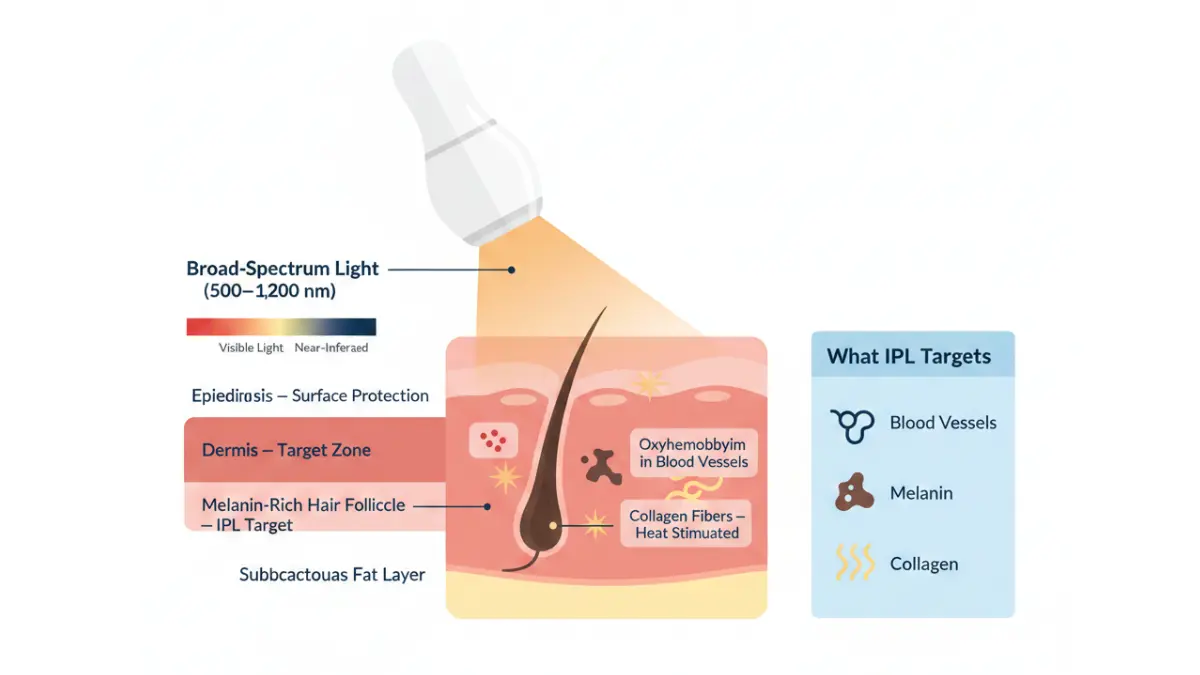
IPL treatment is a non-invasive light-based therapy that uses a broad spectrum of wavelengths — approximately 500 to 1,200 nanometers — to target specific structures inside the skin called chromophores. These include melanin (the pigment responsible for age spots and hair color) and oxyhemoglobin (the protein in red blood vessels).
Unlike laser therapy, which fires a single focused wavelength like a laser pointer, intense pulsed light works more like a camera flash — scattering multiple wavelengths simultaneously across a broader area. This versatility allows one IPL device to treat several skin conditions in the same session.
How IPL Is Different From Laser — The Key Distinction
| Feature | IPL Treatment | Laser Therapy |
|---|---|---|
| Light type | Broad-spectrum, scattered | Single-wavelength, focused |
| Treatment area | Larger area per pulse | Smaller, more precise |
| Sessions needed | 3–8 (condition-dependent) | Fewer, more intense sessions |
| Skin tone suitability | Types I–III (limited for IV–VI) | Some lasers safe for all skin types |
| Average cost per session | $300–$1,200 | $500–$2,300 |
| Recovery time | 1–3 days (mild redness) | Up to 2 weeks (ablative lasers) |
| Common uses | Skin, hair, dry eye, rosacea | Skin resurfacing, tattoo removal |
What Happens Inside Your Skin During IPL
The IPL device emits light pulses that penetrate into the dermis (the second skin layer) without damaging the outer epidermis. The targeted chromophores absorb the light and convert it into heat, which then destroys the unwanted pigment cells or collapses the abnormal blood vessels. A secondary effect is collagen stimulation — the heat triggers your skin’s natural repair process, increasing collagen production and improving overall skin texture over time.
The FDA first approved the original intense pulsed light device in 1995, and the global IPL device market is now valued at over $2.3 billion in 2025, according to industry data — reflecting decades of clinical use and technological refinement. You can verify FDA device classifications through the U.S. FDA medical device database.
If you’re noticing unusual skin changes and wondering whether a condition might respond to IPL, you can use our Symptom Checker to help identify potential underlying causes before consulting a specialist.
The 6 Conditions IPL Treatment Can Improve — And One It Can Make Worse
This is the section WebMD and Healthline fragment across five separate articles. We’ve consolidated the complete clinical picture here, so you don’t have to piece together the answer yourself.
1. Sun Damage and Photoaging
IPL treatment is most frequently used for photoaging — the visible skin damage caused by years of UV exposure. This includes sunspots, age spots, uneven skin tone, fine lines, and broken capillaries. The light energy targets melanin deposits and oxyhemoglobin, breaking them down so the body can naturally eliminate the discolored cells.
Evidence strength: Strong. Multiple peer-reviewed studies support IPL’s effectiveness for photorejuvenation in Fitzpatrick skin Types I–III. The American Academy of Dermatology confirms that lasers and light devices can treat sun-damaged skin with clinically meaningful results.
2. Rosacea and Facial Redness
For patients with rosacea-related visible blood vessels and persistent facial redness, IPL treatment targets oxyhemoglobin in superficial telangiectasias, collapsing the abnormal vessels. According to the AAD’s clinical guidance on rosacea laser therapy, most patients see a 50%–75% reduction in visible blood vessels after 1–3 treatments, and some achieve 100% clearance.
Evidence strength: Strong for vascular rosacea. Moderate for redness-only subtypes.
3. Hair Removal
IPL hair removal targets melanin in the hair follicle, converting light to heat that destroys the follicle’s hair-producing papilla. It is most effective for dark hair against light skin — the high contrast allows precise melanin targeting without absorbing surrounding skin pigment.
Results require 6–8 sessions, spaced 4–6 weeks apart. At-home IPL devices are primarily designed for this use, though with less intensity than professional machines. If you’re also managing hair loss concerns, our Hair Loss Treatment Guide covers alternative options including PRP and DHT blockers.
Evidence strength: Strong for dark hair on light skin. Weak for light hair or dark skin.
4. Dry Eye Disease (Meibomian Gland Dysfunction)
This is the most clinically significant recent development in intense pulsed light therapy — and the one most clinics forget to mention. IPL treatment has been demonstrated to significantly improve meibomian gland dysfunction (MGD), the most common underlying cause of evaporative dry eye disease.

The light targets abnormal blood vessels near the eyelid margins, reducing inflammatory mediators that clog the meibomian glands. A retrospective study from Mayo Clinic found that IPL combined with meibomian gland expression (the IPL/MGX protocol) improved dry eye symptoms in 89% of patients and meibomian gland function in 77% — including patients who had previously failed LipiFlow thermal pulsation therapy.
If you experience persistent dry eye symptoms, our Eye Exam tool can help you assess your visual health before scheduling a consultation.
Evidence strength: Moderate to Strong (2025 data). Four monthly sessions recommended for optimal results, with maintenance every 3–6 months.
5. Acne and Post-Acne Pigmentation
IPL photofacial treatment can reduce inflammatory acne by targeting the bacteria Cutibacterium acnes and reducing sebaceous gland activity. It is also effective for post-acne hyperpigmentation (the dark spots left after breakouts clear). Results vary more than with skin rejuvenation, and IPL is typically used as an adjunct to topical or oral acne therapy rather than a standalone solution.
Evidence strength: Moderate. Most effective for mild-to-moderate inflammatory acne in lighter skin tones.
6. Vascular Lesions and Spider Veins
IPL has been used since its FDA approval in 1995 to treat telangiectasias, spider veins, cherry angiomas, and port wine stains. Oxyhemoglobin absorbs the light energy, which coagulates and collapses the abnormal vessel. Reviewed clinical data published on PubMed Central (PMC3390232) confirms IPL’s long-term efficacy for facial telangiectasias across large patient cohorts.
Evidence strength: Strong for superficial telangiectasias and spider veins.
⚠️ What IPL Can Make Worse: The Melasma Warning
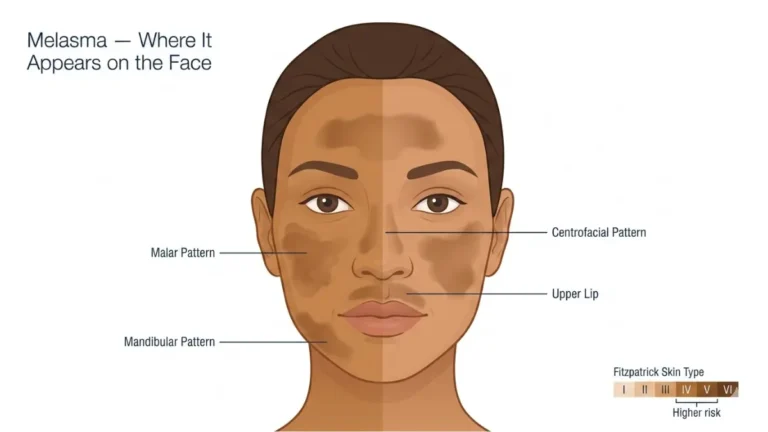
This is what most clinics don’t disclose upfront. Melasma — a complex hormonal pigmentation condition presenting as broad patches across the cheeks, forehead, and upper lip — can be paradoxically worsened by IPL treatment.
The heat generated during IPL can trigger a post-inflammatory hyperpigmentation response in melasma-prone skin, deepening the discoloration rather than clearing it. If you suspect you have melasma (rather than simple sun spots), always confirm the diagnosis with a board-certified dermatologist before proceeding with any light-based treatment. This distinction is critical — and it’s one that WebMD’s IPL article from 2018 does not adequately address.
The Fitzpatrick Skin Type Safety Matrix — What Clinics Skip
This is the most important section for patient safety, and it’s the one no competitor covers comprehensively in a single visual format.
IPL treatment works by targeting melanin. This creates an inherent risk: the more melanin a person’s skin contains, the more the surrounding skin — not just the target — absorbs the light energy, leading to burns, blisters, hyperpigmentation, or hypopigmentation.
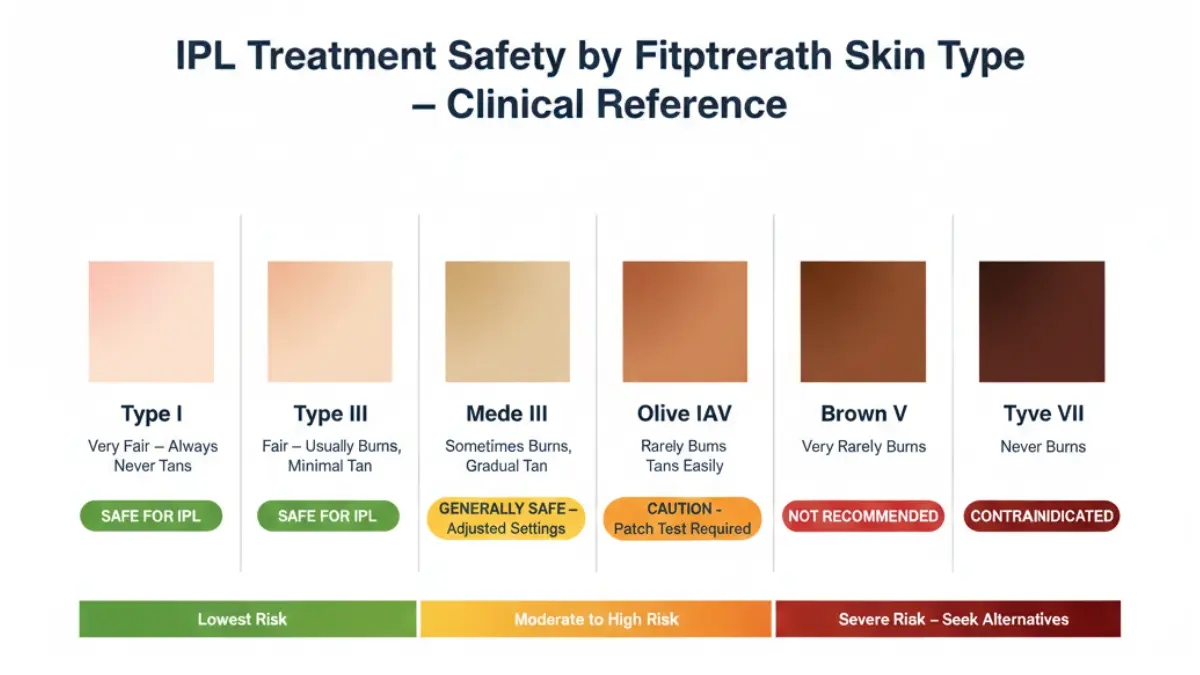
The Fitzpatrick Skin Type Scale classifies skin into six types based on pigmentation and UV response. Here is the definitive IPL safety matrix for 2026:
| Fitzpatrick Type | Skin Description | IPL Safety | Risk Level | Action |
|---|---|---|---|---|
| Type I | Very fair, always burns, never tans | ✅ Safe | Low | Standard treatment |
| Type II | Fair, burns easily, tans minimally | ✅ Safe | Low | Standard treatment |
| Type III | Medium, sometimes burns, gradually tans | ✅ Generally Safe | Moderate | Adjusted settings |
| Type IV | Olive, rarely burns, tans well | ⚠️ Caution | High | Patch test mandatory |
| Type V | Brown, very rarely burns, tans deeply | ❌ Not Recommended | Very High | Seek alternatives |
| Type VI | Dark brown/black, never burns | ❌ Contraindicated | Severe | Nd:YAG laser instead |
Key 2025 clinical data point: People with Fitzpatrick Type IV–V skin have a threefold increased risk of post-inflammatory pigmentation changes after IPL treatment compared to Types I–III.
Safe Alternatives for Darker Skin Tones
If your skin is Fitzpatrick Type V or VI, IPL is not appropriate for hair removal or pigmentation treatment. Safer alternatives include:
- Nd:YAG laser (1064nm): The safest hair removal option for dark skin, as its longer wavelength penetrates past surface melanin
- Electrolysis: Targets the follicle electrically, regardless of skin or hair color
- Fractional laser with appropriate settings: Can be used cautiously under expert supervision
Always disclose your full sun exposure history to your provider before any session. A recent tan — even from a tanning bed or self-tanner — temporarily increases melanin concentration and can elevate risk even in normally suitable skin types.
What Happens During an IPL Treatment Session (Step by Step)
Before Your Session: 2-Week Preparation Checklist
Proper preparation significantly reduces your risk of side effects. Your provider should advise the following:
- Avoid sun exposure and tanning for at least 2 weeks before treatment
- Stop using retinoids, AHAs, and vitamin C serums 5–7 days prior
- Discontinue blood thinners and NSAIDs (aspirin, ibuprofen) if medically safe to do so — confirm with your prescribing physician
- Do not wax, thread, or use depilatory creams on the treatment area
- No chemical peels within 2 weeks
- No Accutane use within the past 6 months
- Avoid alcohol for 24 hours before treatment
Inform your provider of all current medications, especially photosensitizing drugs such as tetracyclines, certain antifungals, or diuretics, as these can increase the risk of adverse reactions.
During the Procedure
A typical IPL treatment session follows this sequence:
- Skin cleansing — the treatment area is thoroughly cleaned
- Cooling gel application — a clear ultrasound-type gel is applied to protect the epidermis and improve light penetration
- Eye protection — dark glasses or metal corneal shields are placed over the eyes
- Light pulse delivery — the handheld device is pressed against the skin and flashes are applied in overlapping passes
- Sensation — most patients describe each pulse as a rubber band snapping against the skin; a numbing cream can be applied 30–60 minutes before if needed
- Session duration — 20–30 minutes for a full face; up to 60 minutes for larger body areas
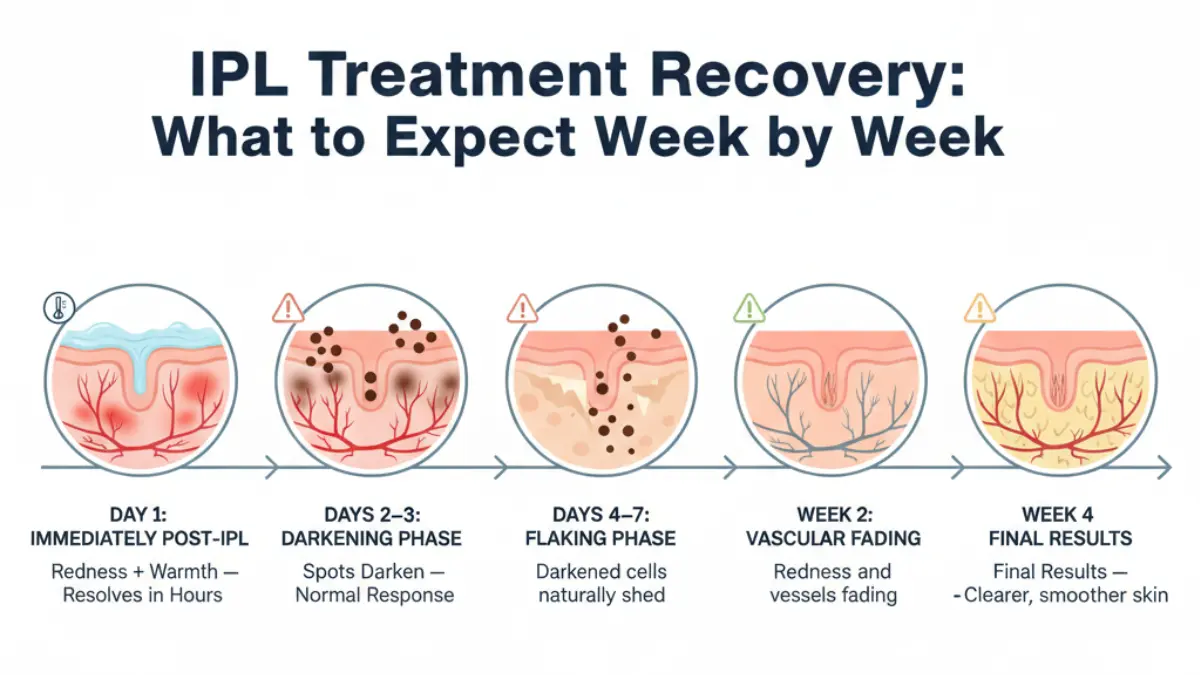
After IPL: Day-by-Day Recovery Timeline
| Timeline | What to Expect |
|---|---|
| Day 1 | Redness, warmth, mild swelling (like a sunburn) — typically resolves within 4–6 hours |
| Day 2–3 | Brown spots may darken and appear more prominent — this is normal and expected |
| Days 4–7 | Darkened spots begin to crust and flake off naturally — do not pick |
| Week 2 | Skin tone begins to even out; redness from vascular treatment fades |
| Week 4 | Full results from each session visible; skin texture and tone improved |
Critical aftercare rules:
- Apply SPF 30+ sunscreen daily — UV exposure after IPL can cause permanent pigmentation changes
- Use a gentle, fragrance-free cleanser only
- No makeup for 24 hours post-treatment
- Avoid hot showers, saunas, and strenuous exercise for 48 hours
How Many Sessions Do You Actually Need?
| Condition | Sessions | Spacing | Maintenance |
|---|---|---|---|
| Sun damage / photofacial | 3–5 | 3–4 weeks | Annual touch-up |
| Rosacea (vascular) | 1–3 | 3–4 weeks | As needed (new vessels) |
| Hair removal | 6–8 | 4–6 weeks | Annual touch-up |
| Dry eye (IPL/MGX protocol) | 4 | 4 weeks | Every 3–6 months |
| Acne | 3–5 | 3–4 weeks | As directed |
| Spider veins | 2–4 | 4–6 weeks | As needed |
IPL Treatment Cost in 2026 — What You’ll Actually Pay
The most frequently cited IPL cost figures online are years out of date. Here is the current 2026 pricing landscape across the United States.
Professional IPL: 2026 Cost Breakdown by Treatment Area
| Treatment | Cost Per Session | Sessions Needed | Total Investment Range |
|---|---|---|---|
| Full Face (Photofacial) | $300–$700 | 3–5 | $900–$3,500 |
| Neck | $200–$450 | 3–5 | $600–$2,250 |
| Chest / Décolletage | $250–$500 | 3–5 | $750–$2,500 |
| Hair Removal – Small Area (upper lip) | $50–$150 | 6–8 | $300–$1,200 |
| Hair Removal – Large Area (legs) | $150–$600 | 6–8 | $900–$4,800 |
| Dry Eye (IPL/MGX Protocol) | $400–$800 | 4 | $1,600–$3,200 |
Prices vary by geographic location (metropolitan areas typically charge 20–40% more), provider credentials, and device technology used.
At-Home IPL Devices: Honest Comparison
At-home IPL devices cost $100–$650 as a one-time purchase. They use significantly lower light intensities than clinical devices for safety reasons.
What at-home IPL can do effectively:
- Gradual hair reduction on dark hair, light skin (6–12 weeks for visible results)
What at-home IPL cannot safely or effectively do:
- Treat vascular lesions, rosacea, or sun damage (insufficient clinical intensity)
- Treat meibomian gland dysfunction (requires precise periocular placement)
- Be used on Fitzpatrick Type IV–VI skin (same contraindication applies)
Bottom line: At-home devices are a reasonable option for hair maintenance between professional sessions. They are not a substitute for clinical treatment of medical skin or eye conditions.
Does Insurance Cover IPL Treatment?
In most cases, no. IPL is classified as a cosmetic procedure by virtually all U.S. health insurance plans — meaning you pay out of pocket even when treating rosacea or sun damage.
Potential exception: If an ophthalmologist prescribes IPL specifically for chronic dry eye disease secondary to meibomian gland dysfunction, some insurance providers — particularly those covering ophthalmological procedures — may partially reimburse the cost. Always request a pre-authorization letter and a formal diagnosis code from your doctor before submitting a claim.
IPL Side Effects, Who Must Avoid It, and the IPL vs. Laser Decision Guide
Common Side Effects (Temporary)
The vast majority of IPL treatment side effects are mild and resolve within days. According to clinical data, roughly 80% of patients experience at least one temporary reaction:
| Common Side Effect | Duration | Management |
|---|---|---|
| Redness / erythema | 4–6 hours | Cold compress, avoid heat |
| Mild swelling | 24–48 hours | Elevate, cold compress |
| Sunburn-like sensation | 4–6 hours | Cool cloth, aloe vera gel |
| Darkening of spots | Days 2–7 | Normal; do not pick or scrub |
| Temporary skin dryness | 1–2 weeks | Gentle moisturizer, no actives |
Serious Risks (Rare, But Real)
These complications are uncommon when IPL is performed by a qualified provider — but they occur more frequently with inadequately trained technicians at budget med spas:
- Burns and blistering — from improper device settings or insufficient cooling
- Permanent hyperpigmentation — especially in undertreated darker skin types
- Hypopigmentation (permanent lightening) — rare but irreversible
- Paradoxical hypertrichosis — unexpected increased hair growth near treatment zones, particularly in Fitzpatrick Types III–VI
- Infection — if post-care protocols are not followed
If you experience unusual skin changes after IPL treatment — including darkening, blistering, or prolonged redness beyond one week — use our Symptom Checker and contact your provider immediately. You can also review our guide on skin cancer warning signs to understand which post-treatment changes warrant urgent medical evaluation.
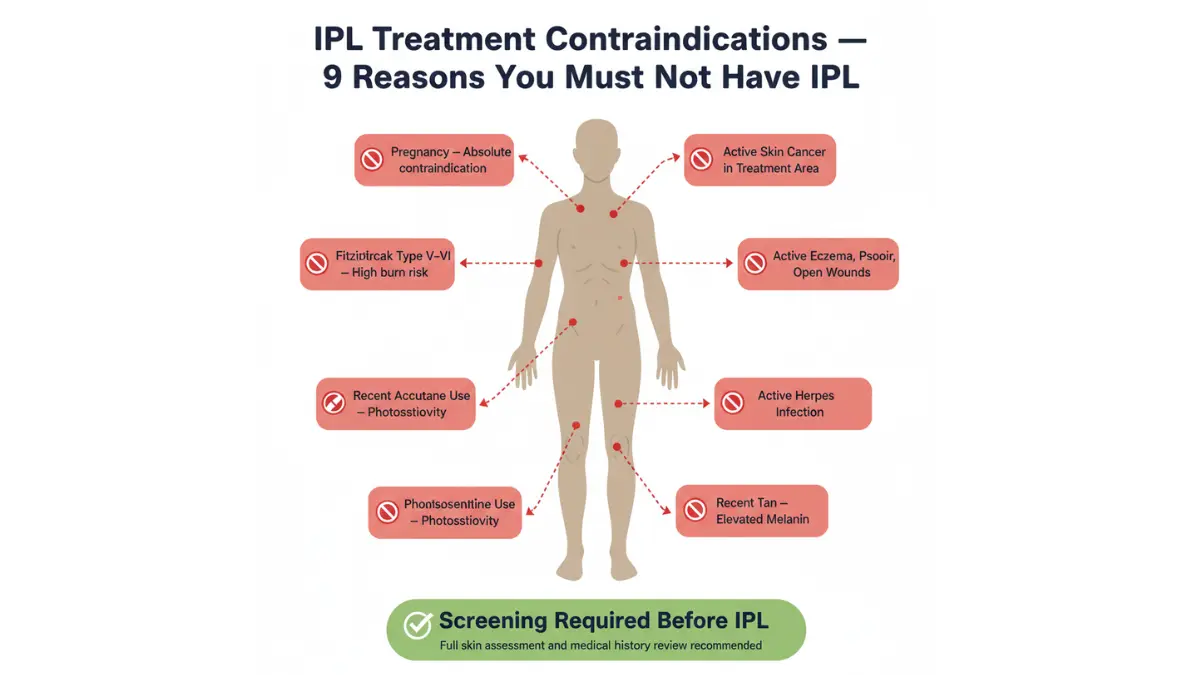
Absolute Contraindications — Do Not Get IPL If…
The following are hard contraindications for intense pulsed light therapy. A reputable provider will screen for every one of these before proceeding:
- ❌ Pregnancy — no safety data exists for fetal exposure; strictly avoided
- ❌ Active skin cancer in or near the treatment area
- ❌ Fitzpatrick Type VI skin — extreme burn and permanent pigmentation risk
- ❌ Recent Accutane use within the past 6 months (severe photosensitivity)
- ❌ Active eczema, psoriasis, or open wounds in the treatment area
- ❌ Photosensitizing medical conditions (lupus, porphyria, polymorphous light eruption)
- ❌ Active herpes simplex outbreak — heat can trigger a severe, widespread infection
- ❌ Tattoos in the treatment area — the device targets dark ink as if it were melanin, causing painful burns and permanent tattoo distortion
- ❌ Recent tan (within 4 weeks from sun, tanning beds, or self-tanner)
If you have a personal or family history of skin cancer, use our Genetic Risk Assessment Tool to better understand your baseline risk before pursuing any light-based skin treatment.
IPL vs. Laser: Which Should You Choose?
| Decision Factor | IPL Treatment | Laser Therapy |
|---|---|---|
| Best for | Multiple conditions at once, larger areas | Single precise condition, any skin tone |
| Skin tone range | Types I–III (limited for IV–VI) | Nd:YAG safe for all skin types |
| Sessions required | More sessions, lower intensity | Fewer sessions, higher intensity |
| Recovery time | 1–3 days | Up to 2 weeks (ablative) |
| Cost per session | $300–$1,200 | $500–$2,300 |
| Dry eye treatment | Yes (IPL/MGX protocol) | No |
| Hair removal (dark hair) | Yes | Yes (more effective) |
| Hair removal (dark skin) | Not safe | Nd:YAG: Yes |
| Collagen stimulation | Moderate | Strong (fractional lasers) |
For patients with concerns about both skin rejuvenation and underlying health factors, our LASIK and eye laser cost guide offers additional context on light-based ophthalmological procedures. And for anyone managing conditions that intersect with metabolic health — such as rosacea linked to inflammatory states — our Blood Sugar Converter can help you track relevant biomarkers between medical appointments.
Frequently Asked Questions About IPL Treatment
Q1: What is IPL treatment used for?
IPL treatment is used for six primary conditions: sun damage and photoaging, rosacea, unwanted hair removal, dry eye disease (meibomian gland dysfunction), acne and post-acne pigmentation, and vascular lesions including spider veins. Its broad-spectrum light allows one device to address multiple conditions in a single session.
Q2: How many IPL sessions do I need to see results?
Most patients need 3–5 sessions for skin conditions such as sun damage or rosacea, spaced 3–4 weeks apart. Hair removal requires 6–8 sessions. Dry eye treatment follows a 4-session monthly protocol. You may notice subtle improvement after session one, but full results are typically visible 4 weeks after the final session.
Q3: Does IPL treatment hurt?
Most patients describe each pulse as a brief, sharp snapping sensation — similar to a rubber band flicking against the skin. The procedure is generally well-tolerated without anesthesia. If you have low pain tolerance, a topical numbing cream applied 30–60 minutes prior can significantly reduce discomfort.
Q4: Is IPL treatment safe for dark skin tones?
No — not without significant risk. Fitzpatrick Type V–VI skin is a contraindication for standard IPL treatment due to the high melanin concentration, which causes the surrounding skin to absorb light energy alongside the target, resulting in burns, blistering, and permanent pigmentation changes. Safer alternatives include Nd:YAG laser for hair removal and electrolysis.
Q5: How long do IPL treatment results last?
For vascular lesions, results typically last 3–5 years before new vessels form. Sun damage and photoaging results last 1–2 years with proper sun protection. Hair removal results can be semi-permanent with maintenance. Dry eye improvements from the IPL/MGX protocol often last 6–9 months before a maintenance session is needed.
Q6: What is the difference between IPL and laser treatment?
IPL emits multiple wavelengths simultaneously across a broad area, while laser therapy delivers a single precise wavelength. IPL is gentler, has shorter recovery time, treats more conditions per session, and costs less per session — but requires more sessions. Lasers are more effective for single-target conditions and can be safely used on a wider range of skin tones.
Q7: Can IPL make my skin worse?
Yes, in specific situations. IPL can worsen melasma by triggering post-inflammatory hyperpigmentation. It can cause paradoxical increased hair growth in Fitzpatrick Types III–VI. Burns and permanent discoloration can occur if performed by an unqualified provider or on contraindicated skin types. Always verify your provider’s credentials before booking.
Q8: How much does IPL treatment cost in 2026?
A full-face IPL photofacial costs $300–$700 per session in 2026, requiring 3–5 sessions for a total investment of $900–$3,500. Hair removal costs $50–$600 per session depending on body area. Dry eye IPL/MGX typically runs $400–$800 per session for a 4-session protocol. Most insurance plans do not cover these costs.
Q9: Can I do IPL treatment at home?
At-home IPL devices ($100–$650) are appropriate for gradual hair reduction on dark hair and light skin. They are not appropriate for treating rosacea, sun damage, vascular lesions, or dry eye — these conditions require clinical-grade device intensity and professional training. The same Fitzpatrick skin type contraindications apply to at-home devices.
Q10: Is IPL treatment covered by insurance?
Rarely. IPL is classified as cosmetic by most U.S. insurers. The one exception is IPL prescribed specifically by an ophthalmologist for chronic dry eye secondary to meibomian gland dysfunction — some plans will partially cover this under ophthalmological benefits. Always request pre-authorization documentation.
Q11: Can IPL treat dry eyes?
Yes — and this is one of its most significant medical applications. IPL treatment targeting the periocular region reduces inflammation around the meibomian glands that produce the oil layer of tears. When combined with meibomian gland expression (the IPL/MGX protocol), a 2025 Mayo Clinic retrospective study found symptom improvement in 89% of patients with chronic dry eye disease who had not responded to other therapies.
Reviewed by the mymedicineadvisor.com international medical panel | February 2026 | For educational purposes only — not a substitute for professional medical advice.
Explore more health guides at mymedicineadvisor.com/health/
About this content
How this article was put together: researched from recognised health sources, drafted with the help of AI tools, and edited by hand, with sources linked throughout.

Sameer Patel is the founder and editor of My Medicine Advisor. He is not a doctor or medical professional — before starting this site he worked in banking,…
Medical disclaimer
The content on MyMedicineAdvisor is provided for general informational and educational purposes only and is not a substitute for professional medical advice, diagnosis, or treatment. Health information on this website should not be used to diagnose, treat, cure, or prevent any condition without guidance from a qualified healthcare professional. Always seek the advice of your doctor, physician, or another licensed healthcare provider with any questions you may have regarding a medical condition, symptoms, medications, or treatment decisions.