On This Page – Quick Medical Summary
Quick Answer: As of April 2026, there are 93+ active mesothelioma clinical trials recruiting patients across the United States. These trials offer access to immunotherapy combinations, CAR-T cell therapy, and gene therapy — treatments not yet available in standard care. If standard treatment is no longer working, a mesothelioma clinical trial could be your most powerful next step.
When Michael, a 61-year-old Navy veteran from Virginia, was told his standard chemotherapy had stopped working, his oncologist suggested one more option — a mesothelioma clinical trial testing pembrolizumab combined with chemotherapy. Eighteen months later, his tumor had shrunk by 40%. He is still in the trial today.
Michael is not the exception. He is the growing rule.
Every FDA-approved mesothelioma treatment you have access to today — including nivolumab plus ipilimumab — exists because patients before you chose not to give up.
📌 Disclaimer: This article is for educational purposes only and does not constitute medical advice. Always consult a qualified oncologist before making any treatment decisions.
What Are Mesothelioma Clinical Trials? (And Why 2026 Is a Turning Point)
A mesothelioma clinical trial is a carefully regulated research study that tests new treatments, procedures, or combinations of therapies on real patients. These are not experiments in the dark — they are conducted under strict FDA oversight with multiple safety checkpoints at every stage.
For patients reading this in 2026, the timing could not be more critical. Two landmark trials — CheckMate-743 and KEYNOTE-483 — have already led to FDA approvals that are now considered standard care. A third wave of trials is currently recruiting, and the treatments being tested right now are the standard of care of 2028.
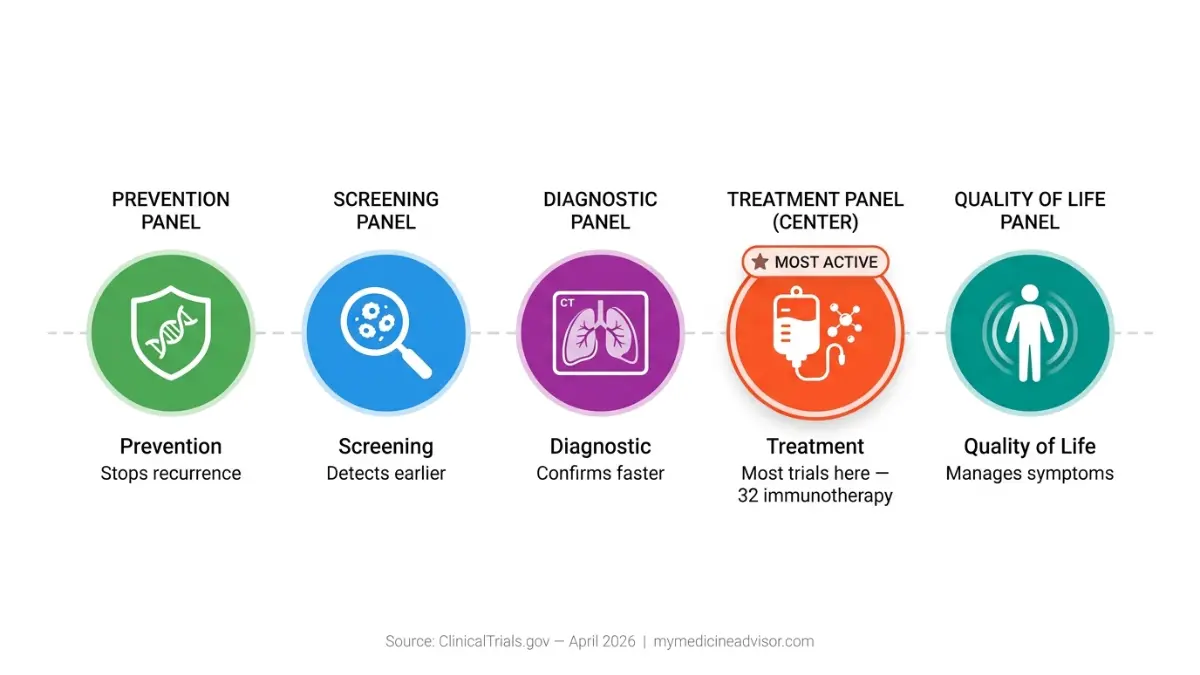
The 5 Types of Mesothelioma Clinical Trials
| Trial Type | What It Tests | Who It’s For |
|---|---|---|
| Treatment | New drugs, immunotherapy, surgery combinations | Most patients |
| Prevention | Ways to stop recurrence | Post-treatment patients |
| Screening | Earlier detection methods | High-risk individuals |
| Diagnostic | Better tests to identify mesothelioma earlier | Newly symptomatic patients |
| Quality of Life | Managing symptoms and side effects | All stages |
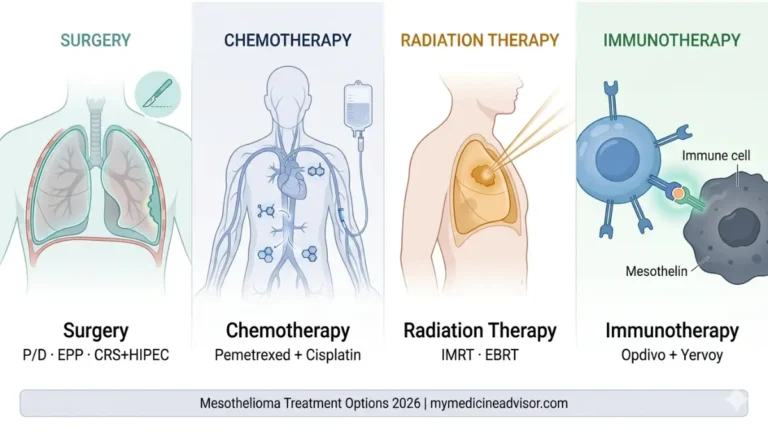
Understanding your full range of mesothelioma treatment options — including trials — is the first step toward the best possible outcome.
Why 2026 Is Different
The National Cancer Institute reports that mesothelioma clinical trials are now testing three entirely new frontiers simultaneously: CAR-T cell therapy, anti-TIGIT checkpoint inhibitors, and MTAP-deletion targeted drugs. No previous year has had this volume of high-phase, high-promise trials open at once.
⚡ What This Means For You: If standard therapy has reached its limit, you may have 3–5 credible trial options available RIGHT NOW — but enrollment windows close fast. The average trial enrollment window is 8–14 months before spots fill.
The 4 Trial Phases — With Real Survival Data Attached
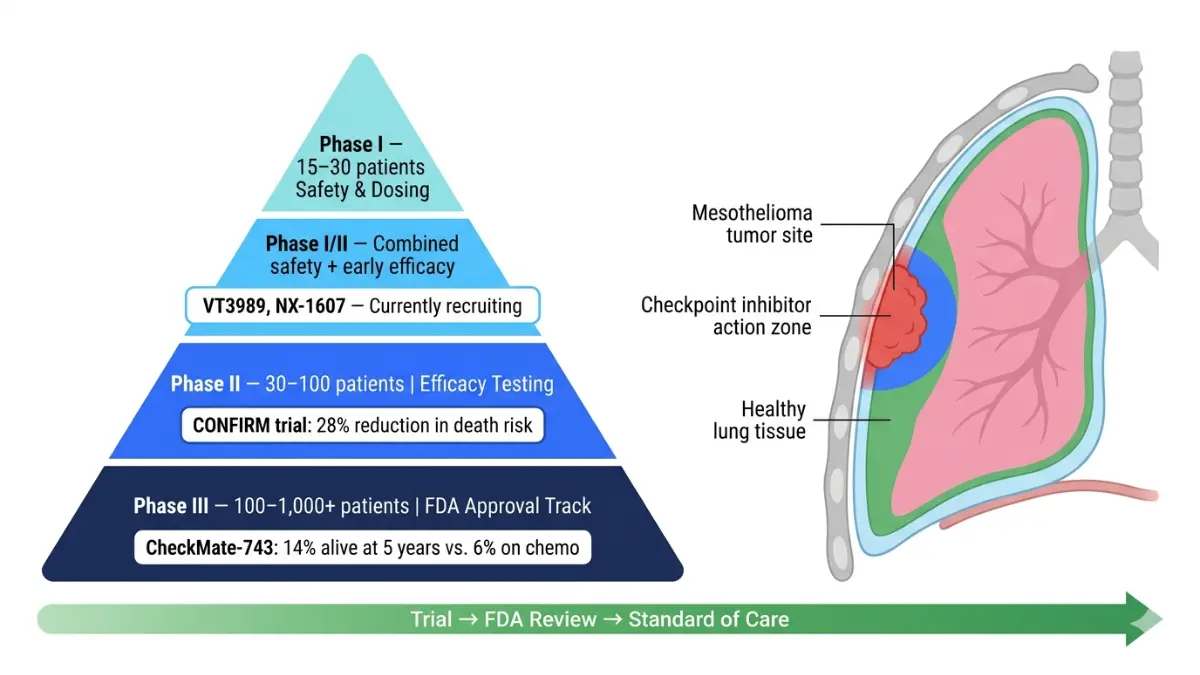
Every mesothelioma clinical trial moves through phases. But unlike what competitors tell you, the phase tells you more than just “how many patients” — it tells you how much real-world survival proof exists.
Phase-by-Phase Breakdown With Real Data
| Phase | Patients | Primary Goal | Real Example | Key Result |
|---|---|---|---|---|
| Phase I | 15–30 | Safety & dosing | NX-1607 (UCSF) | Safety confirmed, dose identified |
| Phase II | 30–100 | Does it work? | CONFIRM trial | 28% reduction in death risk (HR 0.72) |
| Phase III | 100–1,000+ | Beats standard care? | CheckMate-743 | 14% alive at 5 years vs. 6% on chemo |
| Phase IV | 1,000+ | Long-term monitoring | Post-KEYNOTE-483 | 52% response rate confirmed post-approval |
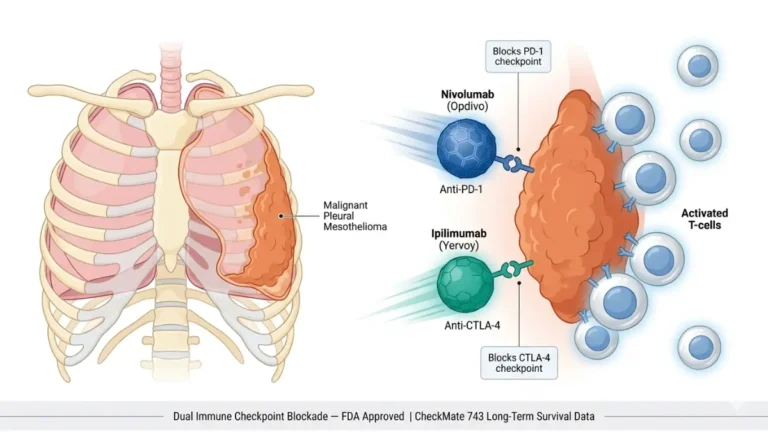
CheckMate-743 enrolled 605 patients and proved that nivolumab plus ipilimumab delivered survival gains no chemotherapy had ever matched. Five-year follow-up data, published in 2026, shows the survival curves continue to separate over time — meaning the benefit grows, not shrinks.
KEYNOTE-483 tested pembrolizumab added to standard chemotherapy. The result: a 52% objective response rate — the highest ever recorded in a first-line mesothelioma trial. The FDA approved this combination in September 2024.
Your Safety Net: Who Protects You Inside a Trial?
- Institutional Review Board (IRB): Independent ethics committee that reviews every step
- FDA oversight: Federal law governs every protocol
- Data Safety Monitoring Board: Stops a trial immediately if harm is detected
- Informed consent: You receive full written details — and you can exit at any time
You can explore how immunotherapy works as a treatment category in our detailed guide on mesothelioma immunotherapy and nivolumab.
⚡ What This Means For You: Phase III trials carry the most survival proof. Phase I/II trials carry the most cutting-edge access. Both have patient protections that are among the most rigorous in all of medicine.
Who Qualifies? The Eligibility Checklist
This is the section no competitor covers with enough precision. Eligibility is not one-size-fits-all — it depends on your specific diagnosis type, cell type, prior treatments, and current health status.
Universal Eligibility Factors (Most Trials)
- ✅ Confirmed mesothelioma diagnosis (histologically verified)
- ✅ Performance status (ECOG 0–2: able to perform routine activities)
- ✅ Adequate organ function (kidney, liver, bone marrow)
- ✅ Prior treatment history (some trials require 1–2 prior regimens)
- ✅ No active autoimmune disease (for immunotherapy trials)
- ✅ Informed consent — you must fully understand and agree to participate
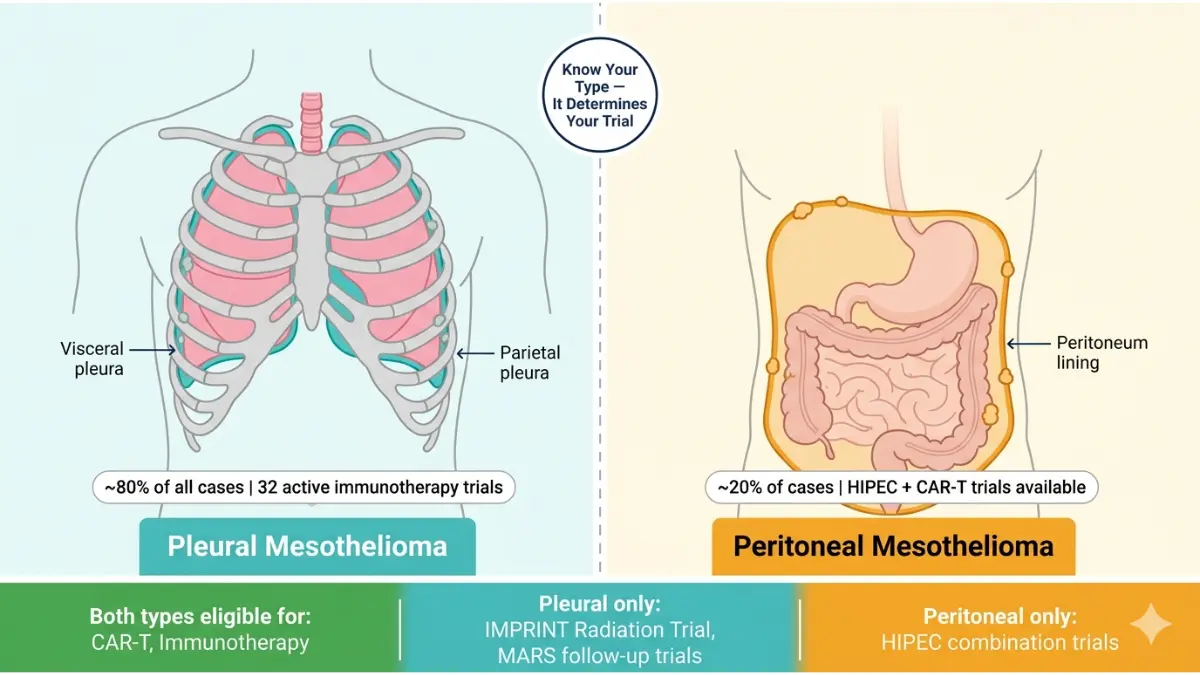
Pleural vs. Peritoneal: Which Trials Match Your Diagnosis
| Trial Focus | Pleural Mesothelioma | Peritoneal Mesothelioma |
|---|---|---|
| Immunotherapy combos | ✅ 32 active trials | ✅ Limited but growing |
| CAR-T therapy | ✅ 5 active trials | ✅ Eligible in most |
| Surgical trials | ✅ MARS 2 aftermath trials | ✅ HIPEC combination trials |
| Targeted therapy | ✅ MTAP-deletion trials | ✅ Mesothelin-targeted |
If you’re managing peritoneal mesothelioma specifically, there are now dedicated trial tracks that didn’t exist before 2023.
Veterans: Your Fast-Track Access (Missed by Every Competitor)
Military veterans represent a disproportionately high percentage of mesothelioma patients due to shipyard and naval asbestos exposure. What most articles don’t tell you:
- The VA has dedicated mesothelioma oncology programs at major VA medical centers
- Veterans can access trial matching services through the VA’s National Oncology Program
- VA benefits can cover routine care costs associated with qualifying trials
- Many NCI-designated cancer centers have veteran liaison programs for trial enrollment
Our complete guide on veterans’ mesothelioma VA claims and benefits covers how to access these programs step by step.
What If You Don’t Qualify?
Do not stop here. The FDA’s Expanded Access Program (also called “compassionate use”) allows patients who don’t qualify for a trial to still access the investigational drug — outside the trial — in life-threatening situations. Ask your oncologist about this pathway specifically.
⚡ What This Means For You: Even if you’ve had multiple prior treatments, many second-line and third-line trials exist specifically for you. The American Society of Clinical Oncology (ASCO) formally recommends trial enrollment for patients whose first-line chemotherapy has failed.
The Hottest Mesothelioma Trials in 2026 — CAR-T, Immunotherapy & Beyond
The 2026 trial landscape is the most diverse in mesothelioma research history. Here’s exactly what’s being tested and why it matters.
Active Trial Categories (April 2026)
| Category | Active Trials | Key Drugs | What It Does |
|---|---|---|---|
| Immunotherapy combinations | 32 | Pembrolizumab, Nivolumab, Tremelimumab | Unlocks immune system to attack cancer |
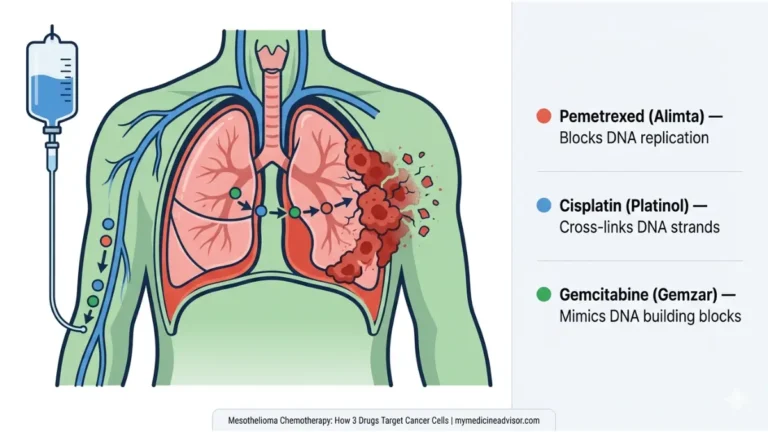
| Chemotherapy combos | 13 | Pemetrexed + novel agents | Enhances kill rate of standard drugs |
| CAR-T cell therapy | 5 | Tmod™ CAR-T, CAR.70-NK cells | Engineered immune cells targeting mesothelin |
| Targeted therapy | 6 | TNG908 (PRMT5 inhibitor), IAG933 | Blocks specific cancer growth pathways |
3 Trials You Need to Know About Right Now
1. Tmod™ CAR-T (Mesothelin-Targeted) This trial tests engineered T-cells that seek out and destroy mesothelin-expressing mesothelioma cells — the same protein found on 90%+ of mesothelioma tumors. Early results in solid tumors show this approach may work where immunotherapy alone has failed.
2. VT3989 (YAP/TAZ Pathway Inhibitor — UCSF) This is a first-in-human study. VT3989 blocks the YAP/TAZ signaling pathway — a key driver of mesothelioma cell survival that chemotherapy cannot touch. Currently in Phase I/II at UCSF.
3. IMPRINT Trial (Pembrolizumab + Radiation — MD Anderson) This Phase I dose-escalation trial combines pembrolizumab with intensity-modulated pleural radiation therapy. It targets the chest wall specifically — a critical pain and disease control site. Results are expected in late 2026.
A comprehensive review of the immunotherapy landscape is available through the NIH’s peer-reviewed clinical trial resource, which covers checkpoint inhibitor progress in mesothelioma across 25+ years of research.
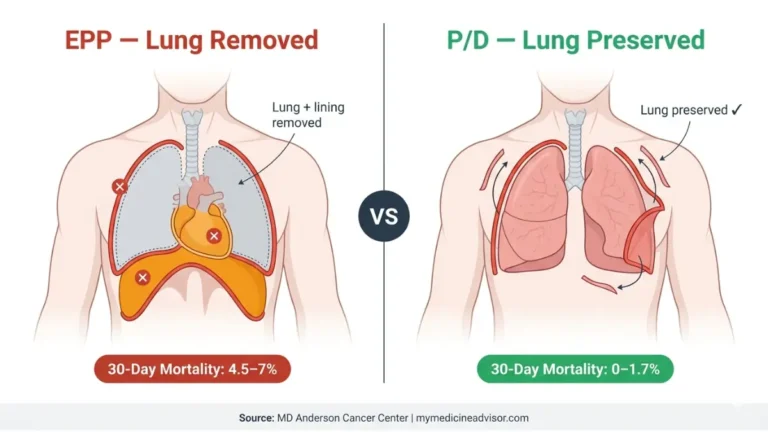
If you want to understand how these newer approaches compare to standard mesothelioma surgery options like EPP vs. P/D, our surgical guide provides the full breakdown.
⚡ What This Means For You: If you have non-epithelioid (sarcomatoid or biphasic) cell type — the hardest-to-treat form — immunotherapy trials show the most dramatic benefit. CheckMate-743 showed 12% alive at five years in non-epithelioid patients on immunotherapy vs. just 1% on chemotherapy.
How to Find and Join a Mesothelioma Clinical Trial — Your 48-Hour Action Plan
This is where most articles fail you. They tell you trials exist. They don’t tell you exactly what to do in the next 48 hours.
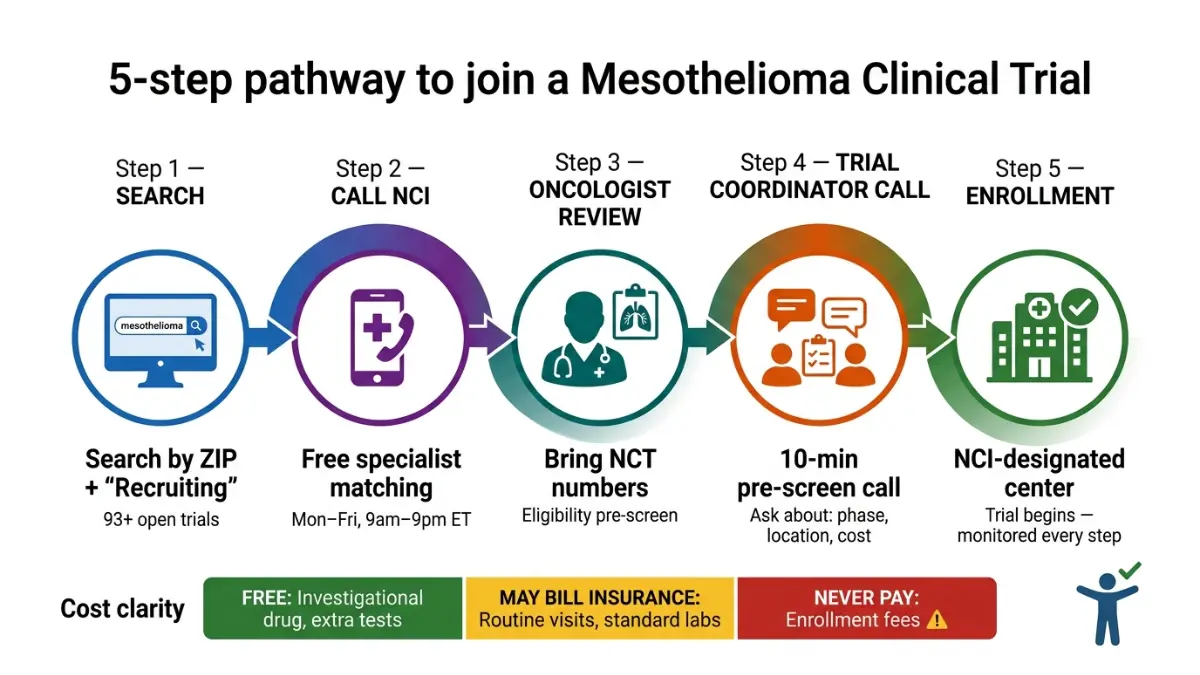
Your 5-Step Action Plan (Start Today)
Step 1: Search ClinicalTrials.gov Go directly to ClinicalTrials.gov and search “mesothelioma” — filter by Status: Recruiting and your state or ZIP code. Note the NCT number of every trial that looks relevant.
Step 2: Call the NCI Cancer Information Service Call 1-800-4-CANCER (1-800-422-6237) — Monday–Friday, 9am–9pm ET. These are NCI-trained specialists who will match you to open trials based on your diagnosis, treatment history, and location. Free service.
Step 3: Bring NCT Numbers to Your Next Oncologist Appointment Your oncologist can review your medical records against the trial’s inclusion/exclusion criteria — faster than any online checker. Come prepared with 2–3 NCT numbers from Step 1.
Step 4: Request a Pre-Screen Call with the Trial Coordinator Every trial listing on ClinicalTrials.gov includes contact information for the trial coordinator. A 10-minute call can tell you if you’re worth pursuing a full screening visit.
Step 5: Get a Second Opinion at an NCI-Designated Cancer Center NCI-designated centers run the most trials and have the most trial coordinators. Use the NCI’s Cancer Center locator to find the closest one to you.
What Does a Clinical Trial Actually Cost?
| Cost Item | Who Pays |
|---|---|
| Investigational drug/treatment | Trial sponsor (FREE to you) |
| Extra tests required by trial | Trial sponsor (FREE to you) |
| Routine medical care during trial | Your insurance / Medicare |
| Travel and lodging (some programs) | NCI travel assistance available |
Important: Medicare and most private insurers are legally required to cover routine care costs in qualifying clinical trials. If your insurer refuses, this is an appeal-able decision.
Understanding your full mesothelioma stages and survival guide can help you determine which trial phase and category is most appropriate for your current disease stage.
Our Genetic Risk Assessment Tool may also be useful in understanding whether specific molecular-targeted trials match your tumor profile — ask your oncologist about MTAP-deletion testing specifically.
⚠️ Red Flag Warning
Legitimate clinical trials NEVER charge patients to participate. If a trial requires an upfront payment, enrollment fee, or asks you to purchase the experimental drug, it is not a legitimate FDA-registered trial. Verify every trial at ClinicalTrials.gov using its NCT number before proceeding.
⚡ What This Means For You: You can complete Steps 1–3 before your next oncologist visit. This is not a passive process — patients who actively research trials and bring NCT numbers to appointments are significantly more likely to enroll.
Your Rights, Real Risks, and What to Expect
Joining a mesothelioma clinical trial is not surrendering control — it is the most proactive decision a patient can make. But knowing your rights makes it empowering rather than intimidating.
Your Rights as a Trial Participant
- Right to full information: You receive a complete informed consent document before anything begins
- Right to ask questions: Trial coordinators must answer every question before you sign
- Right to withdraw: You can leave a trial at any point, for any reason, without affecting your standard care
- Right to your data: You are entitled to know your trial results
- Right to emergency unblinding: If you have a serious adverse event, your treatment assignment is immediately revealed to your physician
Common Side Effects in 2026 Immunotherapy Trials
Current trials primarily involve checkpoint inhibitors and CAR-T therapies. The most common side effects are immune-related adverse events (irAEs):
- Fatigue (most common — manageable)
- Skin rash or itching (usually mild)
- Colitis or diarrhea (monitored closely)
- Thyroid disruption (managed with hormone supplements)
- Pneumonitis (rare but serious — monitored via regular imaging)
These side effects are tracked in real time. Trial teams intervene immediately when thresholds are reached. The monitoring protocol in 2026 trials is more sophisticated than anything used in standard outpatient care.
You can prepare for what lies ahead by reading our complete guide on mesothelioma chemotherapy side effects and mesothelioma diagnosis and critical tests.
For broader context on survival statistics and what they mean for your specific situation, our mesothelioma survival rate guide and the pillar mesothelioma survival article provide the most comprehensive data available outside of a clinical consultation.
You can also use our Symptom Checker to track and log any new or changing symptoms before and during trial participation — a useful record for your trial coordinator.
⚡ Final Takeaway: The average enrollment window for an open mesothelioma clinical trial is less than 14 months. Trials that are open today may be closed by the time your next appointment arrives. The only wrong decision is waiting too long to ask.
Frequently Asked Questions — Mesothelioma Clinical Trials 2026
1. What is a mesothelioma clinical trial?
A mesothelioma clinical trial is a regulated research study testing new treatments on real patients. Every trial follows NIH and FDA guidelines to ensure safety and scientific accuracy.
2. How do I find mesothelioma clinical trials near me in 2026?
Search ClinicalTrials.gov using “mesothelioma” + your ZIP code, filtered by “Recruiting” status. The NCI helpline (1-800-4-CANCER) can also match you for free.
3. How do I qualify for a mesothelioma clinical trial?
Eligibility depends on your mesothelioma type (pleural or peritoneal), cell type (epithelioid, sarcomatoid, biphasic), performance status, prior treatments, and organ function. Your oncologist can run a pre-screen review.
4. Are mesothelioma clinical trials free?
The investigational treatment and all extra trial-required tests are provided at no cost. Routine care may be billed to your insurance or Medicare, which is legally required to cover it in qualifying trials.
5. What is the most promising mesothelioma trial in 2026?
Immunotherapy combinations (32 active trials) and CAR-T mesothelin-targeted therapy (5 active trials) are the most advanced. KEYNOTE-483 produced the highest response rate ever recorded — 52% — in first-line mesothelioma.
6. What is the difference between Phase I, II, and III trials?
Phase I tests safety (15–30 patients). Phase II tests effectiveness (30–100 patients). Phase III compares the new treatment to standard care in 100–1,000+ patients and is the gateway to FDA approval.
7. Can I join a trial if I’ve already had chemotherapy?
Yes. Many trials are specifically designed for patients who have already completed first-line treatment. The CONFIRM trial, for example, targeted patients with relapsed mesothelioma after prior treatment and showed a 28% reduction in death risk.
8. What happens if I don’t qualify for any clinical trial?
The FDA’s Expanded Access (Compassionate Use) program may allow you to receive investigational drugs outside of a trial. Ask your oncologist specifically about this pathway.
9. Are mesothelioma clinical trials safe?
All trials are reviewed by an Institutional Review Board (IRB), monitored by a Data Safety Monitoring Board, and regulated by the FDA. You retain the right to withdraw at any time without penalty.
10. How long does a mesothelioma clinical trial last?
Treatment phases vary from months to over a year. Follow-up monitoring can continue for several years. You can withdraw at any point, but longer participation produces better data and typically means better access to the treatment.
11. Can veterans access mesothelioma clinical trials through the VA?
Yes. The VA’s National Oncology Program offers trial matching for veterans, and many VA medical centers have dedicated mesothelioma oncology programs. See our complete guide on veterans’ mesothelioma VA claims for the full access pathway.
Medical disclaimer
The content on MyMedicineAdvisor is provided for general informational and educational purposes only and is not a substitute for professional medical advice, diagnosis, or treatment. Health information on this website should not be used to diagnose, treat, cure, or prevent any condition without guidance from a qualified healthcare professional. Always seek the advice of your doctor, physician, or another licensed healthcare provider with any questions you may have regarding a medical condition, symptoms, medications, or treatment decisions.