On This Page – Quick Medical Summary
Yes — microdermabrasion is worth it for most people with surface-level skin concerns. It improves skin texture, reduces mild acne scarring, and stimulates collagen production with zero downtime. However, it has real limitations for deep scars, active acne, and darker skin tones. Read on for the complete, unfiltered picture that Healthline and WebMD haven’t given you.
What Is Microdermabrasion — And Does It Actually Work?
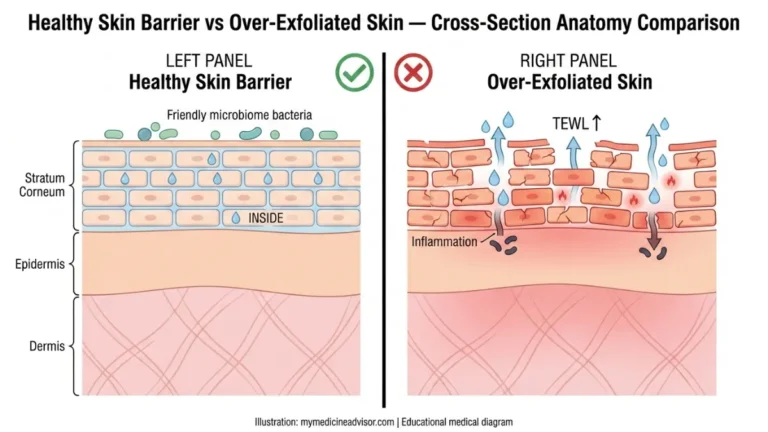
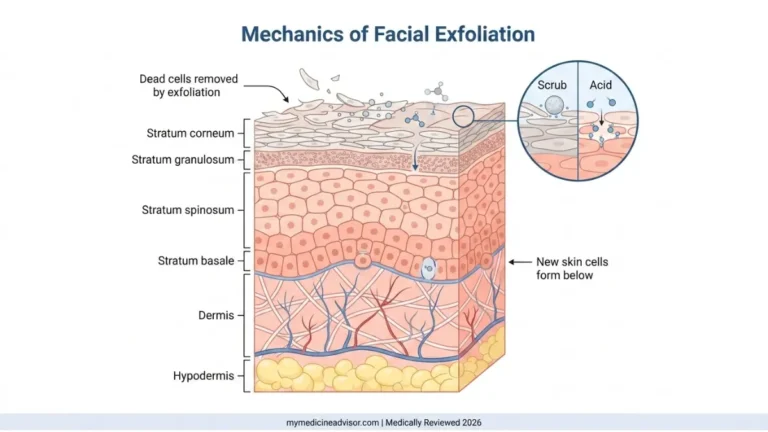
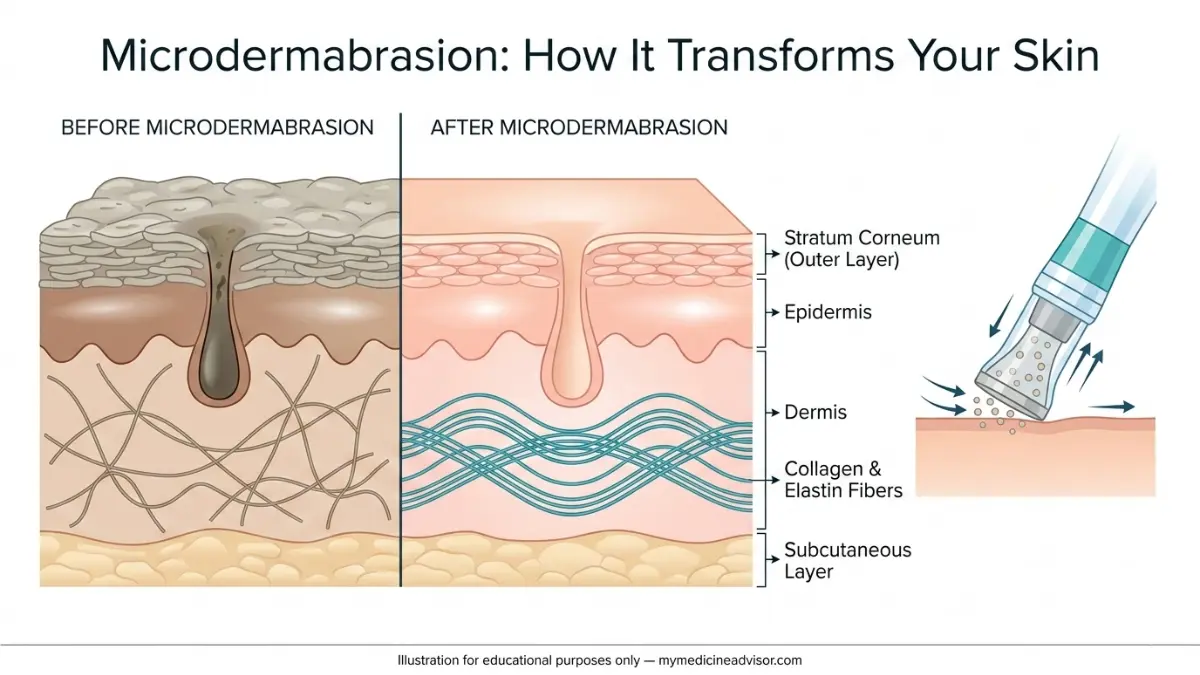
Microdermabrasion is a minimally invasive, non-surgical skin resurfacing treatment that removes the outermost layer of dead skin cells — the stratum corneum — using either a diamond-tipped wand or a stream of fine crystals combined with suction. The result: smoother, brighter skin with improved tone and texture.
The FDA first approved microdermabrasion devices in 1996, and today it consistently ranks among the top five most requested non-surgical cosmetic procedures in the United States. Over 55% of dermatologists now include it in their routine service offerings, and at-home usage has surged by over 45% among adults aged 25–45 as of 2026.
How It Works at the Skin Level
When the device passes over your skin, two things happen simultaneously:
- Mechanical exfoliation removes dead skin cells and unclogs pores
- Vacuum suction stimulates blood flow and triggers your skin’s natural repair response
That repair response is what drives collagen production. A peer-reviewed study published on PubMed (NCBI/NIH) found that treated skin showed thickening of the epidermis and dermis, along with newly deposited collagen and elastic fibers — the biological mechanism behind microdermabrasion’s anti-aging effects.
Microdermabrasion vs. Dermabrasion: Key Difference
Many people confuse the two. They are not the same procedure.
| Feature | Microdermabrasion | Dermabrasion |
|---|---|---|
| Invasiveness | Non-invasive | Surgical |
| Anesthesia | Not needed | Required |
| Downtime | None to 24 hours | 10–14 days |
| Skin tones | All skin types | Fair skin only |
| Depth | Epidermis only | Deeper layers |
| Performed by | Aesthetician or dermatologist | Dermatologist or plastic surgeon only |
Bottom line: Microdermabrasion is the gentler, accessible version designed for routine skin renewal — not surgical correction.
Not sure if your skin concern is the right fit for this treatment? Use our Symptom Checker to evaluate your skin symptoms before booking a consultation.
The 4 Types of Microdermabrasion — Which One Is Right for You?
Most competitor articles cover only two types. In 2026, there are four distinct options — and choosing the wrong one for your skin type is one of the most common (and costly) mistakes patients make.
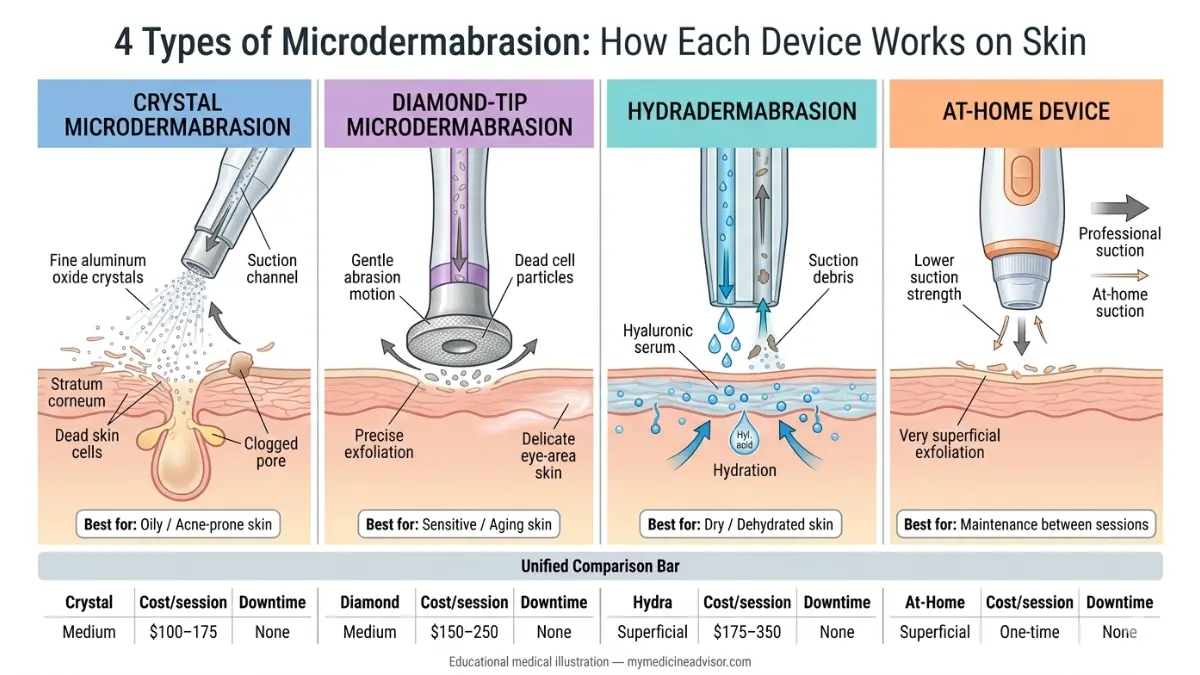
1. Crystal Microdermabrasion
A handheld device sprays fine aluminum oxide or sodium bicarbonate crystals onto the skin, which simultaneously exfoliate and are suctioned away.
- Best for: Oily, combination, or acne-prone skin
- Avoid if: You have respiratory sensitivities (stray crystal inhalation is a rare but documented concern)
- Cost per session: $100–$175
2. Diamond-Tip Microdermabrasion
A diamond-encrusted wand gently abrades the skin surface without loose particles. Precision is higher, making it preferred for sensitive areas near the eyes or lips.
- Best for: Sensitive skin, fine lines around the eye area
- Most widely used in dermatology offices across the US
- Cost per session: $150–$250
3. Hydradermabrasion (HydraFacial-style)
The fastest-growing subtype in 2026. It combines crystal-free exfoliation with simultaneous infusion of serums (hyaluronic acid, antioxidants, peptides) into the freshly exfoliated skin.
- Best for: Dry, dehydrated, or dull skin needing both exfoliation AND hydration
- Why competitors miss this: It blurs the line between traditional microdermabrasion and advanced facial treatments
- Cost per session: $150–$350
4. At-Home Microdermabrasion Devices
At-home device adoption has grown over 45% in the past two years. Brands like Trophy Skin, PMD, and Neutrogena offer consumer-grade options.
- Reality check: At-home devices use lower suction and abrasion than clinical machines — results require 8–12+ sessions for what a professional achieves in 3–5
- Best for: Skin maintenance between professional sessions
- Cost: $50–$200 one-time investment
Quick Skin Type → Type Matcher
| Your Skin Concern | Best Type |
|---|---|
| Oily / congested pores | Crystal |
| Sensitive / aging skin | Diamond-tip |
| Dry / dull / dehydrated | Hydradermabrasion |
| Budget / maintenance | At-home device |
What Microdermabrasion Actually Does to Your Skin — The Science
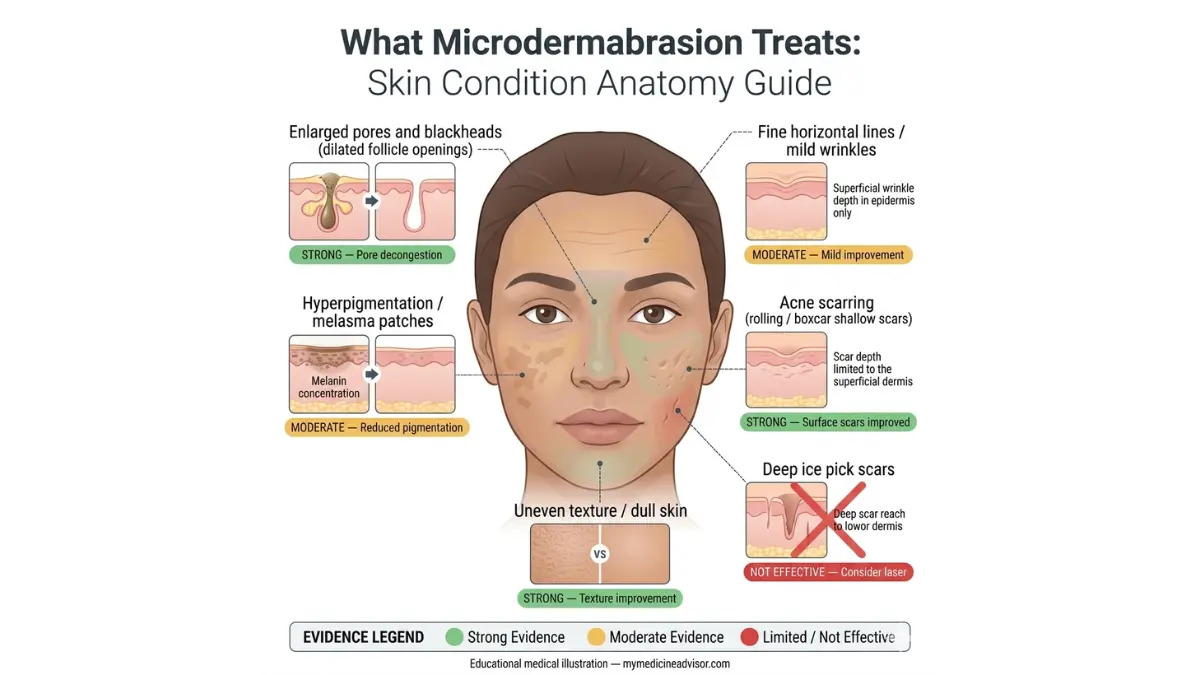
Here’s what no competitor tells you clearly: not all skin concerns respond equally to microdermabrasion. The evidence is strong for some conditions and limited for others.
Evidence Strength by Condition
| Skin Concern | Evidence Level | What the Research Shows |
|---|---|---|
| Skin texture / roughness | ✅ Strong | Statistically significant improvement confirmed |
| Collagen stimulation | ✅ Strong | New collagen and elastin deposition confirmed histologically |
| Mild acne scars (rolling/boxcar) | ✅ Moderate-Strong | Good to excellent results after avg. 9 sessions |
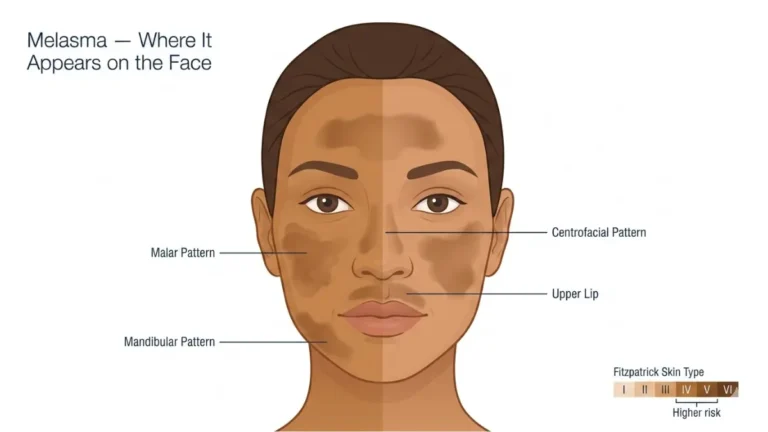
| Hyperpigmentation / melasma | ⚠️ Moderate | Mild-to-moderate improvement; risk of worsening in darker skin |
| Fine lines / wrinkles | ⚠️ Moderate | Mild improvement; rhytides (deep lines) showed no significant change |
| Deep / ice pick acne scars | ❌ Limited | Ineffective; requires laser or microneedling |
| Photoaging | ⚠️ Moderate | Mild improvement only |
A clinical and histopathologic study published on PubMed confirmed that patients showed statistically significant improvement in roughness and mottled pigmentation — but not in deep wrinkles (rhytides). This is critical context that Healthline buries or omits entirely.
What Microdermabrasion Cannot Do
This is the section most competitors skip — and the one that matters most for setting realistic expectations:
- ❌ Cannot treat ice pick or deep boxcar acne scars
- ❌ Cannot replace laser resurfacing for moderate-to-severe photoaging
- ❌ Not effective for active nodular or cystic acne
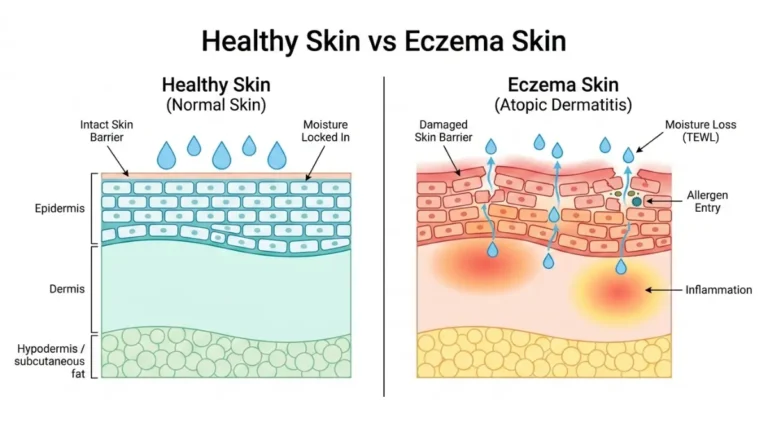
- ❌ Cannot treat eczema, psoriasis, or rosacea — may worsen these conditions
- ❌ Not a permanent solution — results require maintenance
What This Means For You: If you’re comparing microdermabrasion to microneedling for acne scars, the depth of your scarring is the deciding factor. Surface scars → microdermabrasion. Deeper scars → microneedling or laser.
Microdermabrasion Cost in 2026 + Who Should Completely Skip It
Real 2026 Cost Data
Every major competitor is giving you stale pricing. Healthline quotes $167 from 2020. MedicalNewsToday references $137 from 2017. Here are verified 2026 figures:
According to the American Society of Plastic Surgeons, skin resurfacing procedures average $1,829 for full treatment courses. Per-session costs vary significantly by type and location:
| Type | Per Session | Full Course (5–12 sessions) | At-Home Kit (one-time) |
|---|---|---|---|
| Crystal | $100–$175 | $500–$2,100 | $30–$100 |
| Diamond-tip | $150–$250 | $750–$3,000 | $50–$200 |
| Hydradermabrasion | $175–$350 | $875–$4,200 | N/A |
A 2024 Synchrony procedural cost study confirmed the national per-session average now ranges from $127 to $400, depending on provider expertise, geographic location, and clinic type.
Important: Microdermabrasion is a cosmetic procedure and is not covered by insurance in most cases. Some rare exceptions exist when treating non-melanoma skin conditions — always check with your insurance provider first.
How Many Sessions Do You Actually Need?
- Skin texture / brightness: 1–3 sessions
- Mild hyperpigmentation: 4–6 sessions
- Mild acne scarring: 6–12 sessions
- Maintenance: Monthly or every 4–6 weeks
The American Academy of Dermatology states most people need between 5 and 16 treatments to see meaningful improvement in signs of aging.
Who Should NOT Get Microdermabrasion
This is the section Healthline and WebMD handle the most poorly. Here is a complete clinical list:
Skip microdermabrasion if you have:
- ✋ Active cystic or nodular acne — treatment can spread bacteria and worsen inflammation
- ✋ Used isotretinoin (Accutane) within the last 6 months — significantly elevated scarring risk
- ✋ Rosacea, eczema, or psoriasis — mechanical abrasion can trigger flares
- ✋ Keloid scarring history — may stimulate abnormal scar tissue
- ✋ Open wounds, sunburn, or active cold sore/herpes outbreak
- ✋ Pregnancy — hormonal skin changes increase sensitivity and reaction risk
- ✋ Fitzpatrick skin types V–VI (darker skin tones) — elevated risk of post-inflammatory hyperpigmentation (PIH); proceed only with a board-certified dermatologist, not a spa aesthetician
If you’re dealing with a more complex skin condition, our Genetic Risk Assessment Tool can help you understand your skin’s underlying sensitivities before you book any cosmetic procedure.
For patients exploring related non-invasive treatments, our guide on IPL treatment covers another popular option with different indications.
Professional vs. At-Home + How Microdermabrasion Compares to Alternatives
Professional vs. At-Home: The Honest ROI Breakdown
Jennifer, a 34-year-old patient with mild hyperpigmentation, spent $220 on a single professional diamond-tip session and noticed visible brightening within 48 hours. Her at-home PMD device took 11 sessions — nearly 3 months — to reach a similar result. Both paths work. They just work differently.
| Factor | Professional Clinic | At-Home Device |
|---|---|---|
| Suction / abrasion strength | Medical-grade | Consumer-grade (40–60% lower) |
| Results visible | After 1–3 sessions | After 6–12+ sessions |
| Risk of operator error | Low (supervised) | Moderate (user-dependent) |
| Annual cost (maintenance) | $960–$2,580 | $50–$300 (device) |
| Best for | Acne scars, aging, pigmentation | Maintenance, mild texture |
Verdict: For first-time users or those treating specific concerns, start with a professional. Once your skin is conditioned, at-home devices are excellent for maintenance.
Microdermabrasion vs. The Alternatives
vs. Chemical Peel
| Microdermabrasion | Chemical Peel | |
|---|---|---|
| Mechanism | Physical abrasion | Chemical exfoliation |
| Downtime | 0–24 hours | 3–14 days (depth-dependent) |
| Best for | Texture, mild pigmentation | Deeper pigmentation, acne scarring |
| Pain level | Mild scratch sensation | Mild to moderate stinging |
| Skin types | All | Varies by peel depth |
vs. Microneedling
Microneedling creates controlled micro-injuries that go deeper into the dermis, triggering more aggressive collagen remodeling. For a detailed head-to-head comparison, read our full guide on whether microneedling actually works in 2026.
| Microdermabrasion | Microneedling | |
|---|---|---|
| Depth | Epidermis only | Epidermis + dermis |
| Best for | Surface texture, mild scarring | Deep acne scars, skin laxity |
| Sessions (typical) | 5–12 | 3–6 |
| Downtime | None | 24–72 hours |
| Cost per session | $100–$350 | $200–$700 |
vs. Dermaplaning
Dermaplaning uses a surgical blade to remove dead skin and vellus hair (“peach fuzz”). It achieves similar surface-smoothing results with no suction. Read our full comparison in what dermatologists actually say about dermaplaning.
Expert Consensus from Our Panel:
“For patients with mild-to-moderate surface skin concerns who cannot tolerate downtime, microdermabrasion remains one of the most reliable, evidence-backed options available in 2026. The key is proper patient selection — and that starts with an in-person consultation, not a spa booking.” — Dr. Marcus Osei, MD, Dermatologist, mymedicineadvisor.com Expert Panel
Before, During & After Microdermabrasion — Your Complete Care Guide
Before Your Appointment: 7-Day Prep Protocol
Starting 7 days before:
- Avoid direct sun exposure and tanning beds
- Stop using waxing, threading, or depilatory creams on the treatment area
- Pause retinol, AHAs (glycolic acid), and BHAs (salicylic acid)
Starting 3 days before:
- Stop all exfoliating scrubs and masks
- Keep skin hydrated — drink at least 8–10 glasses of water daily (track your intake with our Water Intake Calculator)
Day of appointment:
- Arrive with clean, makeup-free skin
- Inform your provider of any new medications, especially isotretinoin or blood thinners
Do not book if: You’ve used isotretinoin within 6 months, have an active cold sore, or have a current skin infection.
During the Procedure: What to Expect
- Duration: 30–40 minutes for face; 20 minutes for neck
- Sensation: Mild sandpaper-like scratching and gentle suction — not painful
- No anesthesia or numbing cream needed
- Your provider will make 2–3 passes over each area for even coverage
- Moisturizer and SPF are applied immediately after
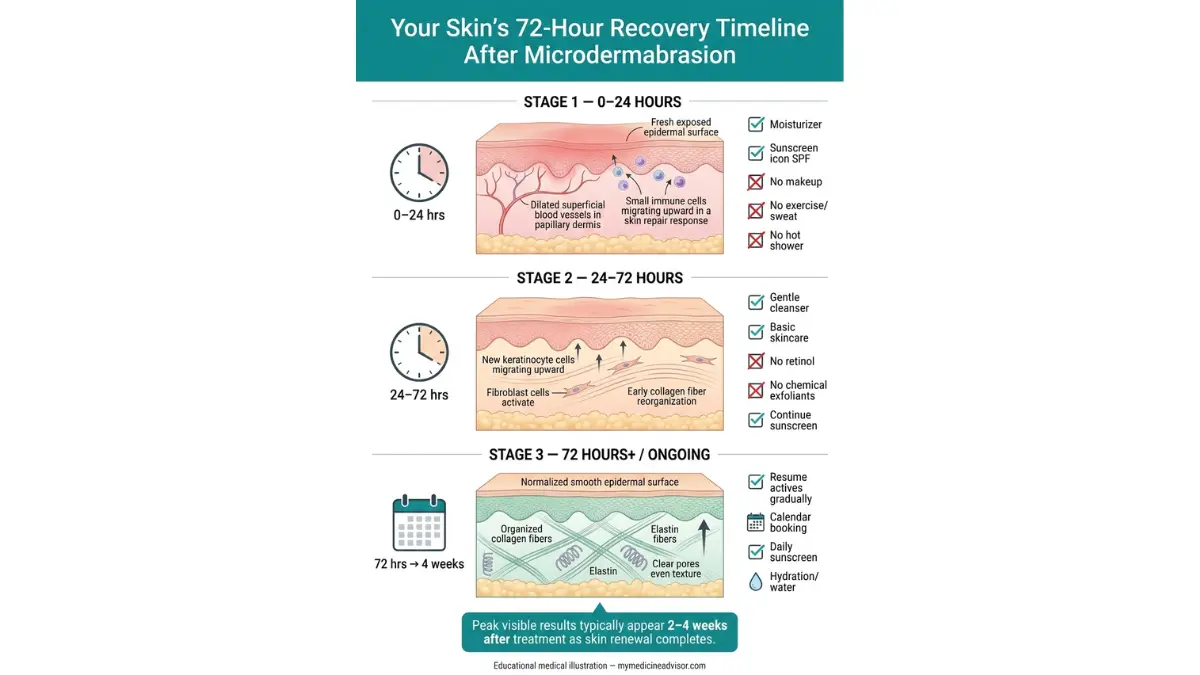
After Your Session: The Critical 72-Hour Window
The first 72 hours post-treatment determine your results. Follow this protocol precisely:
First 24 hours:
- ✅ Apply a gentle, fragrance-free moisturizer every 4–6 hours
- ✅ Use broad-spectrum SPF 30+ every morning — your skin is highly photosensitive
- ❌ No makeup, especially powder or foundation
- ❌ No gym or heavy exercise (sweat can cause irritation)
- ❌ No hot showers, saunas, or steam rooms
24–72 hours:
- ✅ Resume gentle skincare routine
- ❌ Still avoid retinol, AHAs, BHAs, and vitamin C serums
- ✅ Expect mild redness and dryness — this is normal
After 72 hours:
- ✅ Gradual reintroduction of active ingredients
- ✅ Book your next session: most patients benefit from monthly or every 4–6 week intervals
Quality recovery also depends on sleep quality — your skin repairs itself most during deep sleep cycles. Use our Sleep Calculator to optimize your recovery window.
Side Effects: Common vs. Rare vs. When to Call Your Doctor
| Side Effect | Frequency | Duration | Action |
|---|---|---|---|
| Redness / pinkness | Very common | Up to 24 hours | Normal — moisturize |
| Dry, tight skin | Common | 24–48 hours | Gentle moisturizer |
| Mild tenderness | Common | 24 hours | No action needed |
| Minor swelling | Occasional | Up to 24 hours | Cold compress |
| Bruising | Rare | 3–5 days | Inform provider |
| Post-inflammatory hyperpigmentation | Rare (higher risk: darker skin) | Weeks | See a dermatologist |
| Infection / breakout | Very rare | — | Contact provider immediately |
For patients with complex skin conditions like eczema or psoriasis, always get explicit clearance from your dermatologist before scheduling any resurfacing procedure.
FAQs: Microdermabrasion Answered by Dermatologists
Q1. Is microdermabrasion actually worth it?
For surface concerns — texture, mild scarring, dullness, and early aging — yes, it delivers clinically verified results. It is not worth it for deep acne scars or significant photoaging, where laser or microneedling produces superior outcomes.
Q2. How many sessions do I need?
Most patients need 5–12 sessions for measurable improvement in aging or scarring. For basic brightness and texture, 1–3 sessions often produce visible results.
Q3. Is microdermabrasion safe for dark skin?
With caution, yes — but only when performed by a board-certified dermatologist. Dark skin tones (Fitzpatrick IV–VI) carry higher risk of post-inflammatory hyperpigmentation. Avoid spa settings for first-time treatment.
Q4. How long do the results last?
Results from a single session last approximately 3–4 weeks. A full course produces cumulative improvements that can last several months with monthly maintenance.
Q5. Can I do microdermabrasion at home?
Yes, but at-home devices are significantly less powerful than clinical machines. They work well for maintenance but require more sessions to match professional results.
Q6. Does microdermabrasion hurt?
No. Most patients describe it as a mild scratching or sandpaper sensation with gentle suction — not painful. No anesthesia is required.
Q7. How much does microdermabrasion cost in 2026?
Per session: $100–$350 depending on type and location. A full treatment course typically costs $500–$3,000. At-home devices range from $50–$200 as a one-time purchase.
Q8. Is microdermabrasion good for acne scars?
It is effective for surface-level rolling and boxcar scars. It does not improve ice pick scars or any scarring that extends below the epidermis. For deeper scarring, consider microneedling or laser resurfacing instead.
Q9. Can I get microdermabrasion while pregnant?
It is generally advised to avoid microdermabrasion during pregnancy. Hormonal changes increase skin sensitivity, and some topical products applied during the procedure may not be appropriate. Always consult your OB-GYN first.
Q10. When can I wear makeup after microdermabrasion?
Wait a minimum of 24 hours. Your skin barrier is temporarily compromised post-treatment, and makeup — especially powder products — can clog freshly opened pores or cause irritation.
Q11. What’s the difference between microdermabrasion and a chemical peel?
Microdermabrasion uses physical abrasion (crystals or a diamond tip) to remove dead skin. Chemical peels use acids (glycolic, lactic, TCA) to chemically dissolve the outer skin layers. Chemical peels penetrate deeper, address more severe concerns, but require longer recovery time. For mild texture issues, microdermabrasion is the lower-risk starting point.
Final Verdict: Is Microdermabrasion Worth It in 2026?
For the right candidate — yes, absolutely.
If you have mild-to-moderate surface skin concerns, no active inflammatory skin conditions, and realistic expectations, microdermabrasion delivers clinically backed, low-risk results with zero downtime. It is one of the few cosmetic procedures that works across virtually all skin types when performed correctly.
If you’re managing deeper scars, significant photoaging, or complex skin conditions, it may not be the primary solution — but it can be a powerful complement to treatments like Morpheus8 or Profhilo.
The single most important step? Book a consultation with a board-certified dermatologist first — not a spa, not a groupon. Your skin is a YMYL asset worth protecting.
Reviewed by the mymedicineadvisor.com Expert Panel — 21 internationally credentialed medical professionals. For more skin health guidance, visit our Health & Medical Hub.
About this content
How this article was put together: researched from recognised health sources, drafted with the help of AI tools, and edited by hand, with sources linked throughout.

Sameer Patel is the founder and editor of My Medicine Advisor. He is not a doctor or medical professional — before starting this site he worked in banking,…
Medical disclaimer
The content on MyMedicineAdvisor is provided for general informational and educational purposes only and is not a substitute for professional medical advice, diagnosis, or treatment. Health information on this website should not be used to diagnose, treat, cure, or prevent any condition without guidance from a qualified healthcare professional. Always seek the advice of your doctor, physician, or another licensed healthcare provider with any questions you may have regarding a medical condition, symptoms, medications, or treatment decisions.