On This Page – Quick Medical Summary
If you or someone you love was just handed a prostate cancer stage — a number like “Stage II” alongside terms like Gleason, Grade Group, and PSA — the report can read like a foreign language at the worst possible moment. This guide explains what each of the four prostate cancer stages means, in plain words.
Where you are right now shapes what matters most:
- Just diagnosed and trying to read your report? Start with how staging is decided, then the stage-by-stage breakdown.
- Worried about whether your stage is survivable? The survival section puts the numbers in honest context.
- A caregiver or partner? The questions-to-ask section gives you something concrete to bring to the next appointment.
Here is a steadying fact to begin with: most prostate cancers in the U.S. are found early, before they have spread far. Knowing your stage is the first step toward a plan. This article is part of our full guide to prostate cancer signs and stages.
ℹ️ Medical Disclaimer: This article is general health information, not a diagnosis, treatment plan, or medical advice. Prostate cancer staging, prognosis, treatment selection, medication, and insurance decisions all depend on your individual results and must be made with a board-certified urologist, radiation oncologist, or medical oncologist who has examined you. Always consult your own care team before acting on anything you read here.
How doctors decide your prostate cancer stage
Your stage is not a single test result — it is a summary built from several pieces of information about where the cancer is and how it behaves.
Doctors in the U.S. use the AJCC TNM system, most recently updated in 2018, which combines five inputs into one stage, as described in the American Cancer Society’s staging overview.
- T (tumor): how far the primary tumor has grown within or beyond the prostate.
- N (nodes): whether it has reached nearby lymph nodes.
- M (metastasis): whether it has spread to distant parts of the body.
- PSA level: the blood marker measured at diagnosis.
- Grade Group: how abnormal the biopsy cells look, scored from 1 to 5.
🔬 How It Works: A clinical stage (written “cT”) is your team’s best estimate before treatment, based on the digital rectal exam, imaging, PSA, and biopsy. A pathologic stage (“pT”) is assigned only after surgery, when the removed tissue is examined directly — which is why it is generally more accurate.
A higher PSA tends to push toward a higher stage group, but PSA alone does not set your stage; it is weighed alongside the T, N, M, and Grade Group. Many people first arrive here after noticing the symptoms that often lead to testing.
✅ Patient Action: Ask your urologist whether your stage is clinical or pathologic, and request your exact T, N, M, PSA, and Grade Group in writing so you can follow the rest of this guide against your own numbers.
What each of the 4 stages of prostate cancer means
Prostate cancer is grouped into four stages, written I through IV, from least to most advanced.
- Stage I: The cancer is small and confined to the prostate, with a low Grade Group and low PSA. It often can’t be felt on exam and may be found incidentally.
- Stage II: Still confined to the prostate, but larger, more widespread within the gland, or with a higher Grade Group or PSA. It is divided into IIA, IIB, and IIC.
- Stage III: Locally advanced — the cancer has grown beyond the prostate or into the seminal vesicles, or carries a higher PSA or Grade Group, but has not reached distant sites.
- Stage IV: The cancer has spread beyond the area around the prostate — to nearby lymph nodes (Stage IVA) or to distant sites such as the bones, distant lymph nodes, or other organs (Stage IVB).
| Stage | What it means | Key clinical detail |
|---|---|---|
| Stage I | Confined, low risk | Low Grade Group, low PSA |
| Stage II | Confined, higher risk | Sub-stages IIA–IIC |
| Stage III | Locally advanced | Beyond prostate/seminal vesicles; no distant spread |
| Stage IV | Spread beyond the prostate | IVA = nearby nodes; IVB = distant (e.g., bone) |
Source: stage definitions adapted from the American Cancer Society and the AJCC Cancer Staging Manual, 8th edition.
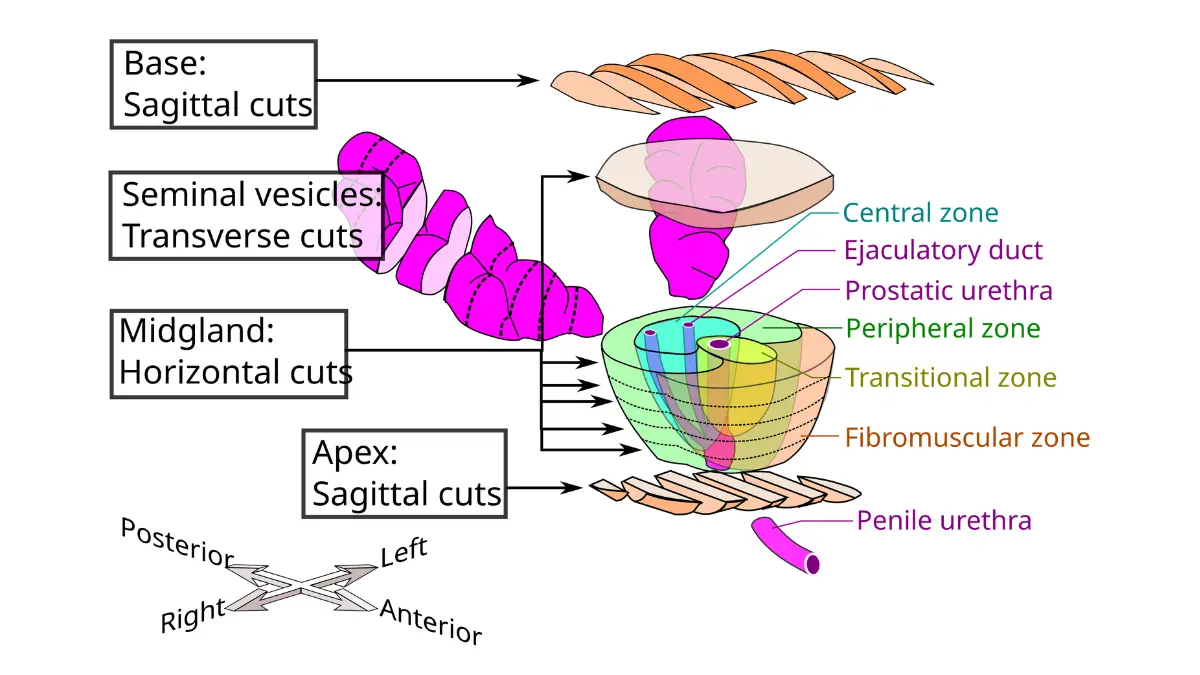
Wikimedia Commons Prostate cutting
, license version should be confirmed on the file page before publishing.
Your full stage — for example, IIB versus IIC — depends on the precise mix of your five inputs, so confirm yours with your care team rather than estimating from this table.
Survival rates by stage — and what the numbers don’t tell you
Survival statistics describe large groups of people, not any single person — and for prostate cancer overall, they are encouraging.
The clearest measure is the 5-year relative survival rate, which compares people with a given stage to the general population. Because the national SEER database groups prostate cancer as localized, regional, or distant rather than by stage number, survival is reported that way too, as shown in the American Cancer Society’s prostate cancer survival data.
📊 Clinical Data Point: For U.S. men diagnosed 2015–2021, the 5-year relative survival rate is greater than 99% for localized and regional prostate cancer, 38% for distant (metastatic) disease, and 98% across all stages combined. — Source: American Cancer Society, last revised January 2026 (SEER data).
The high overall figure largely reflects that most prostate cancers are caught before they spread — about 83% are found at a localized or regional stage.
⚠️ Clinical Warning: A survival percentage is a population average from men diagnosed at least five years ago. It does not account for your age, overall health, Grade Group, PSA, or how your cancer responds to treatment, and it cannot tell you what will happen in your case. Because treatments have improved since these men were treated, today’s outlook may be better than the number suggests.
✅ Patient Action: Ask your medical oncologist how your specific Grade Group, PSA, and general health change your individual outlook — the averages don’t capture the factors that matter most for you.
How your stage helps guide treatment decisions
Your stage, together with your Grade Group and PSA, helps your team match you to the right category of treatment — though the final choice is always individualized.
In general terms, the options fall into a few groups:
- Active surveillance or observation — closely monitoring low-risk, early-stage cancer instead of treating it right away.
- Surgery — removing the prostate, often considered for cancer still confined to the gland; you can read more about prostate surgery and its reported cure rates.
- Radiation therapy — using targeted energy to destroy cancer cells; how radiation therapy works is similar across many cancers.
- Systemic therapy — treatments such as hormone therapy that travel through the body, used more often as cancer becomes advanced or spreads.
🩺 Physician Note: Current ACS guidance frames initial treatment by both stage and risk group, not stage alone — two men with the same stage number can be advised differently because their Grade Group and PSA place them in different risk categories. See how initial treatment is matched to stage and risk group.
Treatment intensity generally rises with stage, grade, and PSA. This article does not recommend a specific treatment, drug, or dose — those belong to a conversation with your clinicians.
✅ Patient Action: Ask your urologist and a radiation oncologist which treatment categories fit your stage and risk group, what each involves, and what the trade-offs are for your situation.
Gleason score, Grade Group, and risk group — how they fit with your stage
The terms on a prostate pathology report overlap, which is why they cause so much confusion — but each describes something distinct.
🔬 How It Works: A pathologist examines biopsy tissue and assigns a Gleason score based on how abnormal the two most common cell patterns look. That score is then translated into a Grade Group, a simpler 1-to-5 scale where 1 is least aggressive and 5 is most.
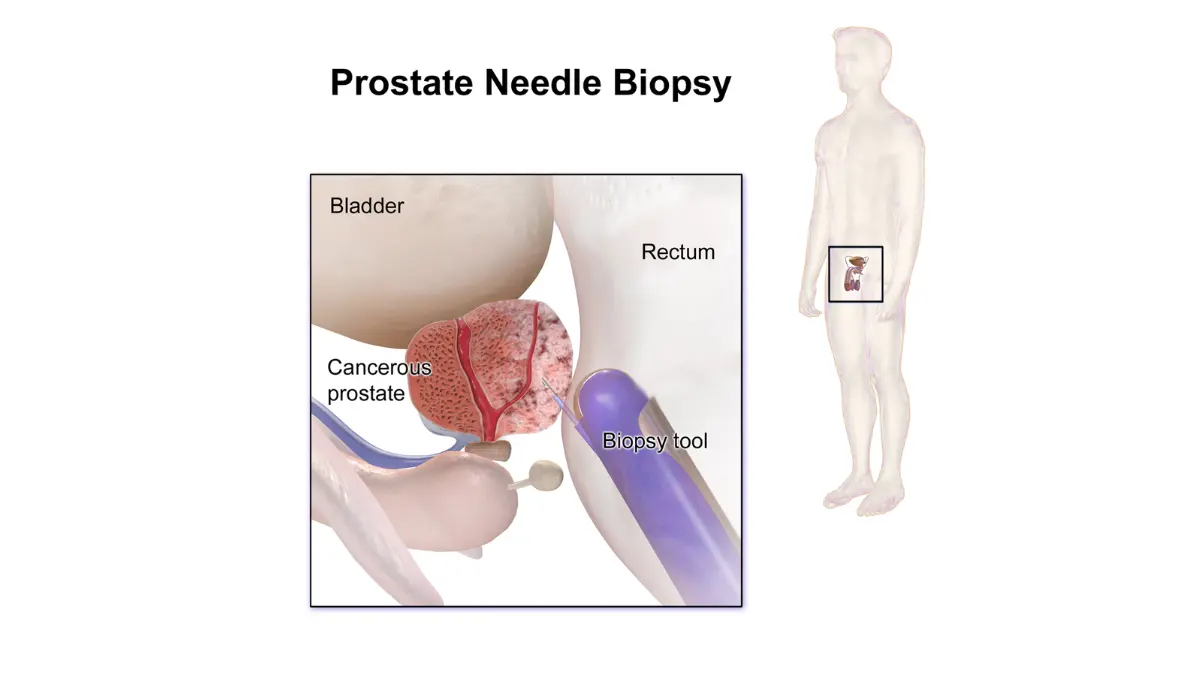
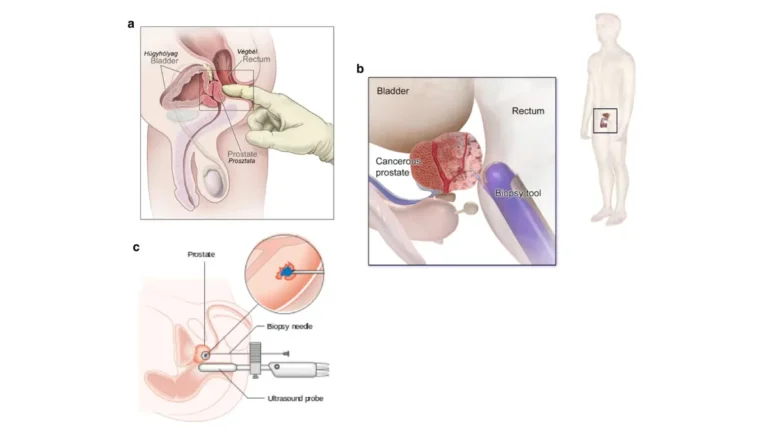
Wikimedia Commons Prostate Needle Biopsy
, licensed under CC BY-SA 4.0.
Here is how the pieces connect:
- The Grade Group is one of the five inputs that determine your stage — so grade and stage are related, but not the same thing.
- A risk group (such as low, intermediate, or high) combines your stage, Grade Group, and PSA to estimate how likely the cancer is to recur or progress.
Put simply: your Gleason score feeds your Grade Group, your Grade Group helps set your stage, and your stage plus grade plus PSA together define your risk group.
✅ Patient Action: Ask for your Gleason score, your Grade Group (1–5), and your assigned risk group, and have your clinician explain how each one shaped your stage.
What to watch for and what to ask your care team
Understanding your stage is most useful when it turns into questions and actions you can take into your next appointment.
Two things are worth knowing up front. First, a stage assigned before surgery can change afterward — when the prostate is examined directly, the cancer is sometimes found to be more extensive than imaging suggested. Second, after treatment your PSA becomes a tracking tool, and a rising PSA can be an early signal that the cancer needs attention again.
⚠️ Clinical Warning: Contact your care team promptly — don’t wait for your next scheduled visit — if you develop new or worsening bone pain, unexplained weight loss, blood in your urine, or new difficulty urinating after a diagnosis or treatment. These can have many causes, but they warrant timely evaluation.
Bring a written list of questions, because it is easy to forget them in the room. Knowing the early warning signs of prostate cancer also helps you describe changes accurately.
✅ Patient Action: Before your appointment, write down: my exact stage; my Grade Group and PSA; my risk group; whether my cancer is localized, regional, or distant; which treatment categories fit me; and what each option’s side effects and recovery look like.
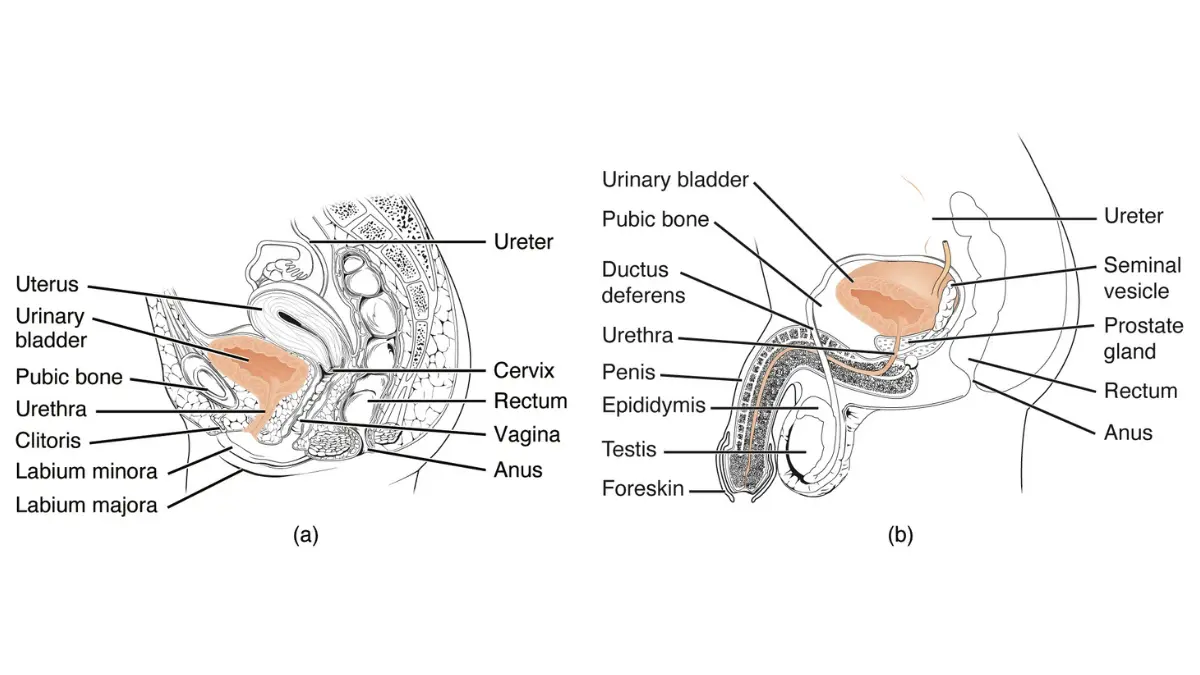
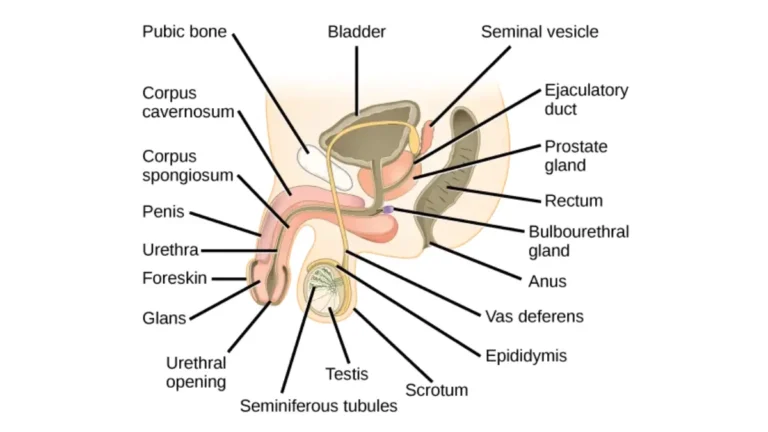
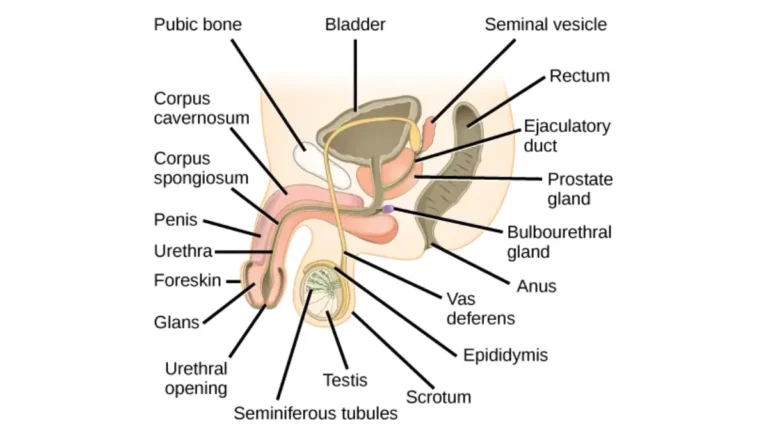
OpenStax Figure 25.3: Gross Anatomy of Urine Transport
, licensed under CC BY 4.0.
Prostate cancer stages: frequently asked questions
1. What are the 4 stages of prostate cancer?
The four prostate cancer stages are I through IV. Stage I is small and confined to the prostate with a low PSA and Grade Group; Stage II is confined but larger or higher-grade; Stage III has grown just beyond the prostate; and Stage IV has spread to nearby lymph nodes or to distant sites such as bone.
2. How is prostate cancer staged?
Prostate cancer is staged using the AJCC TNM system, which combines five inputs: the tumor’s extent (T), lymph node involvement (N), distant spread (M), your PSA level, and your Grade Group. A stage estimated before treatment is “clinical”; one assigned after surgery is “pathologic” and is generally more accurate. Ask your urologist which one applies to you.
3. What does Stage 4 prostate cancer mean?
Stage IV is the most advanced of the prostate cancer stages. It means the cancer has spread beyond the immediate area of the prostate — either to nearby lymph nodes (Stage IVA) or to distant sites such as the bones, distant lymph nodes, or other organs (Stage IVB). Treatment usually centers on systemic therapy; discuss the specifics with your oncologist.
4. Is Stage 1 prostate cancer curable?
Stage I prostate cancer is confined to the prostate and is often highly treatable; for localized disease, the 5-year relative survival rate is greater than 99%. Some early cancers are monitored with active surveillance rather than treated right away. Whether and how to treat it depends on your Grade Group, PSA, and health — decisions to make with your care team.
5. What is the survival rate for each stage of prostate cancer?
National data report 5-year relative survival by spread rather than stage number: greater than 99% for localized and regional prostate cancer, 38% for distant disease, and 98% across all stages combined, for men diagnosed 2015–2021. These are group averages and don’t predict an individual outcome, so ask your oncologist how they apply to you.
6. What is the difference between the Gleason score and the stage?
They measure different things. The Gleason score, and the Grade Group derived from it, describes how aggressive the cancer cells look under a microscope. The stage describes how far the cancer has spread. Your Grade Group is one of several inputs used to determine your prostate cancer stage, so the two are linked but not interchangeable.
7. What is a Grade Group in prostate cancer?
A Grade Group is a 1-to-5 scale, simplified from the Gleason score, that rates how aggressive prostate cancer cells appear — Grade Group 1 is the least aggressive and Grade Group 5 the most. It is one of the five inputs that determine your stage and also helps define your risk group. Ask your clinician for your specific Grade Group.
8. Can the stage of prostate cancer change after surgery?
Yes. A stage assigned before surgery (the clinical stage) is an estimate; the stage assigned after the prostate is removed and examined (the pathologic stage) is based on direct tissue analysis and is generally more accurate. Sometimes the cancer is found to be more extensive than expected. Your surgeon and pathologist can explain any change in your case.
9. Does a higher PSA mean a higher stage?
Not on its own. A higher PSA level tends to push toward a higher stage group, but PSA is only one of five inputs — it is weighed with the tumor’s extent, lymph node and distant spread, and your Grade Group. Two men with similar PSA values can have different stages, so your care team interprets PSA in full context.
10.What stage of prostate cancer needs treatment?
There is no single stage at which treatment automatically begins. Some low-risk, early-stage cancers are watched with active surveillance, while others are treated with surgery or radiation; advanced stages typically call for systemic therapy. The decision depends on your stage, Grade Group, PSA, and overall health, and is made with your care team.
11. What is the most advanced stage of prostate cancer?
Stage IV is the most advanced of the prostate cancer stages. It is divided into Stage IVA, where the cancer has reached nearby lymph nodes, and Stage IVB, where it has spread to distant sites such as the bones or other organs. Even at this stage, treatments aim to control the cancer and protect quality of life.
Understanding your stage is the first step
A prostate cancer stage is information that guides a plan, not a fixed prediction of your future. Most prostate cancers in the U.S. are found early, and even advanced disease is treatable — your stage simply helps your team choose the right approach for you.
Bring your exact stage, Grade Group, PSA, and risk group to your next appointment, along with your written questions. If your concern is family history rather than a current diagnosis, you can assess inherited risk factors and discuss screening with your doctor.
About this content
How this article was put together: researched from recognised health sources, drafted with the help of AI tools, and edited by hand, with sources linked throughout.

Sameer Patel is the founder and editor of My Medicine Advisor. He is not a doctor or medical professional — before starting this site he worked in banking,…
Medical disclaimer
The content on MyMedicineAdvisor is provided for general informational and educational purposes only and is not a substitute for professional medical advice, diagnosis, or treatment. Health information on this website should not be used to diagnose, treat, cure, or prevent any condition without guidance from a qualified healthcare professional. Always seek the advice of your doctor, physician, or another licensed healthcare provider with any questions you may have regarding a medical condition, symptoms, medications, or treatment decisions.