
On This Page – Quick Medical Summary
What prostate cancer survival rates can — and can’t — tell you
If you or someone you love was just given a stage, you are probably reading this with a single question: what does the prostate cancer survival rate actually mean for us? Where you go next depends on your situation. If you were just diagnosed with early, localized prostate cancer, the survival numbers below will likely reassure you, and the section on active surveillance for low-risk disease may be relevant. If your cancer is advanced or has spread, skip to what the distant-stage number means and why outcomes are improving. If you are holding a pathology report and the staging is confusing, the section on how your report maps to the survival table will help most.
Here is the honest headline before any number: more than 3.5 million American men diagnosed with prostate cancer are alive today, and most men diagnosed with it do not die from the disease.
But a survival statistic describes a large group of men — not you. It is a starting point for understanding, not a verdict.
ℹ️ Medical Disclaimer: This article is educational and does not diagnose disease, recommend treatment, prescribe medication, advise on any procedure, or address insurance coverage. Survival statistics are population estimates, not predictions about any individual. Before making decisions about your diagnosis or care, consult a board-certified urologist or oncologist who knows your full medical history.
What “5-year relative survival” actually measures
Every survival figure you are about to see is a 5-year relative survival rate, and reading it correctly changes everything. It is the one definition most articles skip.
A relative survival rate compares men who have a specific stage of prostate cancer to men in the general population of the same age. If a figure is 99%, it means men with that cancer are about 99% as likely as men without it to be alive five years after diagnosis.
🔬 How It Works: “Relative” survival strips out deaths from unrelated causes. Because most men with prostate cancer are older and may have other health conditions, this method isolates the effect of the cancer itself rather than counting every death from any cause.
Why “5 years” doesn’t mean you have 5 years
The five-year window is a measurement convention, not a life expectancy or a countdown. It reflects men diagnosed years ago and tracked for five years; many live far longer, and the figure does not “expire” at year five.
Where the numbers come from
These statistics come from the SEER database, maintained by the National Cancer Institute, which tracks U.S. cancer outcomes. The American Cancer Society draws its published prostate cancer figures directly from this data. You can review the underlying dataset through the NCI’s SEER prostate cancer statistics.
Prostate cancer survival rates by stage (current SEER data)
Overall, the 5-year relative survival rate for prostate cancer is 98% — but that single number hides an enormous range once you break it down by how far the cancer has spread.
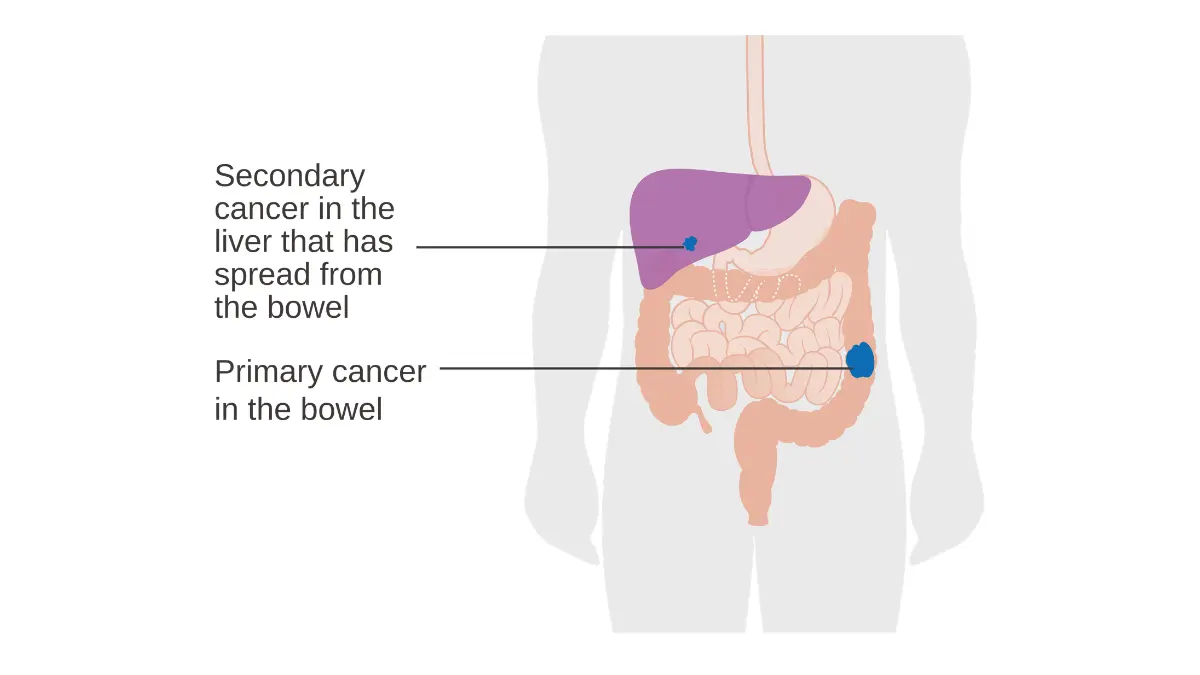
The SEER system does not use the stage numbers on most pathology reports. Instead, it groups prostate cancer into three categories based on spread: localized (confined to the prostate), regional (spread to nearby tissues or lymph nodes), and distant (spread to organs or bones such as the lungs, liver, or bones).
5-year relative survival by SEER stage
| SEER stage | 5-year relative survival | Key clinical detail |
|---|---|---|
| Localized | >99% | No sign of spread beyond the prostate; often curable |
| Regional | >99% | Spread to nearby structures or pelvic lymph nodes |
| Distant | 38% | Spread to distant organs or bones; treatable, not curable |
| All SEER stages combined | 98% | Reflects that most cases are caught early |
Source: American Cancer Society, based on SEER data for men diagnosed 2015–2021 (Cancer Facts & Figures 2026; last revised January 2026). Figures are population estimates, not individual predictions.
📊 Clinical Data Point: Overall 5-year relative survival for prostate cancer is 98%. — Source: American Cancer Society / SEER, 2026.
What the table does not include
That distant-stage 38% is the figure that frightens people most — so read it with context. It reflects men diagnosed up to a decade ago, it is rising as treatments improve (covered below), and it does not account for your Grade Group, PSA, age, or how your cancer responds to treatment. For men weighing whether early, low-risk disease even needs immediate treatment, active surveillance for low-risk disease is a separate decision worth understanding. You can see the source figures on the American Cancer Society’s prostate cancer survival rates page.
Why your report says “Stage 2” but the table says “localized”
This is the single most confusing point for newly diagnosed men, and most survival articles leave it unexplained. Your pathology report almost certainly uses a stage number — Stage 1, 2, 3, or 4 — while every survival table uses localized, regional, or distant. They are two different systems describing the same cancer.
🔬 How It Works: The stage number on your report comes from the AJCC TNM system, which combines tumor extent (T), lymph nodes (N), spread (M), PSA, and Grade Group. The survival table uses the simpler SEER “summary stage,” which only groups cancers by how far they have spread.
How AJCC stages roughly map to SEER groups
As a rough guide, Stage 1 and most Stage 2 cancers are localized; locally advanced Stage 3 disease and some node-positive cancers fall into regional; and cancer that has spread to distant organs or bones is distant. The full mechanics of how prostate cancer is staged and graded are covered in the parent guide to prostate cancer stages and in detail on the American Cancer Society’s prostate cancer staging page.
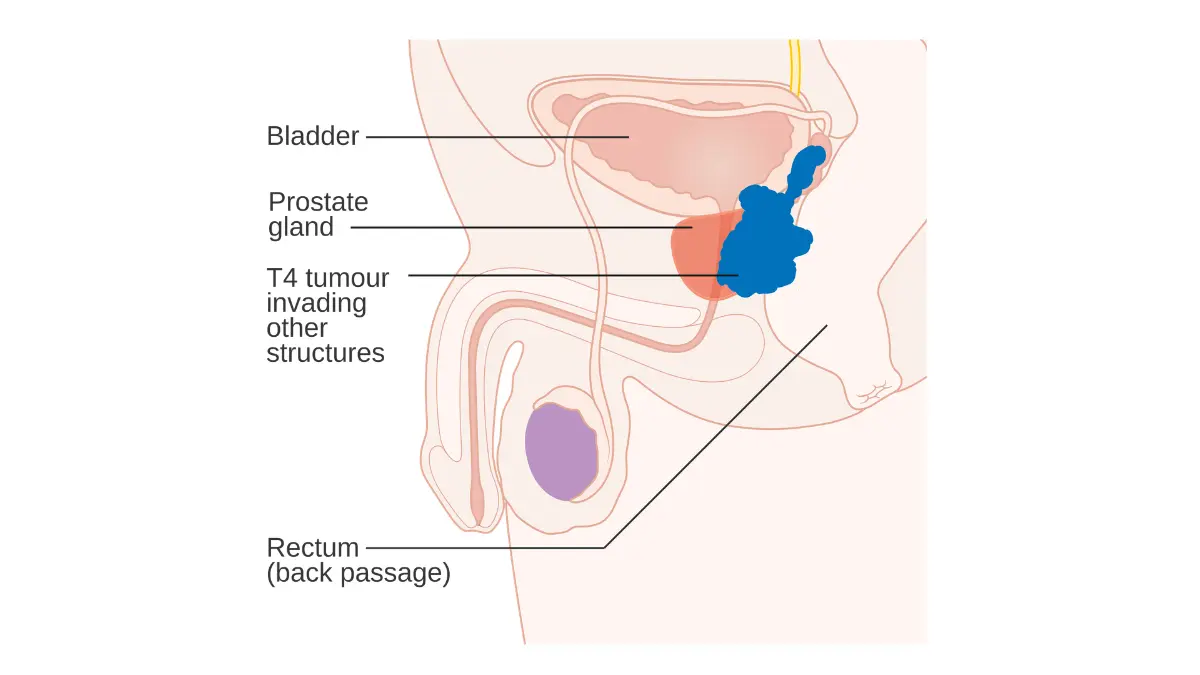
This is an approximation, not a lookup table. A man with Stage 4 disease could be node-positive “regional” or have “distant” spread — and only his care team can say which.
Where Stage 4 fits
When people ask about the survival rate for Stage 4 prostate cancer, they usually mean distant disease, whose 5-year relative survival is 38%. What that looks like day to day is its own topic, covered in what stage 4 prostate cancer means. Nationally, about 70% of cases are localized, 14% regional, and 9% distant at diagnosis, according to CDC data on how prostate cancers are staged.
✅ Patient Action: Ask your doctor two things: “What is my AJCC stage and Grade Group?” and “Is my cancer localized, regional, or distant?” Having both lets you read any survival table correctly.
What changes the outlook within the same stage
Two men with the same SEER stage can have very different outlooks, because the stage bucket is only part of the picture. Think of the table as your stage’s neighborhood; your Grade Group and PSA are your street.
Grade Group and Gleason score
The Gleason score and its simpler Grade Group rating describe how aggressive the cancer cells look. A higher Grade Group signals a more aggressive cancer that is more likely to grow and spread, which shifts the outlook within any stage. How your specific score affects prognosis is covered in how your Gleason score affects outlook.
PSA level and risk groups
Your PSA at diagnosis helps sort localized cancer into low-, intermediate-, and high-risk groups — a higher PSA generally places you in a higher-risk group with a more guarded outlook. Typical ranges are explained in PSA levels by age.
Age, overall health, and treatment response
Younger, healthier men and cancers that respond well to treatment tend toward better outcomes. Inherited factors matter too; you can assess inherited prostate cancer risk factors such as a family history or a BRCA2 mutation, which affect risk rather than predict your prognosis.
🩺 Physician Note: Current guidance emphasizes that stage alone is an incomplete prognostic picture for prostate cancer. Grade Group, PSA, and risk grouping are used alongside stage precisely because survival within a single stage varies widely.
✅ Patient Action: Ask your oncologist, “Given my Grade Group and PSA, where do I fall within my stage’s range?” — a far more useful question than the table alone can answer.
Why survival keeps improving — and why most cases are caught early
There is real, current reason for optimism behind these numbers — grounded in data, not spin.
Most prostate cancers are found early
The overall survival rate is so high largely because roughly 83% of cases are diagnosed at a local or regional stage, where relative survival approaches 100%. Earlier detection through PSA testing is a major reason so many cancers are caught before they spread.
Long-term survival
Survival stays high well beyond five years. The prostate cancer death rate fell by about half from 1993 to 2022, reflecting earlier detection and better treatment.
📊 Clinical Data Point: The 15-year relative survival rate for prostate cancer is 97%. — Source: American Cancer Society, 2025 prostate cancer statistics report.
The distant-stage figure is rising
Even advanced disease is improving. Newer treatments — including hormone therapy for advanced disease and targeted options like Pluvicto (lutetium-177) — have helped lift the distant-stage 5-year figure to 38%, higher than older statistics still quoted elsewhere. The fuller picture for spread disease is covered in the outlook for metastatic prostate cancer.
The honest counterweight: the number of cancers diagnosed at an advanced stage has been rising about 3% per year since 2014, which is why earlier detection still matters. The latest national figures are tracked in the American Cancer Society’s prostate cancer statistics.
Reading your own prognosis honestly (and what “curable” really means)
It helps to know what these numbers can and cannot promise, especially when fear narrows everything to a single word like “terminal.”
Is prostate cancer curable?
Localized and regional prostate cancer can often be cured, particularly when caught early. Distant (metastatic) prostate cancer is generally treatable but not curable — meaning it can frequently be controlled for a long time, not erased. No stage is automatically “terminal,” and a statistic is not a timeline.
What “distant” means for outlook
The 38% distant-stage figure is a group average, not your forecast. It also applies only to the stage at first diagnosis — it does not describe what happens if cancer returns later, which is covered separately in what to know if prostate cancer comes back.
⚠️ Clinical Warning: A survival percentage is a population estimate, not an individual prognosis. No online statistic can tell you how long you will live. Only your oncologist, with your full pathology and treatment response, can estimate your personal outlook.
When and what to ask your oncologist
✅ Patient Action: At your next appointment, ask: “Which SEER group is my cancer in?”, “What is my Grade Group and PSA?”, “Is my treatment aimed at cure or long-term control?”, and “What would change my outlook?”
Prostate cancer survival rate: frequently asked questions
1. What is the survival rate for prostate cancer?
The overall 5-year relative survival rate for prostate cancer is 98%, meaning men diagnosed are about 98% as likely as men without it to be alive five years later. The figure is so high because most cases are found early. It is a group average, so ask your oncologist how it applies to your specific stage.
2. What is the survival rate for stage 4 prostate cancer?
Stage 4 usually corresponds to the SEER “distant” category, which has a 5-year relative survival rate of 38%. That figure is a group average drawn from men diagnosed years ago and is rising as treatments improve. It does not predict any individual’s outcome, so discuss your specific situation with your oncologist.
3. Can you survive prostate cancer?
Yes. More than 3.5 million American men who have been diagnosed with prostate cancer are alive today, and most men diagnosed with it do not die from the disease. Survival depends heavily on stage at diagnosis, with localized and regional disease showing a 5-year relative survival rate above 99%.
4. What is life expectancy with prostate cancer?
Survival statistics describe groups, not individuals, so no exact life expectancy applies to one person. The long-term picture is strong: the 15-year relative survival rate for prostate cancer is 97%. Your age, Grade Group, PSA, and treatment response all shape your outlook, which your oncologist can help interpret.
5. Is prostate cancer curable?
Localized and regional prostate cancer can often be cured, especially when found early. Distant (metastatic) disease is generally treatable but not curable, meaning it can often be controlled for years rather than eliminated. Because curability depends on stage and other factors, confirm what is realistic with your treating oncologist.
6. What stage of prostate cancer is considered terminal?
No stage of prostate cancer is automatically terminal. Distant-stage disease is incurable but still treatable, with a 5-year relative survival rate of 38% that does not represent a fixed timeline. A survival statistic is a population estimate, so ask your oncologist about your individual outlook rather than relying on a stage label.
7. How long can you live with metastatic prostate cancer?
It varies widely between individuals. The 5-year relative survival rate for distant (metastatic) prostate cancer is 38%, and that figure has been rising as newer treatments extend control of advanced disease. Because outcomes differ so much by treatment response and overall health, your oncologist is the right person to estimate your situation.
8. Does a high Gleason score lower survival?
A higher Gleason score, expressed as a higher Grade Group, signals a more aggressive cancer and generally a more guarded outlook within any given stage. It is one reason two men with the same stage can face different survival odds. Ask your oncologist how your specific Grade Group affects your prognosis and treatment plan.
9. What is the long-term survival rate for prostate cancer?
Prostate cancer survival stays high over the long term. The 15-year relative survival rate is 97%, according to the American Cancer Society — largely because most cancers are diagnosed at a local or regional stage where relative survival approaches 100%.
10. Does PSA level affect survival?
Your PSA at diagnosis helps sort prostate cancer into low-, intermediate-, and high-risk groups, with a higher PSA generally placing you in a higher-risk group and a more guarded outlook within your stage. PSA is one piece of the prognosis, so ask your oncologist how your level fits your overall risk grouping.
11. Why is the prostate cancer survival rate so high?
The overall survival rate is high because roughly 83% of prostate cancers are diagnosed at a local or regional stage, where relative survival approaches 100%. Effective early detection and treatment mean most men are caught before the cancer spreads, which lifts the combined 5-year relative survival rate to 98%.
The bottom line on prostate cancer survival
For most men, prostate cancer is a highly treatable disease — the overall 5-year relative survival rate is 98%, and the great majority are diagnosed before the cancer spreads. The numbers fall sharply for distant-stage disease, but even there, outcomes are improving and a statistic is never an individual sentence.
Use the survival table to understand your situation, not to predict it. The figure that matters most is the one your own care team gives you, informed by your stage, Grade Group, PSA, and response to treatment.
For the full picture of how prostate cancer is diagnosed, staged, and treated, return to the complete guide to prostate cancer signs, stages, and treatment, and bring your specific questions to a board-certified urologist or oncologist.
About this content
How this article was put together: researched from recognised health sources, drafted with the help of AI tools, and edited by hand, with sources linked throughout.

Sameer Patel is the founder and editor of My Medicine Advisor. He is not a doctor or medical professional — before starting this site he worked in banking,…
Medical disclaimer
The content on MyMedicineAdvisor is provided for general informational and educational purposes only and is not a substitute for professional medical advice, diagnosis, or treatment. Health information on this website should not be used to diagnose, treat, cure, or prevent any condition without guidance from a qualified healthcare professional. Always seek the advice of your doctor, physician, or another licensed healthcare provider with any questions you may have regarding a medical condition, symptoms, medications, or treatment decisions.